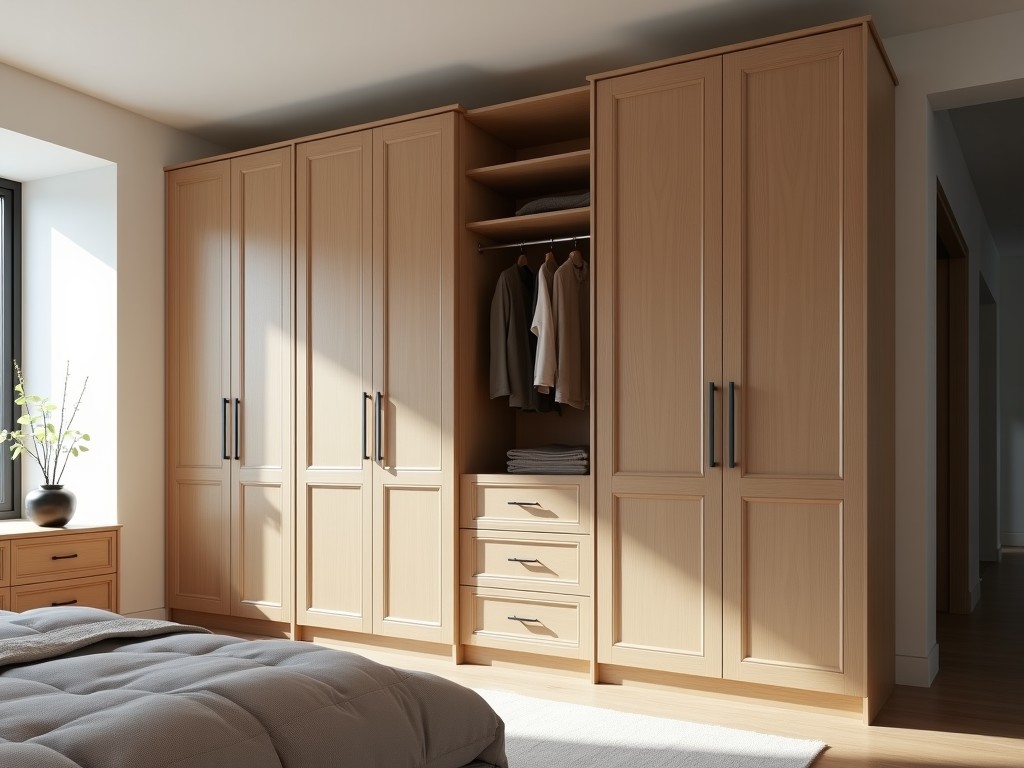
Wall Mounted Closet Organizer System
Wall Mounted Closet Organizer System
A wall mounted closet organizer system provides a structural framework for optimizing vertical storage space in industrial, commercial, and institutional environments. Unlike freestanding units,
- Category:
- Walk In Closet
Wall Mounted Closet Organizer System
A wall mounted closet organizer system provides a structural framework for optimizing vertical storage space in industrial, commercial, and institutional environments. Unlike freestanding units, these systems transfer load directly to the building structure, minimizing floor footprint while maximizing accessibility. This approach is particularly valuable in facilities where floor space is constrained or must remain unobstructed for workflow, equipment movement, or safety compliance.
The core function of such a system is to support adjustable components—shelves, hanging rods, drawers, and bins—at precise vertical intervals. This adjustability allows reconfiguration without tools or structural modification, accommodating changing inventory profiles, seasonal storage needs, or evolving operational requirements. Load distribution is engineered to prevent localized stress on wall substrates, with mounting hardware designed to engage studs, masonry anchors, or structural backing plates as appropriate to the wall type.
Material selection is driven by environmental exposure, load expectations, and lifecycle cost. Cold-rolled steel with powder coating is standard for general indoor use due to its strength-to-weight ratio, corrosion resistance, and finish durability. For high-humidity or chemically aggressive environments—such as food processing, pharmaceutical, or marine facilities—304 or 316 stainless steel variants are specified to resist pitting and stress corrosion cracking. Aluminum alloys may be used where weight reduction is critical, though they require thicker sections to match steel stiffness.
Load capacity per linear meter is a key specification, typically ranging from 150 kg/m for light-duty office or retail applications to over 500 kg/m for heavy-duty industrial shelving supporting bulk materials, tooling, or stacked containers. These values assume proper installation into load-bearing substrates and are validated through static testing per ANSI/BIFMA X5.6 or EN 14073-2 standards. Deflection limits are generally capped at L/180 under full load to ensure functional stability and prevent sagging of stored items.
Modularity is achieved through standardized vertical rail profiles with punched or slotted holes at 25 mm or 32 mm intervals—commonly referred to as the European or American system spacing. This allows horizontal components to be hooked, bolted, or clipped into place without welding or drilling. Accessories such as shelf brackets, rod supports, and drawer glides are designed to interlock with these increments, enabling tool-free reconfiguration while maintaining load integrity.
Finish options extend beyond basic powder coating to include antimicrobial treatments for healthcare settings, UV-stabilized coatings for sun-exposed areas, and textured surfaces to reduce glare in inspection zones. Color coding is often implemented not for aesthetics but for functional zoning—such as distinguishing hazardous material storage, tool check-out stations, or clean garment areas—supporting visual management and 5S principles.
Installation requires accurate wall assessment. Stud spacing, substrate composition (drywall, concrete, CMU, steel stud), and presence of vapor barriers or insulation must be evaluated to select appropriate anchors—toggle bolts, concrete screws, or through-bolts with backing plates. A level rail is critical; even 2° of tilt can cause cumulative misalignment over 2 meters, affecting drawer alignment and shelf stability. Laser levels and shim kits are standard tools for professional installers.
Maintenance is minimal but not negligible. Periodic inspection should verify anchor tightness, especially in vibration-prone environments like workshops or near machinery. Powder coating touch-ups prevent corrosion initiation at scratch points. Stainless steel systems may require passivation after welding or grinding to restore the protective oxide layer. No lubrication is needed for standard hook-in accessories, though sliding drawers may benefit from dry-film lubricants on rollers if specified.
Applications span sectors where organized, accessible storage impacts operational efficiency. In manufacturing, these systems hold jigs, fixtures, and PPE near workcells to reduce motion waste. In healthcare, they store sterile supplies and patient garments in compliance with infection control protocols. Educational institutions use them for lab equipment and seasonal sports gear. Retail backrooms deploy them for inventory staging and returns processing. The common thread is the need to elevate storage without sacrificing floor utility.
| Specification | Typical Range / Option | Notes |
|---|---|---|
| Vertical Load Capacity | 150–500+ kg/m | Dependent on rail gauge, material, and wall anchoring |
| Adjustment Interval | 25 mm or 32 mm | European (32 mm) or US (25 mm) hole pitch standards |
| Standard Materials | Cold-rolled steel, 304/316 SS, aluminum | Selected per environmental and load requirements |
| Finish Types | Powder coat, antimicrobial, UV-stable, passivated | Customizable per facility hygiene or exposure needs |
| Max Recommended Height | 2.4 m (single section) | Taller systems require intermediate bracing or segmented design |
| Accessory Compatibility | Shelves, rods, bins, drawers, hooks | Tool-free adjustment via standardized rail increments |
Customization is typically addressed through rail length, component selection, and finish specification rather than bespoke fabrication. Standard rail lengths range from 600 mm to 2400 mm, allowing seamless splicing for longer runs using alignment connectors. This modular approach reduces lead time and cost compared to fully custom units while still enabling project-specific layouts. Height, depth, and component spacing are adjusted within the fixed increment system to meet ergonomic or storage density goals.
Quality control focuses on dimensional consistency of hole punching, coating adhesion, and load testing of sample assemblies. Rail straightness is checked to within 0.5 mm per meter to ensure accessory alignment. Powder coating thickness is measured via magnetic induction, targeting 60–80 microns for indoor use and 100+ microns for harsh environments. Adhesion is verified via cross-hatch testing per ASTM D3359. Load testing validates that deflection remains within limits under rated capacity.
Packaging is designed to prevent deformation during transit. Rails are bundled with corner protectors and stretch-wrapped; accessories are packed in labeled cartons with dividers to avoid scratching. Long rails may require crating or palletizing with vertical support to prevent bowing. Each shipment includes installation hardware matched to the specified wall type, along with a drilling template for accurate hole placement—reducing field errors and rework.
For procurement, providing wall substrate details, expected load per zone, required accessories, and environmental conditions enables accurate quotation and specification. Lead times are typically 3–4 weeks for standard powder-coated steel; stainless steel or special finishes may extend to 6–8 weeks. Samples of rail profiles and finish swatches are available upon request to validate compatibility with existing infrastructure or design standards.