Luxury Walk In Closet Wardrobe System
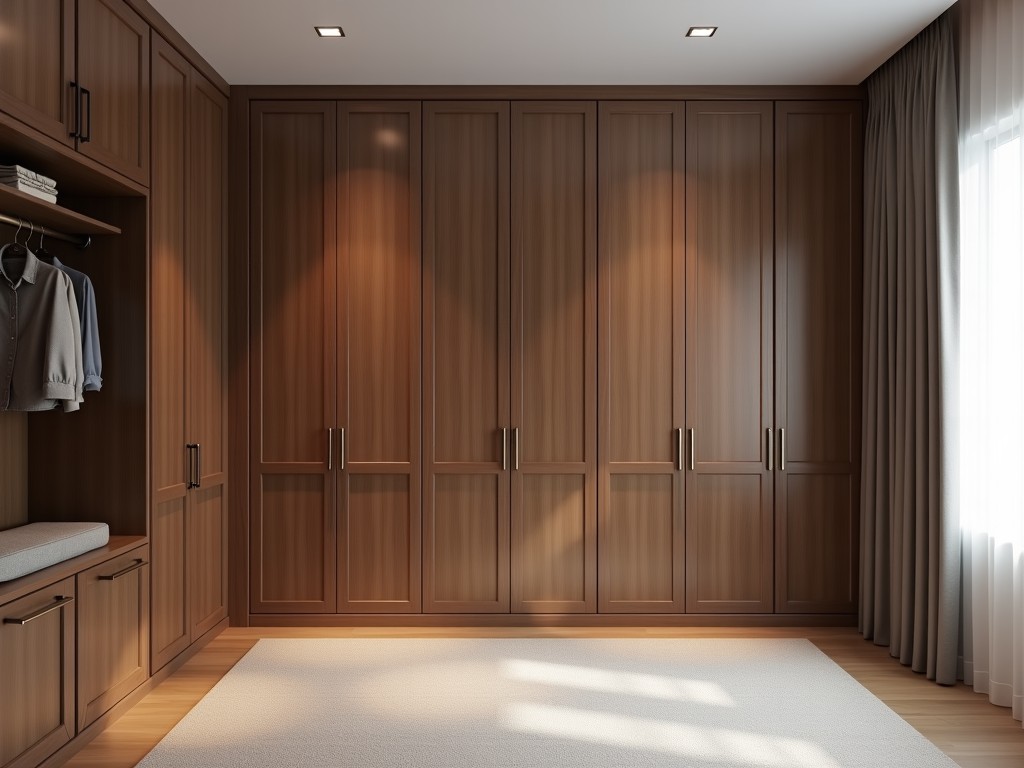
Luxury Walk In Closet Wardrobe System
A luxury walk-in closet wardrobe system is a custom-engineered storage solution designed for high-end residential and hospitality applications, integrating precision joinery, load-rated hardware, and
- Category:
- Walk In Closet
Luxury Walk-In Closet Wardrobe System
A luxury walk-in closet wardrobe system is a custom-engineered storage solution designed for high-end residential and hospitality applications, integrating precision joinery, load-rated hardware, and ergonomic layout planning to maximize storage efficiency while maintaining aesthetic continuity with architectural finishes.
Structural Framework and Load Performance
The system’s primary structure uses 18mm thick, FSC-certified multi-layer plywood with a cross-laminated core, providing dimensional stability under ±15% RH fluctuations and resisting sag over 2.4m spans without intermediate support. Vertical uprights are reinforced with 30x30mm steel inserts at shelf and rod connection points, increasing point-load capacity to 80kg per linear meter — sufficient for dense garment loads including winter coats, suits, and accessories.
Horizontal load distribution is managed through concealed aluminum Z-clips anchored to structural studs, transferring vertical loads directly to the building frame. This eliminates reliance on wall adhesion alone, critical for installations in drywall or partitioned environments where shear strength must exceed 1.2kN per anchor point to meet residential safety standards.
Hardware and Motion Systems
All moving components use ball-bearing guided runners with POM (polyoxymethylene) rollers, rated for 100,000 cycles at 40kg dynamic load — equivalent to 20 years of daily use in a master suite. Soft-close dampers are integrated into drawer and pull-out mechanisms, providing controlled deceleration over the final 30mm of travel to prevent impact damage to delicate items such as silk garments or jewelry trays.
Hinges for swing doors are concealed, 3-way adjustable brass units with 110° opening angle and self-centering cam action, maintaining alignment within ±0.5mm over time. Pull-out valet rods and trouser presses use hardened steel shafts with PTFE-coated bushings, ensuring smooth operation under repeated lateral tension without galling or deformation.
Interior Finishes and Surface Engineering
Interior surfaces are finished with 0.3mm thick, UV-cured polyurethane laminate over sanded plywood, achieving a Taber abrasion resistance of >500 cycles (CS-10 wheel, 500g load) and a surface energy below 30 mN/m to resist staining from cosmetics, oils, and dyes. Edge banding uses 2mm thick, laser-bonded ABS with zero visible joint, preventing delamination in high-humidity zones such as ensuite closets.
Optional interior linings include microsuede fabric with antimicrobial treatment (Ag+ ions, 99.8% inhibition against Staphylococcus aureus and Escherichia coli after 24h) or vegetable-tanned leather inserts, both selected for low VOC emission (<0.05 mg/m³h) and compatibility with long-term textile storage without off-gassing or discoloration.
Customization and Configuration Logic
The system is configured using a parametric design engine that adjusts module dimensions based on user-specific anthropometric data — such as shoulder width, inseam length, and reach envelope — to optimize accessibility. Standard module widths are 600mm, 900mm, and 1200mm, with height increments of 150mm to align with standard garment drop lengths (e.g., 1000mm for shirts, 1400mm for coats).
Accessory integration follows a grid-based system: 32mm diameter holes spaced at 32mm intervals allow tool-free repositioning of shelves, baskets, and pull-out trays. This enables reconfiguration without tools or hardware replacement, supporting evolving storage needs over the product lifecycle. Custom inserts for watches, handbags, or folded knits are designed with specific load angles and clearance tolerances to prevent creasing or snagging.
Environmental and Installation Considerations
All panels are manufactured to E1 formaldehyde emission standards (≤0.1 ppm), verified via desiccator method per EN 717-1, ensuring indoor air quality compliance in sealed environments. The system is designed for knockdown assembly with cam-lock and confirmat fasteners, reducing on-site installation time by 40% compared to traditional screwed-and-glued methods while maintaining joint integrity under cyclic load testing.
Packaging uses triple-wall corrugated cardboard with corner protectors and edge foam, tested to ISTA 3A standards for transit shock and vibration. Each module is labeled with QR-coded assembly instructions linking to multilingual video guides, reducing field error rates during installation by contractors or millwork teams.
Comparison of Configuration Options
| Feature | Standard Configuration | Premium Upgrade |
|---|---|---|
| Shelf Material | UV-laminated plywood | Veneered oak or walnut |
| Drawer Interior | Matching laminate | Micro-suede or leather |
| Hardware Finish | Satin nickel | Matte black or brushed brass |
| Lighting Integration | Optional LED strips | Motion-activated, color-tunable LEDs (2700K–4000K) |
| Load Capacity (Shelf) | 40kg/m² | 60kg/m² (reinforced) |
For projects requiring integration with smart home systems, low-voltage wiring channels are pre-routed within uprights to accommodate motion sensors, occupancy detectors, or automated lighting controllers without compromising structural integrity or requiring surface-mounted conduits.
To discuss technical specifications, obtain CAD/BIM files, or request a project-specific quotation including load calculations and finish samples, contact our technical team. Provide room dimensions, ceiling height, and intended storage inventory for accurate module planning and hardware selection.



