Buy Wood Shelf Aluminum Pole Closet
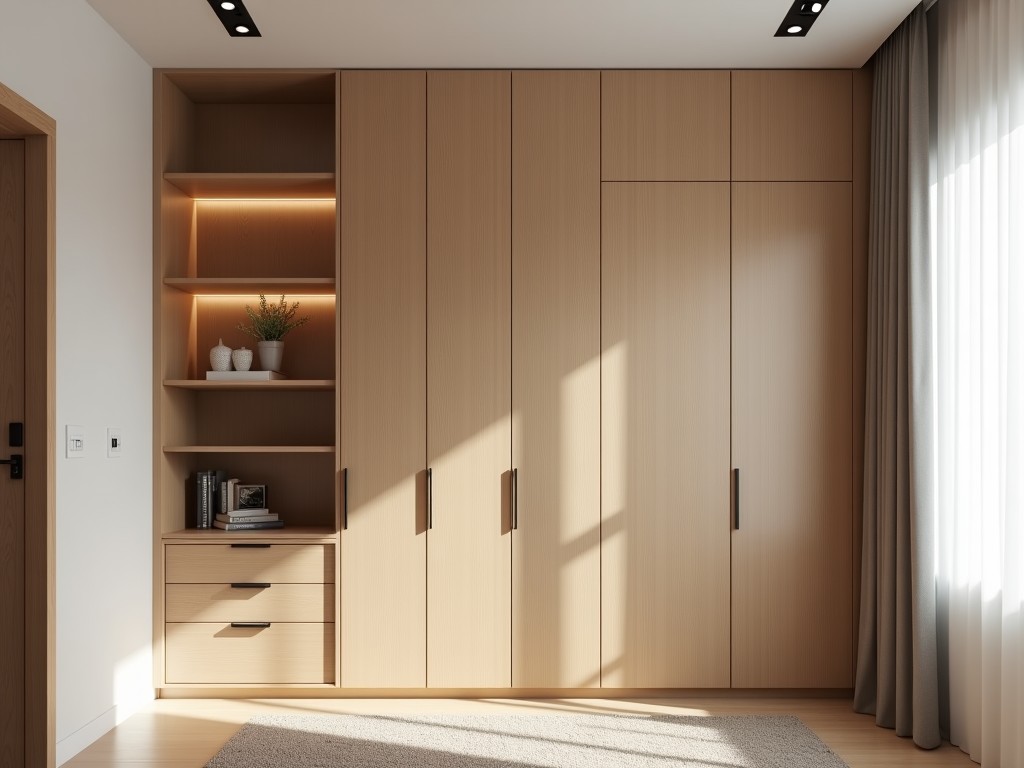
Buy Wood Shelf Aluminum Pole Closet
Selecting closet organization components requires evaluating structural performance, material compatibility, and long-term dimensional stability. This guide details the engineering considerations for
- Category:
- Walk In Closet
Buy Wood Shelf Aluminum Pole Closet Systems
Selecting closet organization components requires evaluating structural performance, material compatibility, and long-term dimensional stability. This guide details the engineering considerations for aluminum pole systems paired with wood shelves, focusing on load-bearing capacity, corrosion resistance, and installation precision relevant to commercial and residential applications.
Structural Design of Aluminum Closet Poles
Aluminum poles used in closet systems typically employ 6063-T5 alloy, selected for its balance of extrudability, tensile strength (approximately 140–180 MPa), and natural corrosion resistance. The T5 temper indicates cooling from elevated temperature followed by artificial aging, which enhances mechanical properties without requiring solution heat treatment. Pole diameters commonly range from 25mm to 32mm, with wall thicknesses between 1.2mm and 2.0mm, directly influencing buckling resistance under axial loads.
Deflection limits are critical for functional performance; a 30mm diameter pole with 1.5mm wall thickness spanning 900mm between supports exhibits less than 2mm deflection under a 50kg uniformly distributed load, based on Euler-Bernoulli beam theory. This ensures shelves remain level under typical clothing storage weights. Connection methods—such as set-screw brackets or press-fit inserts—must maintain electrical isolation to prevent galvanic corrosion when in contact with dissimilar metals.
Wood Shelf Material Compatibility and Loading
Wood shelves in aluminum pole systems are typically fabricated from engineered wood products like particleboard, MDF, or plywood, each with distinct load-deflection characteristics. Particleboard shelves 18mm thick, supported every 600mm, safely carry 20–25kg per linear meter before exceeding L/360 deflection limits. Plywood of equivalent thickness offers higher stiffness due to cross-laminated layers, allowing greater spans or heavier loads.
Surface finishes—such as melamine, veneer, or laminate—affect moisture resistance and edge durability but do not significantly alter structural capacity. Proper shelf-to-pole attachment requires brackets that distribute load across the shelf width and prevent localized crushing. Bracket designs incorporating wide bearing surfaces (>25mm) reduce compressive stress on wood substrates, minimizing creep over time.
Corrosion Resistance and Environmental Considerations
Aluminum naturally forms a passive oxide layer (Al₂O₃) that protects against further oxidation in ambient conditions. In closet environments, exposure to humidity, cleaning agents, or occasional moisture does not typically degrade performance. However, in coastal or high-chloride environments, additional protection such as anodizing (Type II, 10–15µm thickness) or powder coating may be specified to enhance surface durability.
Anodizing increases surface hardness and provides a dielectric barrier, reducing the risk of galvanic coupling if fasteners or brackets are made of steel. Powder coating offers thicker films (60–80µm) with customizable color options but requires careful surface preparation to ensure adhesion. Both treatments maintain dimensional stability since they do not alter the substrate’s mechanical properties.
Installation Precision and Adjustability
Closet pole systems rely on precise vertical alignment and level shelf placement for functional use. Wall-mounted standards or cleats must be installed plumb within ±1.5mm over 2.4m height to prevent cumulative misalignment. Pole-to-bracket interfaces often include vertical adjustment slots (typically 25mm increments) to accommodate uneven floors or ceiling variations.
Horizontal shelf position is controlled by bracket depth and locking mechanisms. Set-screw designs allow micro-adjustment but require periodic torque verification (recommended 1.5–2.0Nm) to prevent loosening under vibration. Alternative cam-lock or toggle systems provide tool-free adjustment with consistent clamping force, reducing installation time in modular applications.
Load Distribution and System Integration
The interaction between pole stiffness, bracket strength, and shelf deflection determines overall system behavior. Finite analysis shows that bracket flexibility can dominate deflection in long-span configurations, making bracket selection as critical as pole sizing. For example, a thin-gauge steel bracket may contribute more to system compliance than the aluminum pole itself.
Shelf overhang beyond support brackets should not exceed 1/6 of the shelf depth to prevent tip-loading failure. For a 300mm deep shelf, maximum overhang is 50mm. End supports or decorative caps are recommended to conceal exposed pole ends and prevent snagging of fabrics.
| Parameter | Typical Range | Impact on Performance |
|---|---|---|
| Pole Diameter | 25–32mm | Larger diameter increases buckling resistance; 32mm offers ~65% higher critical load than 25mm at same wall thickness |
| Wall Thickness | 1.2–2.0mm | Doubling thickness from 1.2mm to 2.4mm increases bending stiffness by ~8x; critical for spans >1000mm |
| Shelf Thickness | 16–22mm (engineered wood) | 18mm particleboard deflects ~2.3x more than 18mm plywood under same load; affects span limits |
| Bracket Material | Steel, aluminum, reinforced polymer | Steel provides highest stiffness; aluminum avoids galvanic issues; polymer reduces cost but may creep under sustained load |
| Surface Treatment | Mill finish, anodized, powder coated | Anodizing adds wear resistance; powder coating enables color matching; neither affects structural capacity |
Applications in Commercial and Residential Storage
In residential closets, aluminum pole systems support seasonal clothing, folded items, and accessory storage. The non-magnetic nature of aluminum prevents interference with electronic devices stored nearby, and its low density reduces dead load on wall anchors—relevant in retrofit installations where substrate strength is unknown.
Commercial applications include retail display closets, hotel wardrobes, and assisted living facilities. Here, durability under frequent use and ease of reconfiguration are priorities. Pole systems allow rapid layout changes without damaging wall finishes, and the absence of volatile emissions from finishes supports indoor air quality compliance in sensitive environments.
Educational and institutional settings benefit from the system’s resistance to vandalism and ease of cleaning. Smooth, non-porous surfaces resist graffiti adhesion and can be wiped down with standard disinfectants. The modular nature also facilitates ADA-compliant height adjustments in shared storage areas.
Customization and Procurement Considerations
Pole length is typically specified to the nearest millimeter, with standard stock lengths of 1200mm, 1800mm, and 2400mm available for cut-to-size service. Custom lengths minimize waste and reduce on-site labor. Anodizing color options include clear, bronze, black, and custom dyes upon request, with thickness documentation available for quality verification.
Shelf dimensions are defined by depth (commonly 300mm, 350mm, 400mm), width (cut to opening), and thickness. Edge banding—PVC, ABS, or wood veneer—protects substrate edges from moisture ingress and impact. Pre-drilled shelf holes for bracket pins are available upon request, using standardized templates (e.g., 32mm system) to ensure compatibility across manufacturers.
Packaging for industrial buyers includes individual pole wrapping, shelf stacking with interleaving protection, and bracket segregation to prevent finish damage. Bulk shipments use palletized configurations with corner bracing and stretch wrapping. Export packaging complies with ISPM 15 for wood components and includes desiccant bags to control moisture during transit.
Quality Control and Testing Philosophy
Dimensional verification occurs at multiple stages: raw extrude diameter and wall thickness (±0.1mm tolerance), cut length (±0.5mm), and anodized coating thickness (measured via eddy current, ±1µm). Mechanical properties are validated through mill test reports on incoming aluminum billets, confirming 6063-T5 temper compliance.
Finished assemblies undergo load testing at 1.5x design load for 10,000 cycles to assess creep and joint settlement. Surface adhesion of coatings is tested per ASTM D3359 (tape test), with minimum 4B rating required. Packaging integrity is validated through drop and vibration simulation to ensure no finish damage upon arrival.
Traceability is maintained via lot numbers linking raw material, extrusion batch, finish lot, and final inspection. This enables rapid root-cause analysis if field performance deviates from expectations. Customers receive material certificates and test summaries upon request, supporting ISO 9001-aligned procurement processes.



