Veneer Tv Feature Wall Cabinet
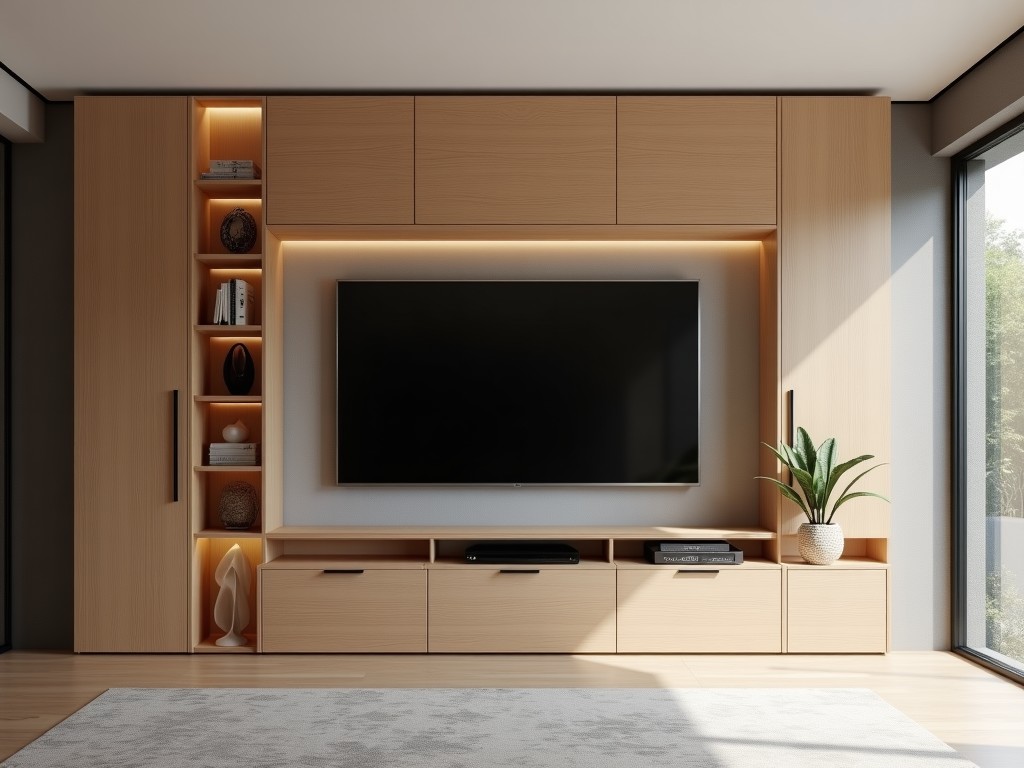
Veneer Tv Feature Wall Cabinet
A veneer TV feature wall cabinet is a wall-mounted or freestanding enclosure designed to integrate a television into architectural wall systems while providing concealed storage, cable management,
- Category:
- TV Cabinet
Veneer TV Feature Wall Cabinet
A veneer TV feature wall cabinet is a wall-mounted or freestanding enclosure designed to integrate a television into architectural wall systems while providing concealed storage, cable management, and structural support. Unlike standard TV stands, it is engineered to align with interior finish planes, often matching surrounding millwork or paneling in material, thickness, and surface treatment. The cabinet serves both functional and aesthetic purposes: it isolates the TV from wall vibrations, manages heat dissipation from electronic components, and maintains a seamless visual plane when the TV is off. Industrial buyers specify these units for high-end residential, hospitality, and corporate environments where architectural coherence and long-term durability are critical.
Core construction typically involves a rigid substrate—such as MDF, particleboard, or plywood—overlaid with real wood veneer sliced from species like oak, walnut, or maple. The veneer is applied using hot-press or cold-press bonding with urea-formaldehyde or PVC-free adhesives, ensuring dimensional stability and resistance to delamination under varying humidity. Edge bands match the veneer grain and thickness, preventing exposed core material. Internal bracing, often using aluminum or steel reinforcement bars, prevents sagging under static loads exceeding 50 kg, which accounts for the TV weight plus additional shelving or equipment. Ventilation channels, precision-routed into the top, bottom, or rear panels, allow passive airflow to maintain operating temperatures below 40°C for enclosed electronics.
Surface finish options include UV-cured polyurethane, water-based lacquer, or oil-modified wax systems, each selected based on abrasion resistance (measured via Taber testing), VOC compliance, and repairability. UV finishes typically achieve 500+ cycles before 10% gloss loss, suitable for high-touch areas. Veneer thickness ranges from 0.6 mm to 2.0 mm, with thinner gauges used for curved or complex profiles and thicker options for high-wear zones. Grain orientation—whether vertical, horizontal, or book-matched—is specified to align with architectural lines and minimize visual disruption at panel joints. All surfaces are sanded to 180-grit minimum before finishing to ensure uniform adhesion and appearance.
Technical Specifications
| Parameter | Typical Value or Range | Notes |
|---|---|---|
| Overall Depth | 150–250 mm | Includes TV thickness, ventilation gap, and rear service clearance |
| Maximum Load Capacity | 80 kg (static) | Tested per ANSI/BIFMA X5.5 for wall-mounted units; includes TV and peripheral load |
| Veneer Thickness | 0.6–2.0 mm | Real wood; species-dependent flexibility and sanding limits |
| Substrate Material | MDF (E1), Plywood (BB/CC), Particleboard (P2) | Selected based on screw hold strength, weight, and moisture resistance |
| Edge Banding | Matching veneer, 0.5–2.0 mm thick | Applied via hot-melt EVA or PUR adhesive; prevents core exposure |
| Ventilation Area | ≥1.5% of rear panel surface | Calculated per IEC 62368-1 for passive cooling of enclosed electronics |
| Finish Hardness | 2H–4H (pencil scale) | UV-cured coatings; measures scratch resistance under controlled load |
| Joint Tolerance | ±0.5 mm | Achieved via CNC routing and dowel/pin alignment systems |
Material Selection and Performance
Substrate choice directly impacts long-term performance. MDF provides uniform density and smooth veneer adhesion but has lower screw withdrawal strength (~600 N) compared to plywood (~900 N), making the latter preferable for load-bearing brackets or frequent disassembly. Particleboard is cost-effective but exhibits higher thickness swelling (>12% at 24h water soak), limiting its use in environments with fluctuating humidity. For projects requiring FSC certification or low formaldehyde emissions, CARB Phase 2 or E0-rated substrates are specified, with veneer adhesives meeting EN 717-1 standards (<0.1 ppm formaldehyde).
Veneer species are selected not only for appearance but also for mechanical properties. White oak offers high hardness (Janka ~1360 lbf) and prominent grain, suitable for high-traffic zones. Walnut provides moderate hardness (~1010 lbf) with a rich, uniform color that minimizes visual variation across panels. Maple, while harder (~1450 lbf), presents challenges in veneer application due to its tight, interlocked grain, which can cause tearing during slicing or sanding. All veneers are kiln-dried to 6–8% moisture content before application to prevent post-installation movement. Cross-banding or backer veneers may be used on large panels to balance stresses and prevent warping.
Finish systems are evaluated for chemical resistance to common cleaners (isopropyl alcohol, ammonia-based solutions) and UV stability. Water-based lacquers typically show <5% color shift after 200 hours of UV exposure (QUV testing), while polyurethane variants exceed 500 hours. Repairability is a key factor: UV finishes require spot-repair kits with matching shear-thinning resins, whereas wax/oil finishes can be refreshed with simple reapplication. Edge sealing is critical—unsealed edges absorb moisture up to 3x faster than faced surfaces, leading to delamination or blistering at joints over time.
Design and Customization Logic
Customization begins with precise TV dimensions and mounting pattern (VESA standard), which dictate the internal cavity size and bracket placement. Clearance is calculated as TV depth + 20 mm for ventilation + 10 mm for service access, ensuring no thermal throttling or cable strain. External dimensions are then aligned with architectural modules—commonly 300 mm or 600 mm increments—to match surrounding wall panels, door frames, or shelving units. Overhangs beyond the TV width are minimized to reduce bending moments on the wall anchor system, typically kept under 50 mm per side unless reinforced with steel stiffeners.
Internal layout is optimized for equipment heat stratification: power supplies and amplifiers are placed in lower compartments where cooler air enters, while heat-generating components like media players occupy mid-zones. Cable ports are positioned to avoid sharp bends, maintaining a minimum bend radius of 10x cable diameter to prevent signal degradation. Ventilation slots are staggered or labyrinth-style to preserve visual continuity while allowing airflow—direct holes are avoided unless covered with acoustically transparent fabric or metal grilles rated for <10% open area loss. Shelving depth is limited to 250 mm to prevent anterior tip-over when loaded, complying with ASTM F2057 stability requirements.
Joinery methods are selected based on disassembly needs and load paths. Cam locks and confirmat screws are used for modular systems requiring field adjustment, while dowel-and-glue joints provide superior shear strength for permanent installations. Corner reinforcement uses metal brackets or plywood gussets when spanning >1200 mm without intermediate support. All edges are radius- or chamfer-finished (minimum 1 mm radius) to eliminate sharp edges that could damage wall finishes during installation or catch on cables. Surface grain direction is mirrored across paired doors or panels to maintain visual symmetry, especially in book-matched veneer layouts.
Quality Control and Testing
Incoming veneer is inspected for color consistency, grain straightness, and defects (knots, splits, insect marks) under 500 lux daylight simulation. Moisture content is verified via capacitance meters, with batches rejected if outside 6–8% ±1%. Substrate panels are checked for thickness variation (±0.2 mm), flatness (<0.5 mm/m warp), and surface roughness (Ra < 8 μm). Adhesive bond strength is tested per ASTM D906, with minimum values of 1.0 MPa for veneer-to-substrate and 0.8 MPa for edge banding. Post-pressing, panels undergo 24-hour conditioning at 23°C/50% RH before further processing to stabilize dimensions.
Dimensional accuracy is verified using CNC probes or coordinate measuring machines (CMM) on critical interfaces: bracket holes, panel alignment pins, and door reveals. Positional tolerance is maintained at ±0.3 mm for functional features and ±0.5 mm for aesthetic edges. Finish quality is assessed via 60° gloss meter (target variance <5 GU across panel), cross-hatch adhesion (ASTM D3359, minimum 4B rating), and mar resistance (Taber Abraser, CS-10 wheels, 500 g load). Units are cycled through 5 temperature/humidity shocks (–10°C to +40°C, 20% to 90% RH) to simulate transport and storage conditions, with inspections for delamination, finish cracking, or joint movement.
Load testing applies static weights up to 125% of rated capacity (e.g., 100 kg for an 80 kg unit) for 24 hours, measuring deflection at mid-span using dial indicators. Acceptable creep is <1.5 mm. Dynamic testing simulates door opening/closing cycles (20,000 motions) with 5 kg loads on shelves to assess hinge wear and screw loosening. Final inspection includes functional verification: door alignment (<1.5 mm gap variation), soft-close mechanism engagement (if applicable), and cable port accessibility. Packaging includes corner protectors, edge guards, and humidity indicators, with units stacked no higher than 1.2 m to prevent compressive deformation.
Applications in Built Environments
In residential high-end interiors, veneer TV cabinets are specified to maintain material continuity between built-in storage, wall paneling, and ceiling treatments—particularly in open-plan living areas where the TV wall serves as a focal point. By matching the veneer species and finish of adjacent bookshelves or cabinetry, the unit avoids visual fragmentation, allowing the technology to recede into the architecture. The concealed cable management reduces clutter, while the rigid mounting prevents micro-vibrations from transferring to the wall surface, which could cause finish cracking or fastener loosening over time in gypsum-based systems.
Hospitality environments—such as boutique hotel suites or corporate lounges—require cabinets that withstand frequent use, cleaning cycles, and varying guest behavior. Here, impact resistance is critical: edges are often reinforced with 2 mm PVC or ABS bands beneath the veneer to absorb glancing blows from luggage or cleaning equipment. Finish selection prioritizes cleanability and chemical resistance, with UV-cured polyurethanes preferred for their ability to withstand daily wiping with hospital-grade disinfectants without whitening or peeling. Ventilation is sized for continuous operation, as TVs in lobbies or waiting areas may run 16+ hours daily, necessitating passive cooling to prevent thermal throttling of internal components.
Corporate settings—executive offices, boardrooms, or control rooms—demand precision integration with AV systems and furniture systems. Cabinets are often designed to accept motorized lifts, rotating mounts, or acoustic panels behind the TV surface, requiring internal clearances that accommodate movement without binding. Cable management includes segregated low-voltage (HDMI, Ethernet) and power channels to prevent EMI interference, with shielded partitions grounded to the cabinet frame. In control rooms, where multiple monitors are mounted in arrays, the cabinet system may extend horizontally to house processors, matrix switches, and UPS units, all while maintaining a uniform veneer plane that matches raised access flooring or wall baseboards.
Ordering and Project Support
To initiate a quotation, provide the following: TV model and VESA pattern, desired external dimensions (H×W×D), substrate preference (MDF, plywood, or particleboard), veneer species and cut (plain-sliced, quartered, rift), finish type (UV, lacquer, oil), and any required internal features (shelves, drawers, cable vents, equipment racks). For architectural integration, supply wall section details, adjacent material specifications, and mounting conditions (stud spacing, wall type, load constraints). Lead times typically range from 4–6 weeks for standard configurations, extending to 8–10 weeks for custom veneer matching or complex geometry. Samples of veneer, finish, and edge banding are available upon request, shipped via courier with transit time included in the project schedule.
Packaging is designed for flat-bed or van transport: units are wrapped in polyethylene film, corner-protected with expanded polystyrene (EPS), and secured in double-wall cardboard cartons with internal bracing. For export, ISPM-15-compliant pallets are used, with desiccant packs and humidity indicators included. Each unit ships with a detailed installation guide, including wall anchor specifications (based on substrate and load), shimming procedures for uneven surfaces, and torque values for fasteners. Assembly hardware is pre-packed and labeled. For large projects, phased delivery and on-site staging coordination are available to align with construction schedules.
After-sales support includes touch-up finish kits matched to the batch number, replacement hardware sets, and technical guidance for field adjustments. Warranty covers material defects and finish adhesion for 24 months from shipment, excluding damage from improper installation, environmental exposure beyond specified limits, or mechanical impact. Technical files—including 2D CAD, 3D STEP, and BIM-ready Revit families—are available for project coordination. All documentation is provided in English; additional language versions are available upon request for international projects.



