Tv Wall With Sliding Doors To Hide Tv
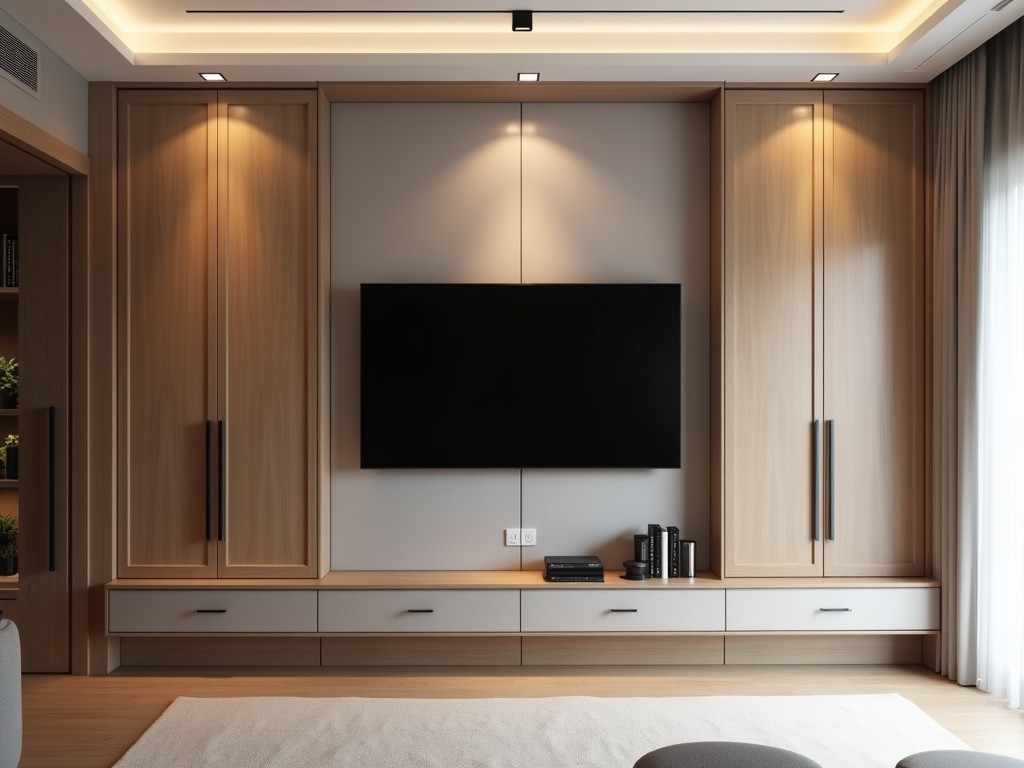
Tv Wall With Sliding Doors To Hide Tv
Industrial and commercial environments increasingly require display solutions that balance visibility with environmental protection and space efficiency. A TV wall with sliding doors to hide TV
- Category:
- TV Cabinet
TV Wall with Sliding Door Wall System: Technical Specifications and Applications
Industrial and commercial environments increasingly require display solutions that balance visibility with environmental protection and space efficiency. A TV wall with sliding doors to hide TV addresses these needs by integrating display functionality with operable enclosure systems. This approach protects sensitive electronics from dust, impact, and unauthorized access while maintaining readiness for immediate use. The following details outline the structural, material, and operational characteristics of such systems for technical evaluation.
Structural Framework and Load Distribution
The wall assembly begins with a load-bearing frame constructed from extruded aluminum profiles or galvanized steel studs, depending on span and load requirements. Vertical members are typically spaced at 600mm intervals to support both the static weight of the display and dynamic forces from door operation. Horizontal rails at top and bottom guide the sliding door mechanism, engineered to handle repeated cycles without sagging or misalignment. Frame deflection is limited to L/200 under full load to ensure door alignment and panel integrity over time.
Mounting provisions for the display are integrated into the frame, often using VESA-compatible brackets with micro-adjustment capability for precise alignment. These brackets are designed to transfer the display’s weight directly to the structural frame, minimizing stress on the wall substrate. Cable management channels are routed within the frame depth to conceal power and signal lines, maintaining a clean interface when doors are closed.
Sliding Door Mechanism and Materials
The sliding door system employs precision ball-bearing rollers or low-friction polymer guides mounted on hardened steel tracks. Rollers are selected based on door weight, with typical load ratings ranging from 50kg to 150kg per set depending on application. Track surfaces are anodized or coated to resist wear and corrosion, ensuring smooth operation over 20,000+ cycles. Door panels are guided by top and bottom tracks to prevent lateral sway and maintain vertical alignment during movement.
Door panels themselves vary in construction based on environmental demands. Common options include:
- Aluminum composite panels (ACP) – 3mm to 6mm thickness, lightweight, corrosion-resistant, suitable for interior environments
- Tempered glass – 6mm to 10mm thickness, provides visibility when closed, requires safety backing for impact resistance
- High-pressure laminate (HPL) over MDF or particleboard core – offers design flexibility, moderate impact resistance, requires edge sealing in humid conditions
- Perforated metal – allows IR signal transmission for remote control while maintaining protection, available in various patterns and gauges
Panel weight directly influences roller and track selection, with engineering calculations performed per project to ensure long-term reliability. Seals, typically brush or silicone-based, are installed along door edges to minimize dust ingress and dampen operational noise.
Integration with Display and Environmental Controls
The enclosure must accommodate not only the display’s physical dimensions but also its thermal and electromagnetic characteristics. Internal clearance is calculated based on manufacturer-specified ventilation requirements, typically adding 50mm to 100mm around all sides of the TV to allow convective cooling. Passive ventilation is often sufficient for lower-power displays, while active cooling fans with filtered intakes may be integrated for high-brightness or continuously operated units.
Electromagnetic interference (EMI) shielding is considered when the enclosure contains conductive materials. Non-conductive spacers or gaskets are used between the display mounting hardware and conductive panels to prevent signal degradation. IR receiver extensions are commonly mounted inside the enclosure, facing outward through a transparent or perforated section of the door to maintain remote functionality when closed.
Lighting considerations include anti-glare treatments on glass doors and internal bias lighting to reduce eye strain in low-ambient environments. All materials are selected for low off-gassing to comply with indoor air quality standards in occupied spaces.
Typical Applications and Operational Benefits
These systems are specified in environments where display protection and space optimization are critical. In retail settings, they secure high-value electronics after hours while allowing daytime visibility through transparent doors. Corporate lobbies and control rooms use them to maintain aesthetic consistency when displays are not in active use, reducing visual clutter. Healthcare facilities install them in patient rooms and waiting areas to protect equipment from contamination and tampering while ensuring readiness for emergencies or information delivery.
Educational institutions apply them in multipurpose rooms where displays serve dual purposes—presentation and environmental display—requiring rapid transition between modes. Transportation hubs utilize them in information kiosks to safeguard equipment from public interaction and environmental exposure. The operational benefit lies in converting a permanently visible display into a protected, on-demand asset without sacrificing accessibility or response time.
Customization and Project-Specific Engineering
Standard configurations serve as starting points, but most installations require adaptation to site-specific constraints. Customization begins with precise dimensional matching to the display model, including allowances for brackets, cabling, and ventilation. Door operation can be configured as single-panel, biparting (center-opening), or multi-track systems depending on wall width and spatial limitations. Hardware finishes—such as brushed aluminum, powder-coated colors, or anodized tones—are selected to match architectural elements.
Additional features may include integrated locking mechanisms (electromechanical or manual), access control interfaces, or synchronized motorized operation for large or heavy panels. Engineering support typically includes load calculations, deflection analysis, and thermal modeling to validate performance under expected conditions. All customizations are documented in fabrication drawings and assembly instructions to ensure consistency across units.
Quality Control and Manufacturing Considerations
Production begins with material verification—incoming aluminum extrusions are checked for temper and dimensional tolerance; glass panels are inspected for edge quality and surface defects; rollers are tested for rotational resistance and load capacity. Assembly involves precise track alignment using laser guides or dial indicators to ensure parallelism within 0.5mm over the full length. Door movement is verified through multiple cycles to confirm smooth operation, proper sealing, and absence of binding.
Finished units undergo functional testing, including door operation speed, noise levels (target <45dB), and seal effectiveness. For projects with specific environmental demands, additional testing such as dust ingress (IP ratings) or cyclic humidity exposure may be performed. Packaging is designed to protect corners and surfaces during transit, with edge protectors and stretch wrapping standard for LTL shipments. Documentation includes installation manuals, maintenance schedules, and warranty terms based on material and mechanism specifications.
For project-specific consultation, including load calculations, material selection guidance, or integration with existing AV systems, contact our engineering team to discuss your requirements. Detailed quotations are provided upon receipt of display specifications, wall dimensions, and environmental conditions.
Request Technical Consultation