Small Living Room Tv Wall Cabinet
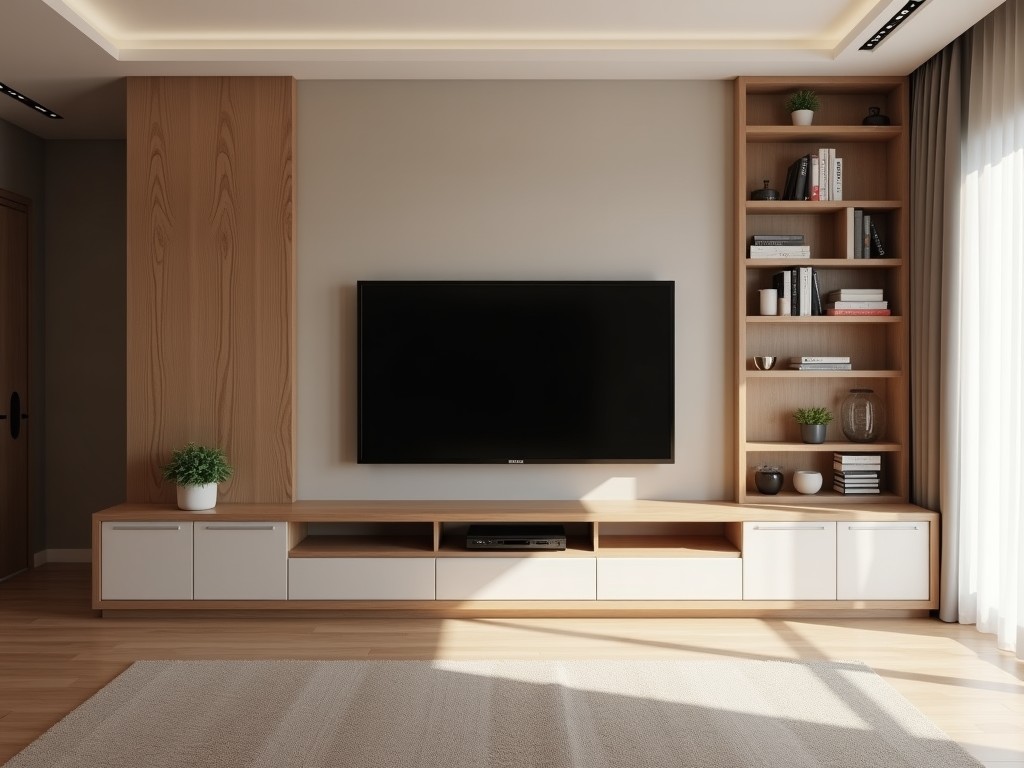
Small Living Room Tv Wall Cabinet
A small living room TV wall cabinet is a wall-mounted storage unit designed to support flat-panel televisions while providing enclosed or open storage for media components, cables, and accessories.
- Category:
- TV Cabinet
Small Living Room TV Wall Cabinet
A small living room TV wall cabinet is a wall-mounted storage unit designed to support flat-panel televisions while providing enclosed or open storage for media components, cables, and accessories. These units are engineered for residential interiors where floor space is limited but ergonomic viewing height and cable management are essential. Unlike freestanding TV stands, wall-mounted cabinets transfer load directly to the wall structure, reducing tipping risk and freeing up floor area. Industrial buyers such as furniture distributors, interior fit-out contractors, and OEMs evaluate these products based on load capacity, material stability, mounting system integrity, and finish durability under long-term indoor environmental conditions.
Structural Design and Load Distribution
The cabinet’s structural integrity depends on a rigid frame typically constructed from engineered wood panels (such as MDF or particleboard) or solid wood, reinforced with metal brackets or cleats at critical load points. The TV shelf must support dynamic and static loads from the display device, which commonly ranges from 15 to 40 kg for 32- to 55-inch screens in small living rooms. Load is transferred through vertical side panels to a wall-mounted cleat or French cleat system, which distributes force across multiple studs or anchors. Deflection limits are critical: shelf sag should not exceed 1/360 of the span under full load to prevent visual distortion or stress on the TV mounting interface. Back panels, often 3mm thick, add shear rigidity and prevent racking under lateral forces.
Mounting hardware must be selected based on wall substrate—concrete, brick, or wood studs—and rated for shear and pull-out strength. For example, a 100 mm x 30 mm steel cleat with four M6 lag bolts into wood studs can safely support 120 kg static load with a 4:1 safety factor. Cable access is facilitated through recessed channels or grommets in the top and bottom panels, maintaining bend radius limits for HDMI and power cords to prevent signal degradation or insulation wear. Ventilation slots or passive airflow gaps (typically 10–15 mm high) along the top or rear edge allow convective cooling for set-top boxes and amplifiers, preventing thermal buildup in enclosed configurations.
Material Selection and Surface Performance
Panel materials are chosen for dimensional stability, screw retention, and finish adhesion. MDF with a density of 680–720 kg/m³ provides uniform machinability and minimal edge chipping during CNC routing, while particleboard offers lower cost at the expense of reduced screw hold strength (typically 70–80 N vs. 110–130 N for MDF). Solid wood options (e.g., pine, poplar) provide higher impact resistance but require sealing to mitigate moisture-induced movement in fluctuating humidity environments. All panels are typically laminated with melamine-faced or veneer surfaces rated for scratch resistance (per EN 438-2) and lightfastness to prevent yellowing under indirect UV exposure.
Edge banding, usually 0.5–2.0 mm thick PVC or ABS, is applied via hot-melt adhesive to seal panel edges against moisture ingress and mechanical wear. Adhesive bond strength must exceed 1.0 N/mm to prevent delamination under cyclic humidity changes. Hardware such as hinges, drawer slides, and shelf pins are selected based on cycle life—e.g., 50,000 operations for soft-close hinges—and corrosion resistance (zinc-plated or nickel-coated for indoor use). Surface finishes are evaluated for stain resistance, cleanability, and compatibility with common household cleaners (alcohol-free, pH-neutral) to maintain appearance over 5–10 year service life.
Standard Dimensions and Configuration Options
Typical overall dimensions for small living room TV wall cabinets range from 800–1200 mm in width, 300–400 mm in depth, and 400–600 mm in height, accommodating TVs up to 55 inches while maintaining proportional scaling to room size. Internal clearances are designed around standard component heights: 100–120 mm for Blu-ray players or streaming boxes, 150–200 mm for AV receivers, and 200–250 mm for soundbars when mounted below the TV. Adjustable shelving systems use 5 mm diameter shelf pins with 32 mm vertical spacing, allowing reconfiguration in 32 mm increments to adapt to changing equipment profiles.
Cabinet configurations include open-shelf designs for ventilation-focused setups, closed-door units with push-to-open or soft-close hinges for dust protection, and hybrid models combining both. Door overlays are typically full or half-overlay, affecting gap uniformity and ease of installation. Some models incorporate integrated LED lighting strips (12V DC, 4.8W/m) along the underside of shelves, activated by motion or door switches, with wiring routed through concealed channels to maintain aesthetic continuity. Back panels may include removable sections for wall access or fixed designs with pre-cut holes for power and AV conduits.
Quality Control and Manufacturing Considerations
Dimensional accuracy is critical for wall alignment and door gap consistency. CNC-cut panels must maintain tolerances of ±0.5 mm on length and width, and ±0.2 mm on thickness to ensure proper hardware fit and surface flushness. Edge banding application is monitored for adhesive temperature (180–210°C) and pressure to avoid bubbles or lifting. Assembly checks include diagonal measurement verification (difference < 2 mm) to confirm squareness, and functional testing of doors and drawers for smooth operation and proper clearance.
Load testing is performed using distributed weights simulating TV and equipment mass, with deflection measured at mid-span. Finish adhesion is validated via cross-hatch tape test (ASTM D3359) requiring no more than 5% coating removal. Humidity conditioning (cycling between 30% and 70% RH at 25°C) assesses panel movement and joint integrity over 72 hours. Packaging involves corner protectors, edge foam, and horizontal stacking in 5-layer corrugated cartons (minimum 300 g/m²) to resist compression and impact during transit, with ISTA 1A or 2A compliance recommended for e-commerce distribution.
| Parameter | Typical Value | Notes |
|---|---|---|
| Max TV Width Supported | 1200 mm | Suits 55-inch displays with side clearance |
| Shelf Load Capacity (UDL) | 25 kg | Per shelf, with center-point deflection < 2 mm |
| Panel Thickness | 16–18 mm | MDF or particleboard core |
| Wall Mount Load Rating | 120 kg | With 4:1 safety factor into wood studs |
| Ventilation Gap Height | 12 mm | Top or rear edge for passive cooling |
| Edge Banding Thickness | 1.0 mm | PVC or ABS, hot-melt applied |
Applications and Installation Context
These cabinets are specified in urban apartments, condominiums, and compact homes where living room dimensions often fall below 3m x 4m, making floor-standing furniture impractical. Interior designers and contractors select wall-mounted units to achieve a floating aesthetic, improve sightlines, and create perimeter storage without obstructing traffic flow. The elevated TV position (typically 1000–1200 mm from floor to screen center) aligns with seated eye height in standard sofas, reducing neck strain. In retrofit installations, the cleat system allows for level adjustment to compensate for uneven walls, a common issue in older buildings.
For OEMs supplying to furniture retailers, modular design enables flat-pack shipping and rapid on-site assembly using cam locks, confirmit bolts, or housing connectors. Distributors benefit from standardized hole patterns and pre-drilled mounting points that reduce field variability. In multi-unit residential developments, cabinets are often customized to match building-wide material palettes (e.g., white melamine, oak veneer) and installed as part of turnkey fit-out packages. Electrical rough-ins are coordinated during framing to position power and low-voltage conduits behind the cabinet location, avoiding surface raceways.
Customization and Project-Specific Adaptation
Dimensions can be adjusted to accommodate non-standard TV sizes or asymmetric wall layouts—for example, widening one side to accommodate a gaming console tower while narrowing the opposite side for slim profile. Material substitutions are available upon request, including moisture-resistant MDF for humid climates, FSC-certified wood cores, or fire-retardant panels (Class B-s2, d0) for commercial or regulated residential applications. Hardware upgrades include soft-close mechanisms, touch-latch doors, or integrated wireless charging pads in shelving surfaces.
Finish customization extends to matte, gloss, or textured melamine foils, wood veneers (oak, walnut, ash), or lacquer coatings in RAL or NCS colors. Edge banding can be matched or contrasted to create visual detailing. Back panel options include ventilated grilles, acoustic fabric for soundbar enclosures, or removable access plates for smart home hubs. All customizations are subject to minimum order quantities and tooling considerations, with lead times typically ranging from 4–6 weeks for standard modifications and 8–12 weeks for fully bespoke designs.



