Oem Tv Wall With Led Lighting
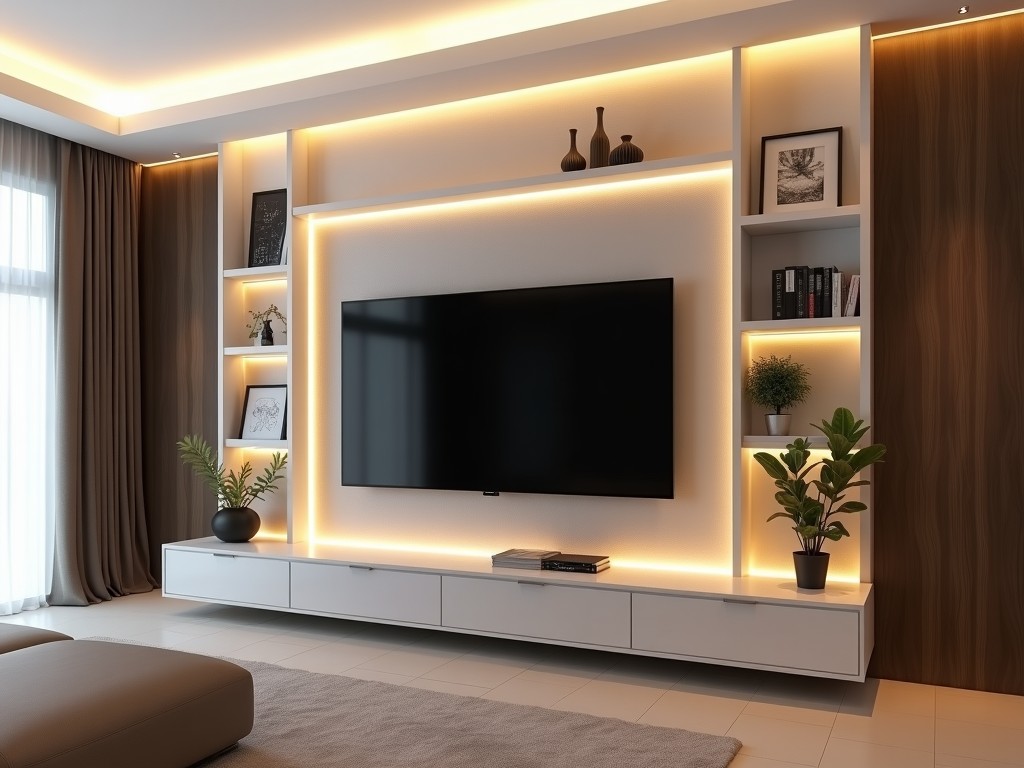
Oem Tv Wall With Led Lighting
An OEM TV wall with integrated LED lighting combines structural support for display arrays with programmable ambient or accent lighting to enhance visual environments in control rooms, broadcast
- Category:
- TV Cabinet
OEM TV Wall with LED Lighting
An OEM TV wall with integrated LED lighting combines structural support for display arrays with programmable ambient or accent lighting to enhance visual environments in control rooms, broadcast studios, and public information spaces. This integration requires careful coordination of mechanical load capacity, thermal management of LED systems, electrical routing, and mounting precision to ensure long-term reliability under continuous operation.
Unlike standalone mounts or decorative lighting fixtures, an OEM TV wall with LED lighting is engineered as a unified system where the lighting is not an add-on but a functional component of the display infrastructure. The LED elements are typically embedded within the frame, behind the screen plane, or along the perimeter to provide bias lighting, status indicators, or architectural accenting without causing glare or interfering with screen visibility.
Structural and Mechanical Design Considerations
The wall structure must support the combined weight of multiple displays, mounting hardware, cabling, and LED components while maintaining sub-millimeter alignment tolerance across the array. This is achieved using welded steel or extruded aluminum frames with modular mounting rails that allow for precise horizontal and vertical adjustment of each display unit. Load distribution is calculated based on display size, quantity, and dynamic forces from vibration or thermal expansion.
Thermal management is critical because LED strips generate heat that, if not dissipated, can degrade luminance output and shift color temperature over time. The design incorporates thermal vias, heat-conductive backing materials, and passive airflow channels within the wall cavity to maintain LED junction temperatures below 85°C under continuous operation. Surface finishes are selected for low emissivity and ease of cleaning in environments requiring frequent maintenance.
LED Lighting Integration and Control
The LED lighting system is specified by wavelength consistency (typically ±5nm for color-critical applications), luminance uniformity (<10% variation across 2m lengths), and dimming range (0.1% to 100% via PWM or analog control). Control protocols include DMX512, DALI, or 0-10V analog inputs, allowing synchronization with video content, environmental sensors, or building management systems. Addressable LED architectures enable per-segment color programming for dynamic zoning.
Electrical routing is segregated from signal cables to prevent electromagnetic interference, with dedicated power supplies rated for continuous duty and equipped with overcurrent, overtemperature, and short-circuit protection. Wiring harnesses use halogen-free, flame-retardant jackets compliant with IEC 60332-1, and connectors are rated for minimum 10,000 mating cycles to support maintenance access.
Material Selection and Environmental Suitability
Frame materials are chosen based on environmental exposure: anodized 6063-T5 aluminum for indoor control rooms due to its corrosion resistance and machinability; powder-coated cold-rolled steel for high-traffic public areas requiring impact resistance; and stainless steel 304 for humid or chemically aggressive environments such as transportation hubs or food processing facilities. All materials undergo salt spray testing (ASTM B117) and UV stability validation where applicable.
Diffuser materials, when used to soften LED output, are selected for light transmission efficiency (>85%), thermal stability (continuous use up to 90°C), and flame rating (UL 94 V-0). Common options include frosted polycarbonate, acrylic with UV inhibitors, or silicone-based optical sheets. Surface treatments are applied to minimize fingerprints and chemical residue accumulation.
Customization and Configuration Options
OEM TV walls with LED lighting are configured per project specifications, with no standard catalog sizes. Key customizable parameters include overall dimensions (height, width, depth), display grid layout (e.g., 2x2, 3x3, 4x6), mounting pattern compatibility (VESA, custom hole patterns), LED type (SMD 5050, 3528, or chip-on-board), color temperature range (2700K–6500K tunable white or full RGB), and control interface type.
Additional options include integrated cable management channels, front-access service panels, seismic reinforcement brackets, and environmental sealing (IP54 rated for dust and splash resistance). Surface finishes can be specified as matte black, custom RAL colors, or brushed metal to match architectural surroundings. All configurations undergo finite element analysis (FEA) to validate structural integrity under expected loads.
Typical Applications and Functional Benefits
In broadcast control rooms, the LED lighting provides bias illumination behind the video wall to reduce eye strain during extended monitoring shifts, with color temperature adjusted to match studio lighting conditions. In command and control centers, programmable LED zones indicate system status—green for normal operation, amber for warnings, red for alerts—enabling rapid visual assessment without requiring operators to read text or icons.
In retail and transportation environments, the lighting enhances brand visibility and wayfinding by synchronizing with promotional content or real-time transit data. For example, LED edges can pulse in coordination with train arrival times or flash during emergency announcements. The structural integrity of the wall ensures that displays remain perfectly aligned despite foot traffic vibration or HVAC-induced air movement.
| Parameter | Typical Range or Option |
|---|---|
| Frame Material | Anodized aluminum, powder-coated steel, stainless steel 304 |
| LED Type | SMD 5050, 3528, COB, addressable RGBW |
| Color Temperature | 2700K–6500K tunable white, full RGB spectrum |
| Control Protocol | DMX512, DALI, 0-10V, Ethernet-based (Art-Net, sACN) |
| Ingress Protection (Optional) | IP20 (standard), IP54 (sealed versions) |
| Surface Finish | Matte black, custom RAL, brushed metal, textured coating |
| Load Capacity (Per Mounting Point) | Up to 150 kg (dependent on frame design and reinforcement) |
Quality control begins at material intake, with mill certificates verified for aluminum temper and steel hardness. Each frame undergoes coordinate measuring machine (CMM) validation of critical dimensions before assembly. LED strips are tested for luminous flux, chromaticity, and forward voltage using integrating spheres and spectroradiometers. Final assembly includes power-on cycling, thermal imaging to detect hotspots, and vibration sweeps to simulate transport and operational conditions.
Packaging is designed for single-handling transport: modular sections are wrapped in anti-static film, placed in custom-cut foam inserts within double-wall corrugated crates, and secured with polypropylene strapping. Corner protectors and shock indicators are included for long-haul shipments. Assembly instructions include torque specifications for fasteners, grounding procedures, and LED addressing diagrams to ensure field deployment matches factory validation.
For engineering teams evaluating display infrastructure solutions, an OEM TV wall with LED lighting offers a path to reduce integration risk by combining mechanical, electrical, and lighting systems into a single, validated unit. To discuss your project’s specific requirements—including dimensions, display array configuration, environmental conditions, and control system compatibility—please provide your technical specifications for a detailed quotation and lead time estimate.