Modern Hidden Tv Console Cabinet
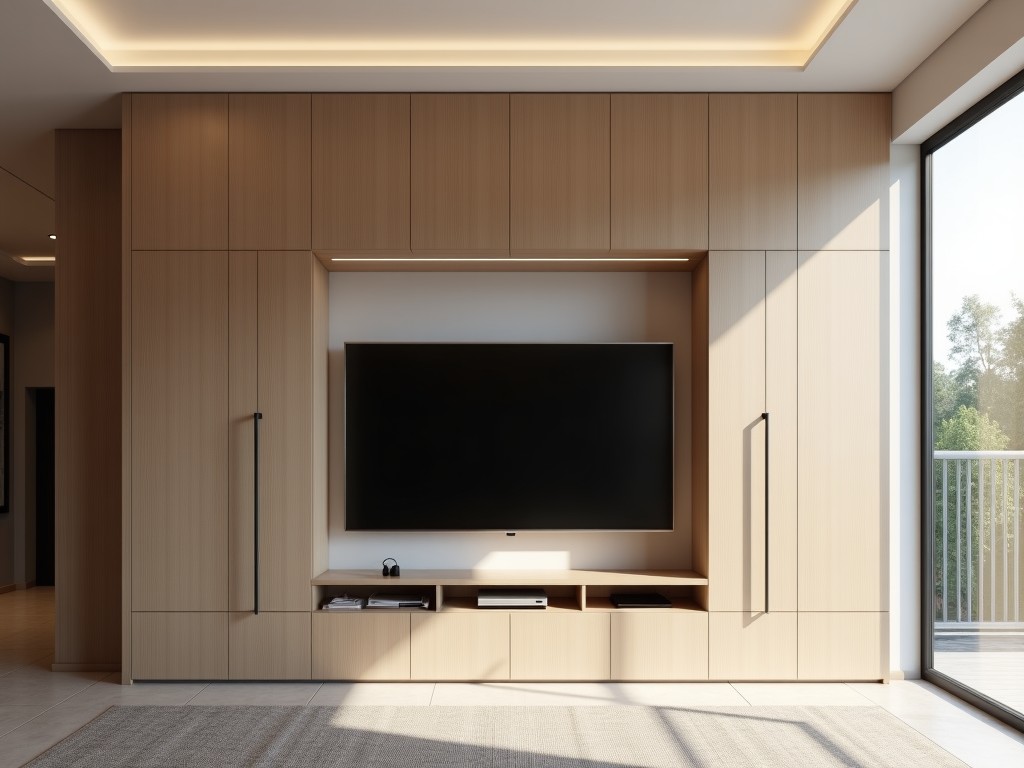
Modern Hidden Tv Console Cabinet
A modern hidden TV console cabinet integrates display functionality with concealed storage, designed for commercial environments requiring both aesthetic minimalism and operational durability. Unlike
- Category:
- TV Cabinet
Modern Hidden TV Console Cabinet
A modern hidden TV console cabinet integrates display functionality with concealed storage, designed for commercial environments requiring both aesthetic minimalism and operational durability. Unlike residential entertainment units, these systems are engineered for high-traffic areas such as corporate lobbies, control rooms, healthcare facilities, and retail spaces where frequent use, cable management, and equipment security are critical. The core design principle centers on seamless integration—when not in use, the television is fully retracted behind precision-fitted panels, eliminating visual clutter while protecting the screen from dust, impact, and unauthorized access.
Structural Framework and Load-Bearing Design
The cabinet’s structural integrity begins with a welded steel subframe, typically constructed from 1.5mm to 2.0mm cold-rolled steel, powder-coated for corrosion resistance in humid or chemically exposed environments. This frame supports dynamic loads from motorized lift mechanisms (rated for 40–60kg TVs) and static loads from shelving or equipment racks, with deflection limits under 1.5mm under full load to prevent panel misalignment. Load paths are engineered to transfer weight directly to the floor via leveling feet with ±10mm adjustment, avoiding reliance on wall anchors in seismic zones or temporary installations.
Side panels and rear access doors use 18mm engineered wood cores (MDF or particleboard) with PVC or laminate finishes, selected for dimensional stability under varying temperature and humidity conditions. Edge banding is applied with hot-melt adhesive to prevent delamination, and all internal surfaces are laminated to resist moisture ingress and simplify cleaning. The frame-to-panel interface uses concealed cam locks and steel brackets, allowing for disassembly and reassembly without visible fasteners—critical for maintenance access in 24/7 operational settings.
Motorized Lift Mechanism and Motion Control
The lifting system employs a dual-motor synchronous drive with ball screw actuators, ensuring smooth, quiet operation (≤45 dB) and precise positional repeatability within ±0.5mm. Each motor includes overload protection and Hall-effect sensors for position feedback, eliminating drift over 10,000+ cycles. The mechanism is rated for 100,000 cycles at full load, with lubrication points sealed for life—eliminating routine maintenance needs in inaccessible installations.
Motion profiles are programmable via embedded controller: soft-start and soft-stop reduce mechanical shock; emergency stop inputs comply with IEC 60204-1 for machine safety. Cable management is integrated through a flexible chain guide that routes power, HDMI, and control cables without twisting or pinching during travel, maintaining bend radii above 10x cable diameter to prevent signal degradation. All electrical components are isolated to Class II standards, with grounding paths bonded to the steel frame.
Material Selection for Durability and Hygiene
Surface finishes are selected based on environmental exposure: high-pressure laminate (HPL) with melamine overlay for general office use, providing abrasion resistance (Taber >400 cycles) and stain resistance to common solvents. In healthcare or laboratory settings, antimicrobial powder-coated steel or seamless solid surface (e.g., acrylic-based) panels are available, meeting ISO 22196 for bacterial reduction. All edges are radius-minimized (R≥2mm) to prevent snagging and facilitate wipe-down cleaning.
Internal shelving uses 12mm thick, moisture-resistant MDF with melamine finish, adjustable in 25mm increments via steel pin holes. Ventilation is passive but engineered: rear panels include laser-perforated zones (40% open area) aligned with TV vent locations, calculated using CFD modeling to maintain <5°C temperature rise above ambient during continuous operation. No active fans are used to avoid noise and failure points in silent environments.
Customization Logic and Integration Parameters
Standard configurations accommodate TVs from 43” to 75” diagonal, with VESA patterns from 200x200 to 600x400mm. Custom brackets are fabricated for non-standard mounts or oversized displays (up to 86”) upon request, with engineering review of load distribution and center-of-gravity shift. Depth is typically 400–500mm to accommodate soundbars, media players, and cable bundles; width and height are tailored to site-specific openings, with tolerances held to ±1.5mm for seamless wall or millwork integration.
Control options include hardwired wall buttons, infrared/RF remote receivers (with learning capability), RS-232/IP control for AV system integration, and optional occupancy sensors for auto-retract in unoccupied spaces. Finish matching to existing millwork is achieved through sample-based color rendering—Pantone or RAL references are used to batch-match laminates or paints, eliminating visual discrepancies in multi-unit installations. All customizations are documented with CAD models and material data sheets forfacility management handover.
Quality Control and Factory Testing
Each unit undergoes a 5-point factory acceptance test: (1) structural load test at 150% rated capacity for 10 minutes, (2) lift cycle test at 100% load for 500 cycles with motion profiling verification, (3) electrical safety test (hipot and ground continuity) per IEC 60950-1, (4) finish adhesion and abrasion resistance per ASTM D3359 and D4060, (5) dimensional inspection of critical interfaces (TV mount, panel gaps, door alignment) using CMM or digital calipers. Units failing any test are quarantined for root cause analysis before rework.
Packaging uses triple-wall corrugated cardboard with custom die-cut inserts to immobilize the TV mount, mechanism, and panels. Corner protectors are molded polyethylene; edge guards are extruded PVC. Units are banded and stretch-wrapped for palletizing, with shock indicators affixed to detect mishandling during transit. Export packaging includes ISPM-15 compliant wooden pallets and desiccant bags for humidity control during long-haul shipment.
Applications in Commercial and Institutional Environments
In corporate lobbies, hidden consoles reduce visual distraction from screening areas while enabling instant display activation for visitor briefings or emergency alerts—eliminating the need for permanent wall mounts that compromise interior design. In 24/7 control rooms, the retractable feature protects screens from airborne particulates and accidental contact during shift changes, extending display lifespan in high-duty-cycle operations. Healthcare facilities benefit from antimicrobial surfaces and seamless cleaning access, meeting infection control protocols in waiting areas or nurse stations where equipment must be both accessible and hygienic.
Retail environments use these consoles to secure high-value demonstration equipment (e.g., smart home demo units) after hours, preventing theft while maintaining an uncluttered sales floor during business hours. Educational institutions install them in lecture halls and collaborative spaces to conceal AV equipment when not in use, preserving sightlines and reducing tripping hazards from exposed cabling. The modular design allows for phased deployment—units can be retrofitted into existing millwork or specified in new construction with coordinated rough-in dimensions for power, data, and HVAC.
| Parameter | Typical Range / Option | Notes |
|---|---|---|
| TV Size Compatibility | 43” – 75” diagonal | Custom brackets available for 86”+ upon engineering review |
| Load Capacity (Lift) | 40–60 kg dynamic | Includes TV, mount, and accessories |
| Cycle Life | 100,000 cycles | At full load, lubricated for life |
| Noise Level (Operation) | ≤45 dB(A) | Measured at 1m distance in quiet room |
| Adjustable Shelving | 25mm increments | Steel pin holes in 12mm MDF shelves |
| Finish Options | HPL, laminate, powder coat, solid surface | Antimicrobial coatings available for healthcare |
| Control Interfaces | Hardwired, IR/RF, RS-232, IP, occupancy sensor | IP control supports Crestron, AMX, Extron integration |
| Depth | 400–500 mm | Accommodates soundbars, media players, cable management |
For projects requiring precise integration, technical documentation including CAD models (STEP/IGES), wiring diagrams, and load calculation sheets are available upon request. Lead times vary from 4–6 weeks for standard configurations to 8–10 weeks for fully custom finishes or non-standard mechanisms, contingent on material availability and engineering review. All units are designed for field serviceability—access panels allow mechanism replacement without dismantling the entire unit, minimizing downtime in critical installations.