Italian Luxury Tv Wall Unit
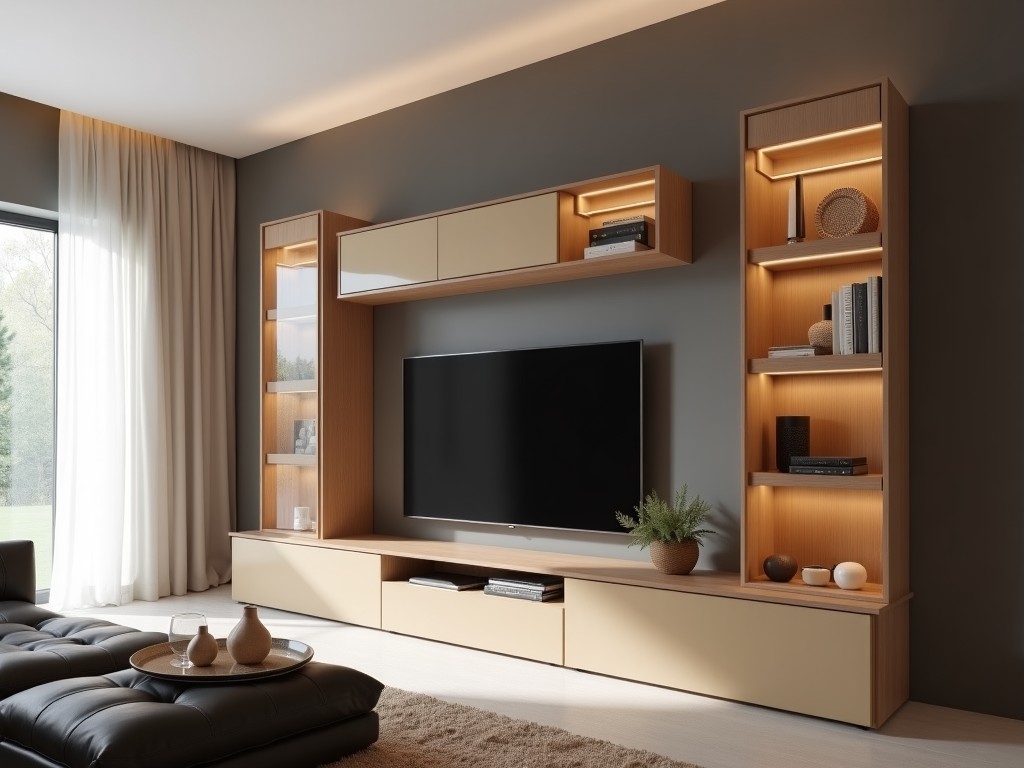
Italian Luxury Tv Wall Unit
An Italian luxury TV wall unit integrates precision cabinetry, material science, and spatial engineering to support high-resolution displays while enhancing interior architecture. These systems are
- Category:
- TV Cabinet
Italian Luxury TV Wall Unit
An Italian luxury TV wall unit integrates precision cabinetry, material science, and spatial engineering to support high-resolution displays while enhancing interior architecture. These systems are engineered for load distribution, thermal management, and aesthetic continuity in residential and hospitality environments where visual impact and long-term stability are critical.
Unlike standard entertainment centers, luxury units address micro-vibration damping, concealed cable routing, and material expansion coefficients to prevent warping or misalignment over time. Design considerations include panel thickness tolerance (±0.5mm), edge sealing integrity, and finish adhesion under 40–60% relative humidity cycling.
Structural Configuration and Load-Bearing Design
The primary frame employs multi-layer hardwood substrates (typically beech or poplar core) with cross-banded veneers to minimize anisotropic movement. Vertical load paths are calculated using finite element analysis to ensure deflection remains under L/360 for a 50kg TV load over a 1800mm span.
Reinforcement zones incorporate steel brackets (S235JR grade) with powder-coated finishes, embedded within dado joints to maintain clean sightlines. Shear resistance is optimized through interlocking tenon-and-mortise connections reinforced with PVAC dispersion adhesives, achieving shear strength >1.8MPa in laboratory conditioning.
Adjustable leveling feet with M10 threaded inserts accommodate floor tolerances up to 15mm, preventing racking-induced stress on wall anchors. Wall fixation uses chemical anchors (vinylester resin) into concrete or solid masonry, rated for 2.5kN pull-out resistance per fastener.
Material Selection and Surface Finishing
Exterior surfaces use 3mm thick solid wood veneers (walnut, oak, or zebrano) book-matched for grain continuity across panels. Veneer moisture content is stabilized to 6–8% prior to pressing, reducing post-installation cupping risk. Edge bands are laser-applied polymethyl methacrylate (PMMA) with refractive index matching to eliminate visible seams.
Interior shelving utilizes 18mm MDF with Class E1 formaldehyde emission, laminated with melamine-impregnated paper for abrasion resistance (Taber wear index <80mg/1000 cycles). Back panels incorporate perforated hardboard (3mm) for passive ventilation, maintaining rear cavity airflow >0.5m/s to dissipate heat from OLED/QLED panels.
Finishing involves UV-cured polyurethane coatings (2K system) with Shore D hardness 75–80, providing scratch resistance equivalent to 2H–3H pencil grade. Coating thickness is controlled to 40–60μm via automated spray booths, ensuring uniform gloss (60±5 GU at 60° angle) and chemical resistance to common household solvents.
Thermal and Vibration Management
Passive cooling is achieved through strategically placed vents (15mm slots) aligned with TV exhaust zones, creating chimney effect airflow without mechanical fans. Thermal modeling confirms surface temperature rise <8°C above ambient during 8-hour 4K HDR playback at 300nits brightness.
Vibration isolation employs constrained-layer damping (CLD) pads between the TV mount and internal frame, using viscoelastic polymer (loss factor η>0.15 at 20–200Hz) to attenuate structural resonance. This reduces audible buzz from panel flex by >12dB in the 50–150Hz range, critical for dialog clarity in home theater applications.
Cable management channels maintain 50mm bend radius for HDMI 2.1 and power cords, preventing signal degradation. Separate low-voltage conduits isolate AV cables from 230V AC runs, maintaining EMI shielding >40dB from 30MHz–1GHz.
Customization and Dimensional Flexibility
Units are manufactured to project-specific dimensions using CNC nesting optimization, with standard width increments of 50mm and height adjustments in 25mm modules. Depth typically ranges from 350mm (slim profile) to 500mm (deep shelving), accommodating soundbars, media consoles, or climate control units.
Internal configurations include adjustable glass shelves (8mm tempered, edge-polished), drawers with soft-close mechanisms (30,000-cycle rating), and motorized lifts (linear actuators, 200N thrust, <45dB operation). All moving parts undergo 10,000-cycle endurance testing per EN 15338:2007.
Finish options extend beyond wood to include matte lacquer (RAL 9005), brushed aluminum inserts, or back-painted glass (6mm low-iron) with ceramic frit printing. Custom lighting integrates LED strips (2700K–4000K tunable, CRI>90) with PWM dimming and DALI compatibility for smart home systems.
Quality Control and Manufacturing Tolerances
Dimensional inspection occurs at three stages: post-cutting (±0.2mm), post-assembly (±0.5mm), and pre-packaging (±1.0mm). Diagonal tolerance is maintained <1.5mm to prevent racking. Surface flatness is verified using laser triangulation, with deviation <0.3mm over 1000mm length.
Adhesive bond strength is tested via peel adhesion (ASTM D903) requiring >1.5N/mm, and finish adhesion uses cross-hatch tape test (ASTM D3359) requiring 5B rating. Humidity cycling tests (48h at 30% RH, 48h at 80% RH) validate finish integrity with no blushing or delamination.
Final assembly includes torque verification of all fasteners (M4–M8, 1.5–3.5Nm) using calibrated drivers. Packaging employs triple-wall corrugated boxes with internal EPE foam corners and humidity indicators, designed for ISTA 3A performance to withstand 1.2m drops and 15kPa compression.
| Parameter | Typical Value | Test Method / Standard |
|---|---|---|
| Max TV Weight Capacity | 50 kg | Static load test (EN 14073-2) |
| Deflection at Max Load | < L/360 | Dial gauge measurement |
| Surface Gloss (60°) | 60 ± 5 GU | ASTM D523 |
| Formaldehyde Emission | Class E1 | EN 717-1 |
| Operating Humidity Range | 40–60% RH | Manufacturer specification |
| LED Lifespan (L70) | 50,000 hrs | IES LM-80 |
Applications in High-End Environments
In luxury residential settings, these units serve as focal points in living rooms where architectural coherence is paramount. Designers specify them to align with millwork details such as door casings, wainscoting, or ceiling coffers, ensuring visual continuity through matching veneer cuts and finish sheen.
In boutique hotels and high-end retail lounges, the units support 75–85inch OLED displays while concealing media players, amplifiers, and climate sensors. The thermal management design allows continuous operation in confined spaces without exceeding component temperature limits, critical for 24/7 digital signage applications.
Marine and aviation installations utilize modified versions with salt-resistant coatings (ISO 12944 C5-M) and vibration ratings compliant with MIL-STD-810H. These adaptations maintain the aesthetic language of Italian luxury while meeting environmental durability demands.
For technical consultation, material samples, or project-specific quotations, contact our engineering team to discuss load requirements, finish options, or integration with smart building systems.
Request Technical Specification