Handleless Tv Wall Unit Manufacturer
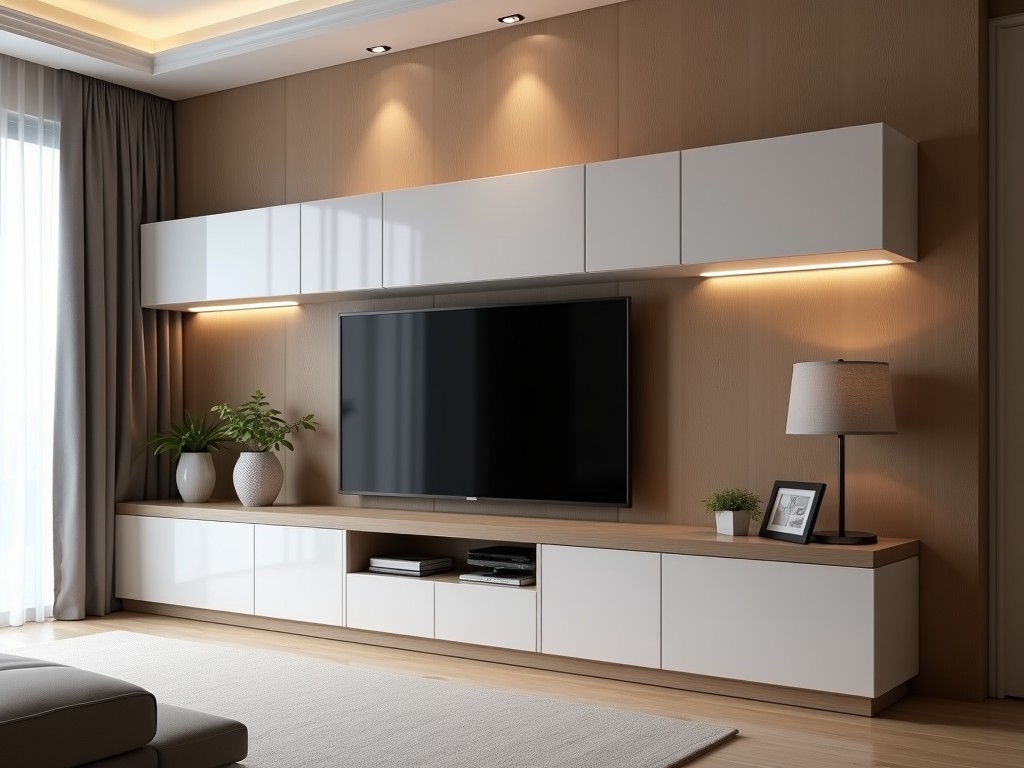
Handleless Tv Wall Unit Manufacturer
Handleless TV wall units represent a minimalist mounting solution where the display appears to float without visible brackets or handles. This design eliminates external fasteners on the front
- Category:
- TV Cabinet
Handleless TV Wall Unit Manufacturer
Handleless TV wall units represent a minimalist mounting solution where the display appears to float without visible brackets or handles. This design eliminates external fasteners on the front surface, relying instead on concealed anchoring systems within the wall structure or behind the unit. The absence of handles contributes to a seamless visual profile, particularly valuable in environments where aesthetics and space efficiency are critical, such as control rooms, broadcast studios, medical imaging facilities, and corporate lobbies.
Manufacturing these units requires precision engineering to ensure load distribution, thermal management, and long-term stability. The wall attachment system must accommodate the TV’s weight and dynamic forces from vibration or accidental impact, while maintaining a flush mounting plane. Material selection focuses on rigidity, dimensional stability, and compatibility with common wall substrates like concrete, steel studs, or gypsum board. Units are typically fabricated from extruded aluminum, cold-rolled steel, or high-density composite panels, chosen based on load requirements and environmental conditions.
Key Design Considerations
Structural integrity begins with the wall interface. Load calculations must account for both static weight and seismic or vibrational loads, especially in industrial or transportation-related installations. The mounting system distributes force across multiple anchor points to prevent localized stress on the wall substrate. For example, a 65-inch commercial display weighing 25 kg may require four M10 anchors spaced 600 mm apart in concrete, whereas the same load in steel studs necessitates load-spreading plates to avoid pull-through.
Thermal performance is another critical factor. Enclosed wall units can trap heat generated by the TV’s power supply and processing units, potentially reducing lifespan or triggering thermal shutdowns. Effective designs incorporate passive ventilation channels — typically 10–15 mm gaps at the top and bottom — or integrate low-profile heat sinks into the unit’s rear structure. Surface finishes are selected not only for appearance but also for emissivity; matte black or anodized coatings improve heat dissipation compared to reflective surfaces.
Cable management is integrated during design to maintain the clean aesthetic. Internal conduits or channels route power, HDMI, and control cables from the wall inlet to the TV’s connection points, preventing external clutter. These pathways must maintain minimum bend radii for signal integrity (e.g., 40 mm for HDMI 2.1) and allow for service access without disassembling the unit. Some designs include removable rear panels or magnetic access covers for maintenance.
Material and Construction Options
| Material | Typical Use Case | Advantages | Limitations |
|---|---|---|---|
| Extruded Aluminum (6063-T5) | High-end corporate, broadcast | High strength-to-weight, corrosion resistant, easy to machine | Higher material cost, requires thermal break for insulation |
| Cold-Rolled Steel (SPCC) | Industrial control rooms, military | High rigidity, cost-effective, easy to weld and powder coat | Heavier, prone to rust if coating damaged |
| High-Density Fiberboard (HDF) with PVC Lamination | Retail displays, hospitality | Low cost, smooth finish, good for veneer or paint | Limited load capacity, moisture sensitive |
| Stainless Steel (304) | Medical, food processing, marine | Corrosion resistant, hygienic surface, durable | Expensive, difficult to form, requires specialized tooling |
Material choice directly affects installation complexity and long-term maintenance. Aluminum units often use T-slot systems for adjustable internal components, while steel variants rely on welded brackets and punched mounting holes. Composite materials may require adhesive bonding or mechanical fasteners at joints, necessitating environmental sealing to prevent delamination. All materials undergo surface treatment — anodizing for aluminum, powder coating for steel, or lamination for composites — to enhance durability and meet specific environmental ratings (e.g., IP54 for dust and splash resistance).
Customization and Engineering Support
Manufacturers typically begin with the TV’s VESA pattern, weight, and dimensions, then engineer the wall interface based on substrate analysis provided by the client. Customization includes adjusting the unit’s height, width, and depth to accommodate specific viewing angles, ambient lighting constraints, or architectural features like baseboards or crown molding. Depth is particularly important — units must protrude far enough to clear wall-mounted outlets or switches but remain shallow enough to preserve the flush appearance.
Additional features are engineered per project: integrated IR repeaters for remote control through opaque fronts, motorized tilt or lift mechanisms (requiring external power and control wiring), or antimicrobial coatings for healthcare environments. Each modification undergoes structural validation — for example, a motorized lift adding 5 kg of moving mass requires recalculating dynamic load factors and reinforcing the mounting plate accordingly.
Prototyping is common for complex installations. Manufacturers may provide CAD models for client review, followed by a physical sample to validate fit, finish, and load performance before full production. This reduces risk in high-value projects where rework is costly. Documentation includes load certificates, material test reports, and installation manuals detailing anchor types, torque values, and verification procedures.
Quality Control and Testing
Quality assurance focuses on dimensional accuracy, surface integrity, and load validation. Critical dimensions — such as VESA hole alignment, wall anchor spacing, and internal clearance — are inspected using CMMs or calibrated fixtures, with tolerances typically held to ±0.5 mm for mating surfaces and ±1.0 mm for overall dimensions. Surface finishes are checked for adhesion (cross-hatch test), thickness (eddy current or magnetic gauges), and uniformity under standardized lighting.
Load testing applies static forces exceeding the rated capacity — commonly 150% of maximum TV weight — for a minimum duration (e.g., 10 minutes) to detect creep or joint failure. Dynamic testing simulates vibration or impact using shaker tables or pendulum impact testers, particularly for units in transit environments or public spaces. Thermal validation may involve infrared thermography to confirm surface temperatures remain within safe limits during prolonged operation.
Final inspection includes functional checks: cable routing continuity, access panel operation, and levelness verification. Units are packaged with corner protectors, edge foam, and moisture barriers, then secured in crates or pallets with shock indicators to monitor handling during transit. Export shipments comply with ISPM 15 for wood packaging and include desiccants to prevent condensation.