Dark Walnut Tv Media Wall Suppliers
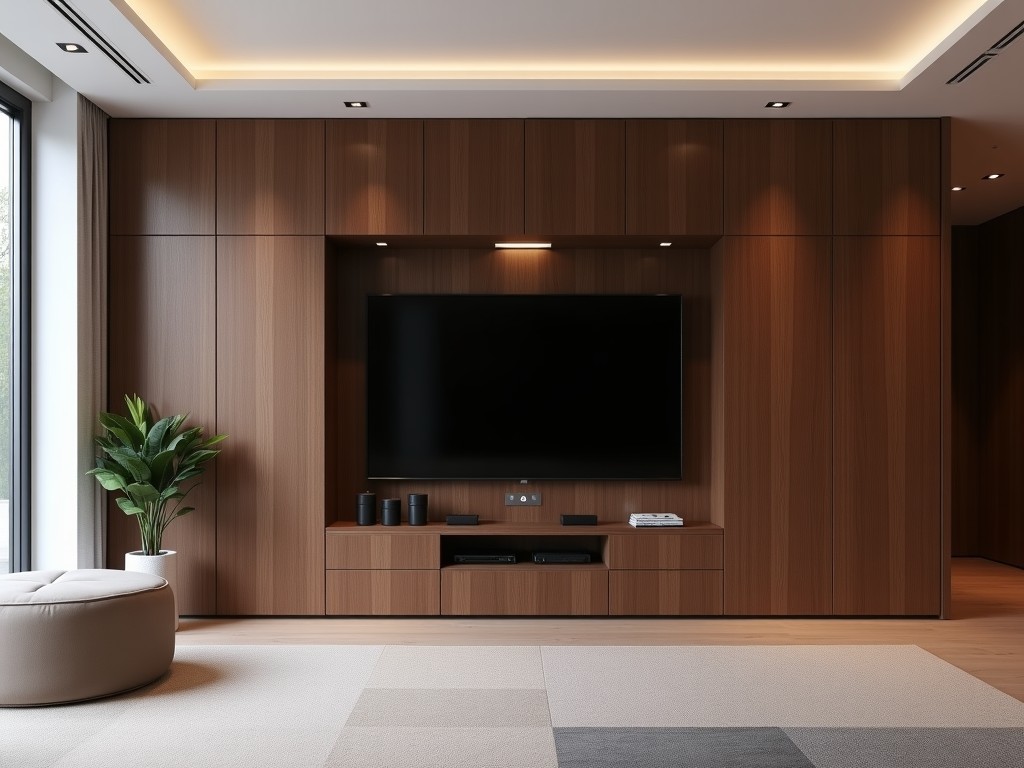
Dark Walnut Tv Media Wall Suppliers
A dark walnut TV media wall integrates structural support, cable management, and aesthetic finishing into a single wall-mounted unit designed for commercial and residential installations. These
- Category:
- TV Cabinet
Dark Walnut TV Media Wall Systems
A dark walnut TV media wall integrates structural support, cable management, and aesthetic finishing into a single wall-mounted unit designed for commercial and residential installations. These systems are engineered to securely mount displays ranging from 55 to 100 inches while concealing power, HDMI, and AV cabling within a routed chase or conduit system. The surface finish replicates the grain and tonal depth of natural walnut through engineered wood composites or thermofoil overlays, providing dimensional stability and resistance to warping in variable humidity environments.
Material Composition and Surface Performance
The core substrate typically consists of CARB Phase 2 compliant medium-density fiberboard (MDF) or particleboard with a minimum density of 650 kg/m³, selected for its uniform machinability and screw-holding capacity exceeding 180 N in face grain. Surface layers are applied via vacuum thermoforming or hot-press lamination using PVC-free, phthalate-free thermofoil films calibrated to match the L*a*b* color values of aged walnut (L: 28–32, a: 4–6, b: 8–12). Edge sealing is performed with 0.5 mm PVC or ABS edge banding, heat-activated at 180–200°C, to prevent moisture ingress at cut points and maintain a seamless visual transition between panel and trim.
Optional upgrades include moisture-resistant (MR) grade substrates with paraffin wax emulsion treatment for installations in coastal or high-humidity zones, or fire-retardant (FR) coatings meeting ASTM E84 Class B requirements for use in hotels, offices, and public assembly spaces. All finishes undergo accelerated UV exposure testing (ASTM G154) to verify color stability, with delta-E values kept below 3.0 after 500 hours of exposure to simulate 5 years of indirect sunlight.
Structural Design and Load Capacity
Load-bearing capacity is determined by the wall anchoring system, not the media wall panel itself. Standard configurations use dual 12-gauge steel Z-brackets welded to a 1.5 mm cold-rolled steel backing plate, distributed across two vertical studs spaced at 400 mm or 600 mm intervals. Each bracket pair supports a static load of up to 150 kg, with a 4:1 safety factor applied for dynamic loads from articulating mounts or seismic zones. The panel thickness ranges from 18 to 25 mm, with 22 mm being the most common for balancing rigidity and weight (approximately 18–22 kg/m²).
Internal cable management is achieved through a 50 mm deep vertical chase routed along the rear panel, accessible via a removable top panel or rear access panel with cam locks. The chase includes pre-drilled 20 mm grommets for cable entry/exit and optional Velcro®-compatible straps or plastic cable ties mounted to nylon rivet bases. For installations requiring power conditioning, a recessed 2-outlet UL-listed power strip can be mounted within the chase, wired to a hardwired inlet located at the base.
Customization and Dimensional Flexibility
Standard panel widths range from 1200 mm to 2400 mm in 100 mm increments, with heights from 400 mm to 800 mm to accommodate varying TV sizes and shelf requirements. Depth is fixed at 50 mm to maintain a low-profile profile while allowing space for cables and small media components. Custom widths beyond 2400 mm are achievable through segmented panels joined with aluminum spline connectors and color-matched seam fillers, maintaining visual continuity under controlled lighting.
Additional features include optional floating shelves (250–400 mm deep) mounted via concealed steel brackets, integrated LED lighting channels (12V DC, 3000K or 4000K) with diffuser lenses, and ventilated rear panels with laser-perforated patterns (15% open area) for active cooling of AV receivers or gaming consoles. All customizations are quoted based on DXF or DWG files provided by the client, with CNC routing tolerances held to ±0.5 mm for panel edges and ±0.2 mm for mounting hole patterns.
Quality Control and Testing Protocols
Incoming raw materials are inspected for density variation (±10%), moisture content (target 6–8%), and surface defect frequency (maximum 2 defects/m²). During production, each panel undergoes a 90-degree bend test on a 100 mm radius mandrel to verify coating adhesion and substrate integrity, with no cracking or delamination permitted. Final assemblies are subjected to a 50-cycle open/close test on access panels and a 100-hour static load test at 120% of rated capacity.
Packaging for export includes corner protectors, edge foam, and 6 mm corrugated cardboard sleeves with ISTA 1A compliance. Units are palletized with stretch wrap and humidity indicator cards to monitor transit conditions. Documentation includes material safety data sheets (MSDS), finish certification, and installation templates with drill guides for VESA patterns ranging from 200x200 to 800x600 mm.
| Parameter | Typical Value | Notes |
|---|---|---|
| Substrate Density | 650–750 kg/m³ | MDF or particleboard, CARB Phase 2 |
| Panel Thickness | 18–25 mm | 22 mm standard |
| Static Load Capacity | 150 kg per bracket pair | 4:1 safety factor |
| Cable Chase Depth | 50 mm | Access via top or rear panel |
| Finish Color Stability | ΔE < 3.0 after 500h UV | ASTM G154, simulated 5-year exposure |
| Edge Banding | 0.5 mm PVC/ABS | Heat-activated, seamless |
Applications in Commercial and Residential Environments
In corporate lobbies and conference rooms, dark walnut media walls reduce visual clutter by consolidating display mounts, soundbars, and control panels into a unified architectural element. The low-reflectance finish minimizes glare under overhead lighting, improving visibility of presented content while complementing wood-paneled walls or stone accents. In hospitality settings such as hotel suites or restaurant private dining rooms, the material’s resistance to staining and ease of cleaning (using pH-neutral cleaners) support long-term appearance retention despite frequent contact.
Residential installations benefit from the product’s ability to conceal unsightly wiring while providing a premium alternative to drywall surrounds. The engineered construction avoids the seasonal movement risks associated with solid wood, making it suitable for installation over insulated exterior walls or in basements with fluctuating moisture levels. Integration with smart home systems is facilitated by low-voltage raceways within the chase for lighting, sensors, or control keypads.
Supplier Evaluation and Procurement Considerations
When evaluating suppliers, request detailed CNC cutting reports showing nest efficiency and kerf compensation settings, as these directly impact material waste and edge quality. Inquire about the thermofoil supplier’s batch traceability and whether finish samples are conditioned at 23°C/50% RH for 48 hours prior to color matching—a standard practice to eliminate hygroscopic variation. Confirm whether wall anchors are included or specified separately, and whether load ratings are tested with the actual mounting hardware intended for use (e.g., toggle bolts vs. wood screws in steel studs).
Lead times typically range from 10 to 18 weeks for custom sizes, depending on substrate availability and finish line scheduling. Samples should include a full-size corner section (150x150 mm) to assess edge treatment and surface texture, not just a small swatch. For projects requiring fire ratings or marine-grade performance, ask for third-party test reports rather than relying on material datasheets alone.