Cream Handleless Media Wall
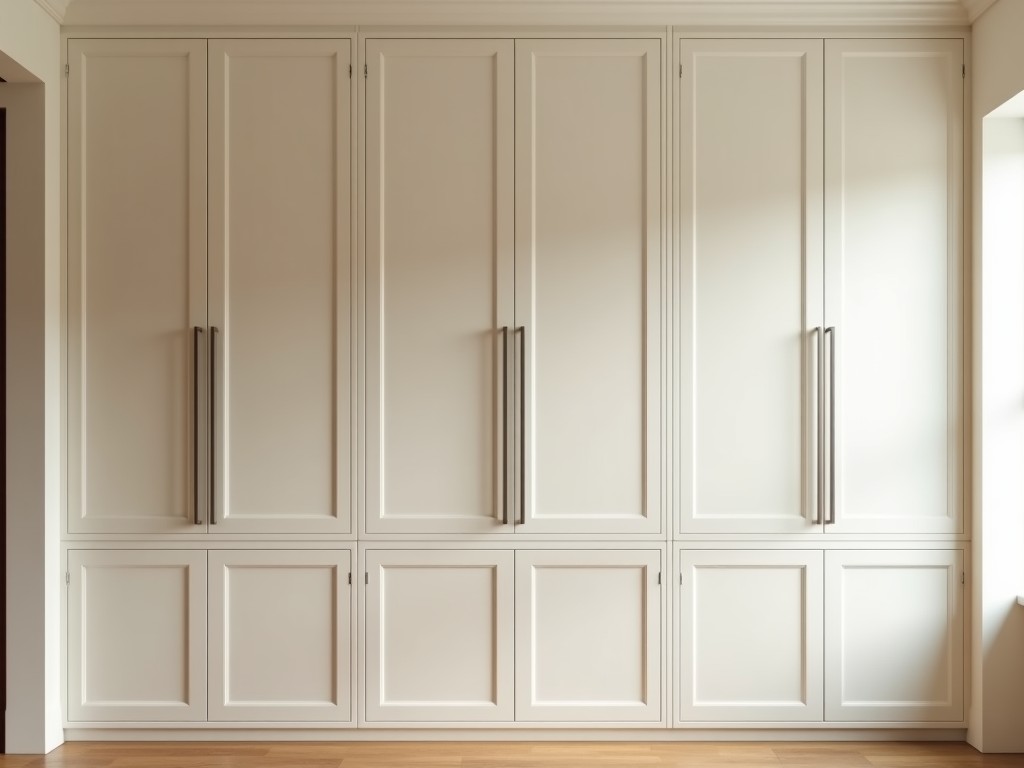
Cream Handleless Media Wall
A cream handleless media wall is a wall-mounted display solution engineered for seamless integration of audiovisual equipment without visible handles or protruding hardware. The design eliminates
- Category:
- TV Cabinet
Cream Handleless Media Wall Systems – Cream Handleless Design
A cream handleless media wall is a wall-mounted display solution engineered for seamless integration of audiovisual equipment without visible handles or protruding hardware. The design eliminates mechanical fasteners on the facade, relying instead on concealed mounting systems and precision-engineered panel joints to maintain a continuous, uninterrupted surface. This approach reduces visual clutter in professional environments where aesthetics and spatial efficiency are critical, such as control rooms, broadcast studios, and corporate collaboration spaces.
Structural Composition and Material Specification
The core structure typically consists of medium-density fiberboard (MDF) or particleboard substrates with a minimum density of 680 kg/m³, selected for dimensional stability under sustained load and resistance to warping in climate-controlled interiors. Surface finishes apply a water-based polyurethane coating in RAL 9001 (cream) with a gloss level of 5–10 GU, measured at 60° incidence, providing stain resistance and ease of cleaning while minimizing glare under ambient lighting. Edge sealing uses UV-cured acrylate to prevent moisture ingress at cut interfaces, maintaining long-term dimensional tolerance within ±0.5 mm over 24-month periods in 20–25°C environments.
Load-bearing capacity is determined by the substrate thickness and reinforcement strategy. Standard configurations use 18 mm thick panels with vertical stiffeners spaced at 400 mm intervals, capable of supporting static loads up to 150 kg per linear meter when mounted to concrete or steel stud backing with M8 chemical anchors. For heavier equipment such as large-format LED walls or server racks, reinforcement options include laminated veneer lumber (LVL) lamination or steel channel inserts, increasing capacity to 300 kg/m without increasing visible profile depth.
Handleless Integration Mechanism
The handleless interface relies on a 10–15 mm deep recess machined into the top edge of lower panels or bottom edge of upper panels, creating a continuous shadow gap that allows finger access for panel movement without visible hardware. This recess is precision-cut using CNC routers with ±0.1 mm tolerance to ensure consistent depth and prevent snagging. The gap width is maintained at 4–6 mm through the use of nylon glide strips or low-friction PET tape along the mating surfaces, reducing actuation force to under 8 N for panels weighing up to 25 kg.
For motorized or assisted movement systems, the recess accommodates low-profile linear actuators or pneumatic assists mounted within the panel cavity, preserving the external aesthetic while enabling powered adjustment. Cable management channels are integrated into the rear structure, with internal dimensions of 25 mm × 15 mm, allowing routing of power, HDMI, and CAT6 cables without external conduits. Bend radius recommendations follow TIA-568-C.2 standards, maintaining minimum 25 mm radius for data cables to prevent signal degradation.
Customization and Dimensional Flexibility
Standard module widths range from 400 mm to 1200 mm in 100 mm increments, with heights adjustable from 200 mm to 800 mm per section to accommodate varying equipment stacks. Custom lengths are achievable through seamless jointing using biscuit connectors or cam-lock fasteners, maintaining alignment within ±0.2 mm over spans up to 3600 mm. Panel thickness options include 15 mm, 18 mm, and 25 mm, selected based on span requirements and load conditions—15 mm for non-load-bearing trim, 18 mm for standard AV equipment, and 25 mm for structural support applications.
Surface finish customization extends beyond RAL 9001 to include other cream variants (e.g., RAL 9002, 1013) or matte/textured coatings upon request, with adhesion testing performed per ASTM D3359 to ensure coating integrity under cyclic humidity exposure (25–80% RH, 10 cycles). Corner treatments offer radius options from 3 mm (standard) to 10 mm (softened edge) or sharp 90° miters, machined to prevent edge chipping during handling. All customizations are validated through prototype testing before full-scale production.
Application Suitability by Environment
In broadcast studios, the cream finish reduces visual contrast against cyclorama walls and minimizes reflected glare under key lighting, improving camera-facing surface neutrality. The handleless design prevents accidental activation during fast-paced operations, while the seamless surface avoids creating visual markers that could interfere with chroma keying. Cable management integrity is critical here—unscreened conduits or exposed bundles can act as antennas, introducing noise into sensitive audio lines; the internal routing maintains shielding effectiveness by keeping conductors grounded and separated.
In corporate control rooms, the low visual footprint supports ergonomic layouts where operators require unobstructed sightlines across multiple displays. The 150 kg/m load capacity accommodates dual-monitor arms, thin-client terminals, and small form-factor PCs without requiring floor-standing racks. Environmental stability is essential—these spaces often operate 24/7 with tight HVAC control, and the substrate’s resistance to hygroscopic expansion prevents joint telegraphing or surface distortion over time.
For educational or training facilities, the smooth, non-porous surface withstands frequent cleaning with isopropyl alcohol-based solutions (up to 70% concentration) without coating degradation, supporting hygiene protocols. The absence of handles reduces pinch points and snag hazards in high-traffic zones, aligning with accessibility guidelines such as ADA Section 404 for protruding objects. Modular reconfiguration allows institutions to adapt layouts as technology evolves, avoiding full-wall replacement.
Quality Control and Manufacturing Process
Incoming substrate is inspected for moisture content (target: 6–8% ±1%) using pin-type meters per ASTM D4442, with boards outside this range rejected to prevent post-assembly movement. Panel squareness is verified on a granite surface plate with dial indicators, accepting deviations no greater than 0.3 mm/m. Edge sealing completeness is tested via dye penetrant inspection—any wicking beyond 0.5 mm from the cut line triggers rework.
After coating application, gloss uniformity is measured at 9 points per panel using a gloss meter, with acceptance criteria of ±2 GU from target. Adhesion is validated via cross-hatch tape test (ASTM D3359 Method B), requiring 5B rating (no coating removal). Final assembly checks include gap width verification using feeler gauges (4–6 mm tolerance), actuation force testing with digital force gauges (<8 N for 25 kg panels), and load testing to 125% of rated capacity for 10 minutes with zero permanent deflection (>0.2 mm).
| Inspection Point | Method | Acceptance Criteria |
|---|---|---|
| Substrate moisture content | ASTM D4442 (pin meter) | 6–8% ±1% |
| Panel squareness | Granite plate + dial indicator | ≤0.3 mm/m deviation |
| Edge seal integrity | Dye penetrant inspection | No wicking >0.5 mm from cut |
| Coating gloss uniformity | Gloss meter (60°) | ±2 GU from target (5–10 GU) |
| Coating adhesion | ASTM D3359 Method B (tape test) | 5B rating (no removal) |
| Handleless gap width | Feeler gauge set | 4–6 mm |
| Actuation force (25 kg panel) | Digital force gauge | <8 N |
| Load test (125% rated) | Static load, 10 min duration | <0.2 mm permanent deflection |
Packaging and Logistics Considerations
Finished modules are packaged in triple-wall corrugated cartons with internal corner protectors made of expanded polyethylene (EPE) foam, rated for 100 J impact absorption per ASTM D5420. Panels are separated by 3 mm thick corrugated cardboard sheets to prevent surface abrasion during transit. Each unit includes a desiccant pouch (silica gel, 50 g) to maintain internal humidity below 60% RH during shipment. Palletizing uses 4-way entry pallets with maximum stack height of 1.8 m, secured with polyamide strapping and corner boards to prevent lateral shift.
For international shipments, ISPM 15-compliant wood packaging is used where required, with heat treatment documentation provided. Volume efficiency is optimized through modular nesting—standard 600 mm wide modules nest within 1200 mm frames, reducing volumetric footprint by up to 40% compared to flat packing. Labeling includes QR codes linking to installation guides, material safety data sheets (MSDS), and QC certificates, accessible via smartphone scanning.
Installation and Field Adjustment
Installation begins with substrate preparation—ensuring the backing wall is flat within ±1.5 mm over 2 m, verified with a 2 m straight edge and feeler gauges. Mounting rails (aluminum extrusion, 40 × 25 mm) are affixed to the wall using M6 chemical anchors at 600 mm intervals, providing a level reference plane. Panels are hung via keyhole brackets routed into the rear, allowing vertical adjustment of ±10 mm before final locking with set screws. Horizontal alignment is achieved through slotted holes in the mounting hardware, permitting ±5 mm correction.
Joint sealing between panels uses a neutral-cure silicone with shore A hardness of 20–25, applied in a 3 mm bead tooled to a concave profile. This accommodates differential expansion of up to 1.2 mm/m over a 40°C temperature range while maintaining a seamless appearance. Post-installation, a 24-hour cure period is recommended before applying load. Field adjustments after 30 days are accessible via the same handleless recess, allowing re-tightening of fasteners without surface damage.
For spaces requiring frequent reconfiguration, such as demo centers or rental studios, a track-based variant is available—utilizing recessed aluminum channels in the floor and ceiling to support movable wall sections. This system maintains the handleless aesthetic while enabling repositioning in under 15 minutes per module, with repeatability within ±0.5 mm over 50 cycles.



