China Tv Cabinet For Wall Mounted Tv
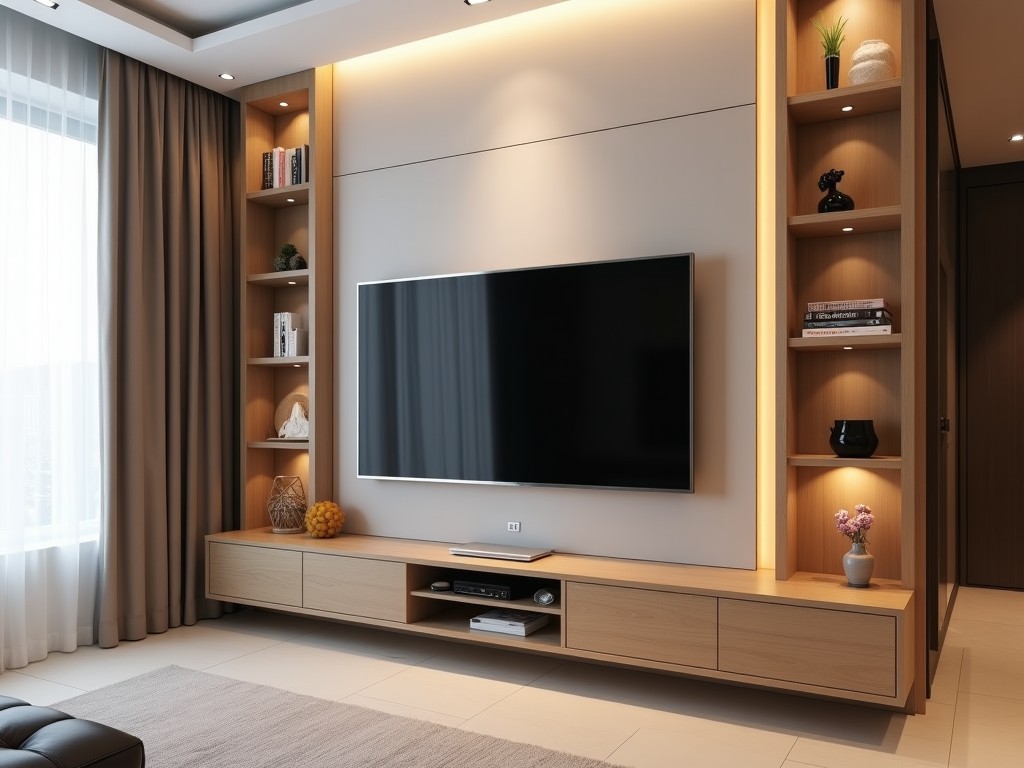
China Tv Cabinet For Wall Mounted Tv
Wall-mounted television installations require structural support that safely transfers dynamic and static loads to the building substrate while maintaining aesthetic integration. A properly
- Category:
- TV Cabinet
China TV Cabinet for Wall Mounted TV
Wall-mounted television installations require structural support that safely transfers dynamic and static loads to the building substrate while maintaining aesthetic integration. A properly engineered TV cabinet functions as both a mounting interface and a load-distributing element, preventing wall damage and ensuring long-term stability under varying TV weights and viewing angles. This page details the technical considerations, material specifications, and design parameters for TV cabinets manufactured in China for commercial and residential wall-mounted TV applications.
Structural Load Capacity and Distribution Principles
The primary function of a TV cabinet is to redistribute concentrated TV weight across a larger wall area to prevent substrate failure. Load capacity depends on cabinet geometry, material thickness, fastening method, and wall substrate type. For typical flat-panel TVs ranging from 15 to 40 kg, cabinets must safely handle 2–3× the static load to account for dynamic forces during adjustment, vibration, and seismic events. Engineering calculations follow principles of beam bending and shear stress, where the cabinet acts as a horizontal beam anchored at multiple points to the wall studs or masonry.
Load distribution efficiency increases with cabinet width relative to TV width. A cabinet spanning at least 1.5× the TV width reduces peak pressure on anchors by distributing force across more fastening points. Depth affects leverage; deeper cabinets increase bending moment on wall anchors, requiring either increased anchor density or reinforced cabinet cross-sections. Manufacturers in China typically design cabinets for 40–60 kg static load ratings with safety factors of 3:1 for gypsum board and 5:1 for concrete or brick substrates, validated through finite element analysis and physical pull-test protocols.
Material Selection and Mechanical Properties
Material choice directly impacts strength-to-weight ratio, corrosion resistance, finish quality, and long-term dimensional stability. Common materials include cold-rolled steel, aluminum alloy, and engineered wood composites, each selected based on load requirements, environmental conditions, and cost targets. Steel offers high tensile strength (typically 300–550 MPa) and rigidity, making it suitable for heavy TVs or public installations. Aluminum provides lower density (≈2.7 g/cm³) with adequate strength for lighter sets and better corrosion resistance in humid environments. Engineered wood (e.g., MDF or particleboard with veneer) is used where aesthetics prioritize over maximum load, often reinforced with internal steel brackets.
Surface treatments enhance durability and appearance. Powder coating on steel provides uniform thickness (60–80 μm), UV resistance, and scratch hardness exceeding 2H pencil grade. Anodized aluminum forms a hard, porous oxide layer (10–25 μm) that accepts dyes and resists abrasion. Wood-based cabinets use melamine laminate or PVC foil with abrasion resistance rated for 100–300 cycles under Taber testing. All finishes undergo salt spray testing (ASTM B117) for 96–240 hours depending on intended environment, with results available upon request for industrial buyers verifying corrosion performance.
Mounting Interface and Fastening System Design
The fastening system must accommodate variations in wall stud spacing, substrate integrity, and TV VESA patterns while minimizing installation error. Cabinets feature multi-point anchoring systems with slotted or adjustable holes to align with irregular stud layouts. Typical configurations include 4–6 anchor points using M8 or M10 bolts with washers and lock nuts to prevent loosening from vibration. For concrete or brick, mechanical anchors (e.g., wedge or sleeve types) are specified with embedment depths of 40–60 mm and torque values of 25–35 Nm to achieve optimal pull-out resistance.
TV attachment interfaces follow VESA standards (MIS-D, MIS-E, F) with mounting holes sized for M4–M6 screws. Depth adjustment mechanisms allow ±15–25 mm of setback to accommodate varying TV thicknesses and cable management needs. Some designs incorporate sliding brackets or quick-release mechanisms for service access without removing the entire cabinet. Tolerance stacking is controlled to <0.5 mm between cabinet and TV mounting planes to ensure flush installation and prevent stress concentration on the TV frame.
Dimensional Customization and Design Flexibility
Standard cabinet dimensions are rarely optimal for every installation due to variations in TV size, wall space, and peripheral equipment. Manufacturers in China offer parametric design adjustments based on project-specific inputs: TV dimensions, VESA pattern, desired viewing height, available wall width, and required clearance for soundbars or gaming consoles. Width adjustments typically range from 600 to 1800 mm in 50 mm increments, height from 300 to 600 mm, and depth from 150 to 300 mm to accommodate cable depth and ventilation needs.
Customization extends to functional features: integrated cable grommets (Ø20–30 mm), vented rear panels for passive cooling (open area ratio 15–25%), and optional shelving for media devices. Shelves are designed with cantilever limits based on material thickness and support spacing, typically rated for 5–10 kg per shelf with deflection limits of L/200. Internal reinforcement ribs or gussets are added where shelf loads exceed material capacity, calculated using beam deflection formulas. All custom dimensions are reviewed for structural integrity before tooling or production.
Quality Control and Manufacturing Consistency
Dimensional accuracy and material consistency are critical for reliable field performance. Manufacturing processes include CNC cutting for steel and aluminum, laser drilling for mounting holes, and precision bending to maintain angular tolerances of ±0.5°. For wood-based cabinets, panel cutting uses CNC routers with tolerances of ±0.3 mm, and edge banding is applied via hot-air adhesive systems to prevent delamination. Welded assemblies (if applicable) undergo visual and dye-penetrant inspection per ISO 5817 for crack-free joints in load-bearing areas.
Final inspection includes load testing of sample units at 150% of rated capacity for 1 minute, torque verification of all fasteners, and surface finish assessment under standardized lighting (D65, 1000 lux). Packaging is designed to protect corners and edges using expanded polystyrene (EPS) or molded pulp with drop test compliance to ISTA 1A or 1B. Each shipment includes installation hardware kits with torque specifications and substrate-specific anchor recommendations, reducing field installation errors and callback rates.
Application Considerations for Commercial and Residential Use
In residential settings, cabinets prioritize aesthetics, ease of installation, and compatibility with common wall constructions (wood studs at 400 or 600 mm centers). Load requirements are moderate, but concealment of cables and integration with interior design are key. In commercial environments—such as hotels, control rooms, or retail spaces—cabinets face higher usage frequency, potential tampering, and stricter safety regulations. These applications often require tamper-resistant fasteners, higher load ratings (up to 100 kg), and compliance with local building codes for seismic zones or public occupancy.
Healthcare and educational installations may require antimicrobial coatings or rounded edges to meet hygiene and safety standards. Industrial buyers should specify environmental conditions (humidity, temperature swings, UV exposure) during quotation to ensure appropriate material and finish selection. Manufacturers in China provide project-specific engineering support, including load calculation reports and installation drawings, to reduce risk and ensure compliance with project specifications.
Typical Specifications and Customization Options
| Parameter | Typical Range / Options | Notes |
|---|---|---|
| Static Load Rating | 40–100 kg | Safety factor 3:1 for drywall, 5:1 for concrete |
| Cabinet Width | 600–1800 mm | Customizable in 50 mm increments |
| Cabinet Depth | 150–300 mm | Includes cable management space |
| Material | Cold-rolled steel, Aluminum alloy, MDF/Particleboard | Surface treatment: Powder coat, Anodize, Melamine laminate |
| VESA Compatibility | MIS-D, MIS-E, F (up to 800×400 mm) | M4–M6 screw size, depth adjustable ±15–25 mm |
| Finish Durability | Salt spray: 96–240 hrs (ASTM B117) | Available upon request for project validation |
Engineers and procurement teams should submit TV specifications, wall substrate details, and installation height requirements to receive a detailed quotation with load calculations, material certifications, and installation drawings. Custom designs are reviewed for structural feasibility before quoting, ensuring that the final product meets both functional and safety expectations. For technical inquiries or to initiate a project-specific evaluation, contact the manufacturer’s engineering team via the provided channel.
For technical consultations, customization requests, or project quotations regarding China-manufactured TV cabinets for wall-mounted TVs, please reach out to discuss your specific requirements.