China Floating Tv Wall Panel
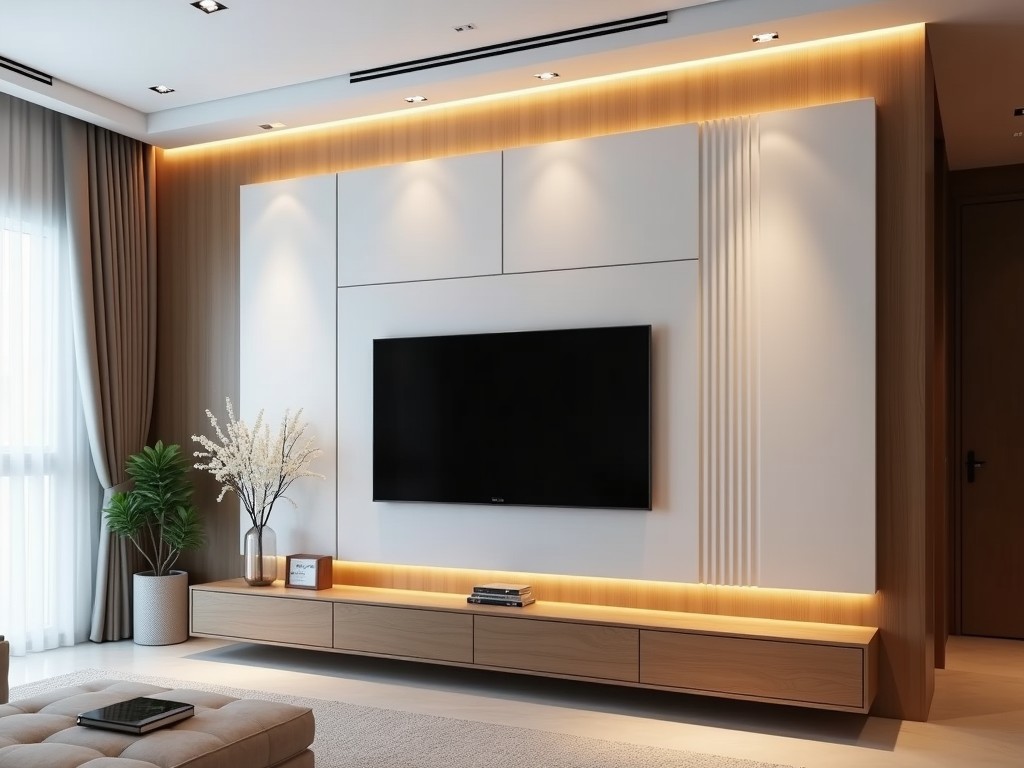
China Floating Tv Wall Panel
A floating TV wall panel is a structural mounting system designed to securely support flat-panel televisions while creating a visually seamless, recessed appearance against the wall. Unlike
- Category:
- TV Cabinet
China Floating TV Wall Panel
A floating TV wall panel is a structural mounting system designed to securely support flat-panel televisions while creating a visually seamless, recessed appearance against the wall. Unlike conventional brackets that protrude visibly, this system integrates the TV into the wall plane through precision-engineered rails, load-distributing frames, and concealed fastening mechanisms.
Manufactured in China using standardized industrial processes, these panels are engineered for commercial, residential, and institutional applications where both mechanical integrity and aesthetic integration are critical. The system typically comprises a steel or aluminum sub-frame, adjustable mounting brackets, and a finished facade panel that aligns flush with surrounding wall finishes such as drywall, plaster, or stone cladding.
Key design considerations include load capacity relative to TV size and weight, wall substrate compatibility (stud, concrete, or block), thermal expansion management, and accessibility for maintenance or cable routing. The floating effect is achieved by recessing the TV mount behind a facade panel that extends slightly beyond the screen edges, creating a shadow gap that enhances visual depth without compromising structural safety.
Core Engineering Features
The load-bearing framework is constructed from cold-rolled steel with a minimum thickness of 1.2mm, formed into C-channel or box-section profiles to maximize bending resistance under dynamic loads. These frames are pre-drilled for horizontal and vertical adjustment, allowing precise alignment of the TV within ±5mm tolerance after installation.
Facade panels are typically fabricated from 6mm thick MDF, plywood, or aluminum composite material (ACM), selected based on fire rating requirements, weight constraints, and finish compatibility. Edges are machined to exact dimensions to ensure uniform reveal gaps of 3–5mm around the TV perimeter, which are critical for achieving the intended floating visual effect.
Mounting interfaces incorporate hardened steel bolts with nylon lock washers to prevent loosening under vibration, and all load paths are analyzed to ensure stress concentrations remain below 40% of material yield strength under worst-case seismic or impact scenarios. Cable management channels are integrated into the sub-frame, with removable access panels sized for standard HDMI and power conduits (up to 25mm diameter).
Material Options and Finishes
| Component | Typical Materials | Finish Options |
|---|---|---|
| Load Frame | Cold-rolled steel (SPCC), 1.2–1.8mm | Zinc plating, powder coat (RAL 9005 black) |
| Facade Panel | MDF, Plywood, ACM, Aluminum | Veneer, laminate, powder coat, anodized |
| Mounting Brackets | Forged steel, extruded aluminum | Black oxide, clear anodize |
| Fasteners | Grade 8.8 steel, stainless steel (A2) | Zinc plated, passivated |
Material selection is project-dependent. For high-humidity environments, stainless steel fasteners and powder-coated aluminum facades are recommended to resist corrosion. In fire-rated assemblies, ACM panels with mineral core and steel frames meeting ASTM E84 Class A are commonly specified. Custom finishes such as wood veneer matching existing millwork or textured stone-effect coatings are available upon request, with color matching provided via RAL or NCS standards.
Load Capacity and Structural Performance
Standard configurations support televisions up to 100kg (220 lbs) with a maximum screen size of 86 inches, based on uniform load distribution across four mounting points. The system incorporates a 3:1 safety factor relative to ultimate tensile strength of the frame materials, verified through finite element analysis under static and cyclic loading conditions.
For larger displays exceeding 100kg, reinforced frames with additional vertical stiffeners and increased bracket count (up to six points) are available, raising capacity to 180kg. Wall substrate must be verified prior to installation: concrete anchors require minimum 20mm embedment in 25MPa+ concrete, while stud walls demand doubling of 2x6 wood studs at mounting locations with 3.5" structural screws.
Deflection under full load is limited to less than 1mm at the screen center, ensuring no perceptible movement during operation. Vibration damping is achieved through elastomeric isolators between the frame and facade panel, reducing transmission of building-borne frequencies above 15Hz. All load ratings are contingent on correct installation per manufacturer specifications; improper anchoring or substrate preparation voids performance guarantees.
Installation and Integration
Installation begins with precise layout of the mounting frame based on TV VESA pattern and desired viewing height. The frame is secured to the wall substrate using appropriate anchors, followed by attachment of the TV mounting brackets. Facade panels are then affixed to the frame using concealed cam locks or magnetic catches, allowing for tool-free removal during maintenance.
Electrical and data conduits are routed through channels in the sub-frame before facade panel installation, with brush-sealed entry points to maintain dust resistance. Access panels are sized to accommodate standard wall plates (up to 2-gang) and are positioned for convenient access to HDMI, power, and control wiring without disturbing the facade alignment.
Alignment is verified using laser levels and shim-adjusted brackets to compensate for wall irregularities. Final facade panel placement ensures uniform reveal gaps, which are critical for the floating illusion; gaps outside the 3–5mm range may require shimming or frame adjustment. All hardware is designed to resist corrosion and maintain clamping force over a 15-year service life under normal indoor conditions.
Applications in Commercial and Institutional Environments
In corporate lobbies and conference rooms, floating TV wall panels reduce visual clutter while supporting large-format displays for video conferencing and digital signage. The recessed mounting minimizes protrusions in high-traffic areas, improving safety and compliance with ADA clearance requirements. Integrated cable management prevents exposed wiring, maintaining a clean aesthetic essential for professional environments.
Healthcare facilities utilize these panels in patient rooms and waiting areas where infection control is paramount; the seamless facade allows for easy cleaning and eliminates crevices that harbor contaminants. The ability to mount displays at ergonomic viewing heights reduces neck strain, and the secure mounting prevents displacement during routine equipment movement.
Educational institutions install floating panels in lecture halls and libraries to support interactive displays and digital whiteboards. The low-profile design preserves sightlines and minimizes damage risk in spaces with high user density. For retail and hospitality, the system enables premium video wall installations that blend with architectural finishes, enhancing brand presentation without obstructive hardware.
Quality Control and Testing
Each production lot undergoes dimensional inspection of frame components using CMM equipment to verify hole positions and profile tolerances within ±0.2mm. Facade panels are checked for flatness and edge squareness, with warping limits set at 0.5mm per meter to ensure proper alignment during assembly.
Load testing is performed on sample units to 150% of rated capacity for a duration of 10 minutes, with strain gauges monitoring frame deflection. Fastener torque is verified using calibrated tools, and all locking features are tested for vibrational loosening per ISO 16130 standards. Finish adhesion and corrosion resistance are assessed via salt spray testing (ASTM B117) for coated components, with minimum 200-hour requirement for interior applications.
Final assembly includes functional verification of TV mounting, facade panel removal/reinstallation, and cable access. Documentation includes material certificates, test reports, and installation instructions specific to the configured system. Traceability is maintained via batch numbers etched on non-visible frame surfaces, supporting warranty claims and field service operations.
For project-specific configurations, load requirements, or finish options, contact our engineering team to discuss technical specifications and obtain a detailed quotation. Provide details including TV model and weight, wall substrate type, desired facade finish, and any integration requirements for control systems or ambient lighting.
Request Technical Consultation