China Cream Tv Feature Wall
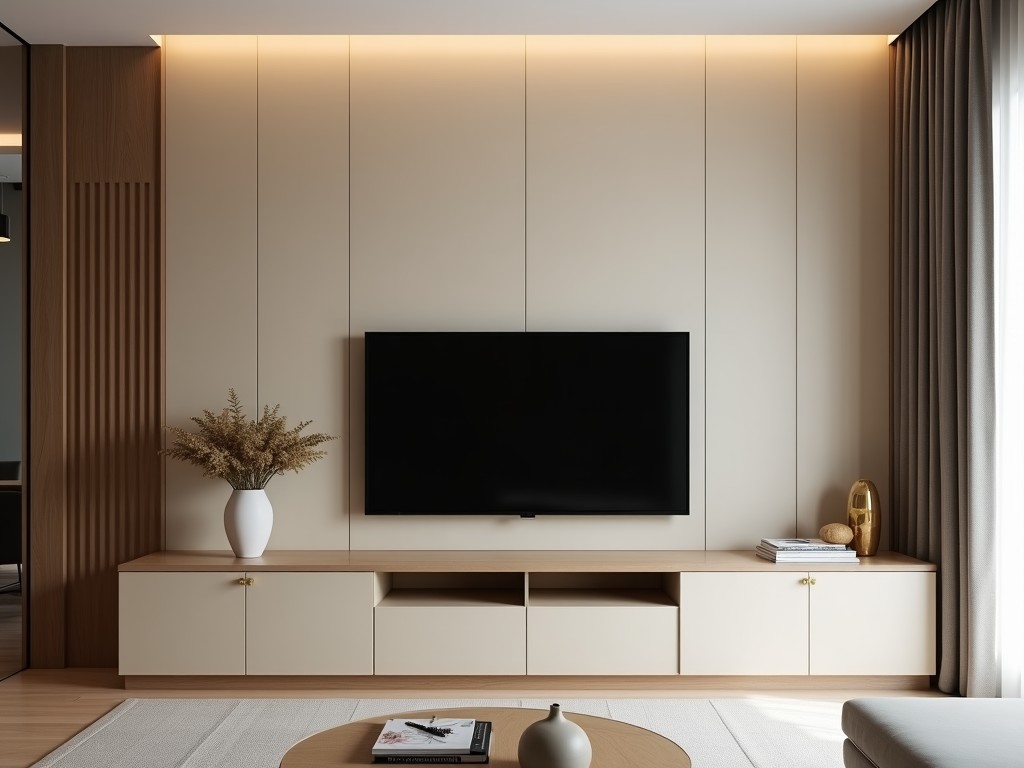
China Cream Tv Feature Wall
China cream TV feature walls are engineered architectural solutions designed to integrate flat-panel displays into interior environments while maintaining aesthetic continuity with surrounding wall
- Category:
- TV Cabinet
China Cream TV Feature Wall Systems
China cream TV feature walls are engineered architectural solutions designed to integrate flat-panel displays into interior environments while maintaining aesthetic continuity with surrounding wall finishes. These systems address thermal management, structural support, cable routing, and surface compatibility for residential and commercial installations.
Material Composition and Surface Finish
The base material is typically a mineral-filled composite panel with a density range of 1.4–1.8 g/cm³, providing sufficient rigidity to resist deflection under static TV loads up to 60 kg. The surface is coated with a water-based acrylic veneer in a standardized China cream color (CIE L*a*b*: L=88, a=2.1, b=8.3), offering a matte finish with 15–20% gloss units to minimize glare under ambient lighting.
Panel thickness options range from 12 mm to 18 mm, selected based on span distance and load requirements. Edge profiles are machined to 2 mm radius to prevent chipping during handling and installation. The composite formulation includes alkaline-resistant additives to maintain color stability in environments with periodic cleaning exposure.
Structural Integration and Load Distribution
Load transfer occurs through a concealed steel subframe anchored to the building structure at 400 mm intervals. The subframe uses C-channel profiles with a minimum section modulus of 1.8 cm³ to limit deflection to L/300 under a 50 kg point load. Load-spreading plates (100×100×5 mm) distribute TV mount forces across a minimum of three panel fasteners.
Isolation pads made of closed-cell neoprene (2 mm thick, Shore A 45) are placed between the TV mount and subframe to dampen vibration transmission. All fasteners are stainless steel grade 304 with torque-controlled installation to prevent substrate cracking. The system accommodates VESA patterns from 75×75 mm to 800×400 mm.
Thermal Management and Ventilation
Passive cooling is achieved through a 25 mm vertical air gap maintained between the TV rear panel and the feature wall backing. This gap is facilitated by 10 mm thick polypropylene spacers installed at the top and bottom edges. Computational fluid dynamics modeling indicates a temperature rise of ≤8°C above ambient for a 55-inch OLED TV operating at 120 W.
Upper and lower vents (each 150 mm wide × 10 mm high) are laser-cut into the panel edges to promote convective airflow. Vent areas are designed to provide a minimum free area of 15 cm² per kW of TV power dissipation. Dust-resistant mesh (0.8 mm aperture, stainless steel) is optionally integrated to prevent particulate ingress without significantly impeding flow.
Cable Management and Accessibility
A rear-mounted PVC conduit (25 mm diameter, UL 94 V-0 rated) runs vertically along the subframe to accommodate power, HDMI, and low-voltage cables. The conduit features snap-fit covers allowing tool-free access for maintenance. Cable bend radius is maintained at ≥10× cable diameter to prevent signal degradation in HDMI 2.1 and optical audio lines.
Outlet boxes (single-gang, 50×50×35 mm) are pre-positioned at the bottom rear corner for power and AV termination. These boxes are compatible with standard international faceplates (UK, EU, US formats) and include strain relief clamps to secure cables under tension. All penetrations are sealed with fire-retardant silicone (UL 1479) to maintain wall assembly fire ratings.
Installation Tolerances and Field Adjustability
Panel-to-panel alignment is maintained within ±0.5 mm using adjustable steel brackets with micro-threaded screws. Vertical and horizontal tolerances are compensated via slotted holes in the subframe, allowing ±3 mm adjustment post-installation. Shim packs (0.1 mm, 0.2 mm, 0.5 mm thick, stainless steel) are provided to correct substrate unevenness.
Sealant joints between panels use a neutral-cure silicone with a shore A hardness of 25 and 100% elongation at break. Joint width is standardized at 6 mm to accommodate thermal expansion (coefficient: 25×10⁻⁶/°C) without stress buildup. Corner details employ pre-molded PVC trims with a lip overlap of 4 mm to protect panel edges from impact.
Typical Configuration Values
| Parameter | Typical Value | Adjustment Range |
|---|---|---|
| Panel Thickness | 15 mm | 12–18 mm |
| Max TV Weight | 60 kg | Up to 80 kg with reinforcement |
| Ventilation Gap | 25 mm | 20–30 mm |
| Surface Gloss | 18 GU | 12–25 GU |
| Thermal Rise (55" OLED) | 7°C | 5–10°C |
Quality Control and Validation
Each panel undergoes spectral reflectance testing to verify color consistency within ΔEab < 1.5 against the China cream reference standard. Dimensional stability is assessed after 24-hour exposure to 40°C/90% RH, with acceptable length change limited to 0.1%.
Load testing applies 1.5× rated TV weight for 24 hours, measuring residual deflection after unloading. Acceptable creep is <0.2 mm. Fire performance is evaluated via ISO 9705 room corner test, with panels achieving Class B-s2,d0 classification when mounted on non-combustible substrates.
Incoming raw materials are certified for VOC content (<50 g/L) and heavy metal compliance (RoHS III). Final assemblies are inspected for edge integrity, joint uniformity, and subframe alignment using calibrated optical comparators (±0.01 mm resolution).
Applications in Interior Environments
These systems are specified in living rooms, hotel lobbies, and corporate reception areas where visual harmony between display technology and architectural finishes is critical. The neutral China cream tone provides a low-chroma backdrop that minimizes visual competition with on-screen content while complementing warm wood tones and natural stone surfaces commonly used in contemporary interiors.
In high-ambient-light environments, the matte surface reduces specular reflections that can degrade perceived image contrast. The thermal management design ensures reliable operation of OLED and QLED displays in enclosed wall niches where passive cooling is the only viable option due to architectural constraints.