Wood Cream Kitchen Cabinets Manufacturer
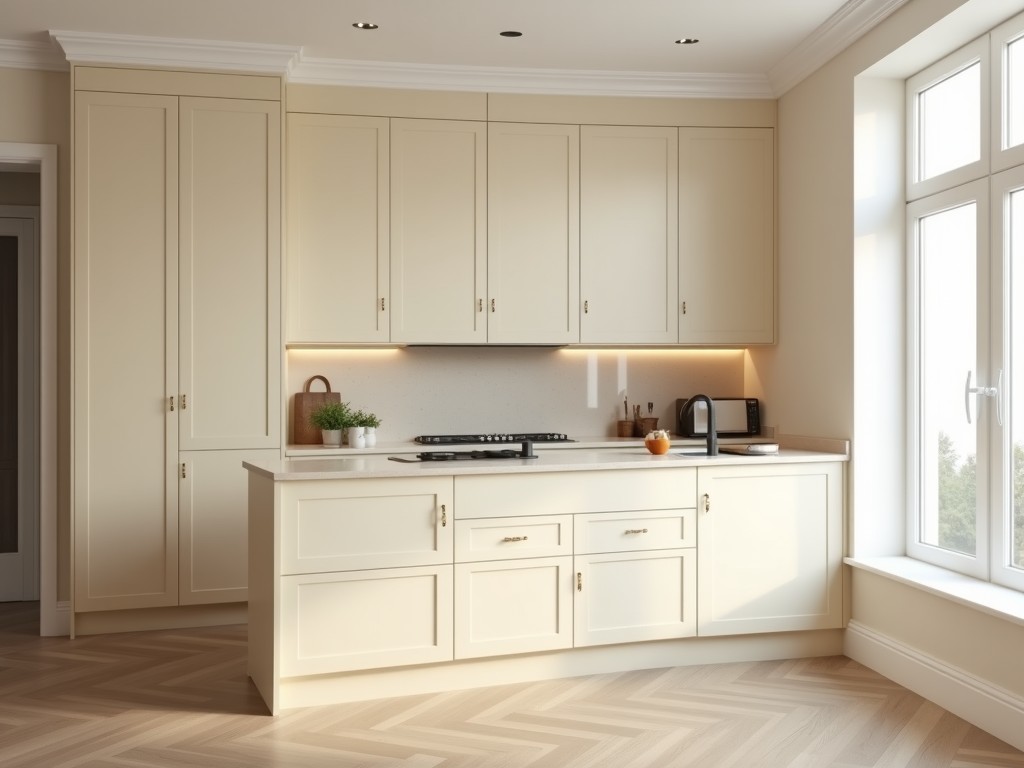
Wood Cream Kitchen Cabinets Manufacturer
Selecting kitchen cabinets requires evaluating material stability, finish durability, and manufacturing precision—especially for cream-toned wood surfaces where subtle variations in grain and color
- Category:
- Kitchen Cabinet
Wood Cream Kitchen Cabinets Manufacturer
Selecting kitchen cabinets requires evaluating material stability, finish durability, and manufacturing precision—especially for cream-toned wood surfaces where subtle variations in grain and color become visually prominent. This page details the technical considerations for specifying wood cream kitchen cabinets from an industrial manufacturing perspective, focusing on factors that influence long-term performance and aesthetic consistency in commercial and residential applications.
Material Selection for Cream-Toned Wood Cabinets
The visual consistency of cream-colored cabinets depends heavily on substrate choice and surface preparation. Commonly used materials include maple, birch, and poplar due to their fine, uniform grain structure and minimal natural pigment variation, which reduces the likelihood of blotching or uneven stain absorption. Medium-density fiberboard (MDF) with a wood veneer overlay is frequently selected for painted cream finishes because it eliminates grain telegraphing and provides a dimensionally stable base that resists warping under fluctuating humidity conditions.
For solid wood constructions, kiln-dried lumber with a moisture content stabilized between 6% and 8% is essential to prevent post-installation movement. Edge-glued panels are preferred over wide planks to minimize cupping and twisting, particularly in frameless cabinet designs where panel integrity directly affects door alignment and hinge performance over time.
Finish Systems and Color Control
Achieving a uniform cream finish requires precise control over pigment load, opacity, and application thickness. Water-based polyurethane or catalyzed lacquer systems are typically used for their low yellowing tendency and resistance to household cleaners. Pigment dispersion is monitored spectrophotometrically to maintain Delta-E values below 1.5 across batches, ensuring color consistency that meets commercial interior design tolerances.
Multiple thin coats—usually 2 to 3 mils per coat—are applied via automated spray lines to avoid orange peel or pooling in recessed areas. Sanding between coats with 220-grit abrasive removes dust nibs and promotes intercoat adhesion. Final topcoats often include UV stabilizers to mitigate fading in sun-exposed installations, a critical consideration for cabinets adjacent to windows or under skylights.
Manufacturing Tolerances and Joinery
Dimensional accuracy directly impacts installation efficiency and long-term functionality. Cabinet carcasses are typically built to ±0.5 mm tolerance on width, height, and depth to ensure seamless ganging in linear runs. Face-frame cabinets use mortise-and-tenon or pocket-hole joinery reinforced with wood glue and mechanical fasteners, while frameless (European-style) cabinets rely on dado, rabbet, and dowel joints with cam locks for alignment.
Door flatness is held to within 0.3 mm over a 300 mm span to prevent visible gaps when closed. Hinge boring is automated to maintain ±0.1 mm positional accuracy, ensuring consistent reveal and smooth operation. Drawer boxes are constructed with dovetail or lock-corner joints and fitted with full-extension soft-close slides rated for 30–50 kg dynamic load, tested to 50,000 cycles without sag or misalignment.
Quality Control and Inspection Protocol
Each production batch undergoes staged inspection to catch defects before value-added processing. Raw materials are checked for moisture content, grain straightness, and surface defects using calibrated moisture meters and visual grading against ASTM D4442 standards. Post-machining, panels are inspected for squareness, edge integrity, and dimensional accuracy using coordinate measuring tools.
Finish quality is evaluated under 5000K daylight simulation lamps at a 45-degree viewing angle. Inspectors check for orange peel, pinholes, color variation, and adhesion using cross-hatch tape tests (ASTM D3359). Final assemblies undergo function testing: door alignment, drawer glide smoothness, and hardware torque verification. Non-conforming items are segregated for rework or scrap based on defect severity and location.
Customization Options for Project-Specific Requirements
Industrial buyers often require adaptations beyond standard catalog offerings. Common customizations include:
- Adjustable shelf systems with pin-hole increments of 32 mm or European-style metal brackets
- Modified stile and rail widths to accommodate non-standard appliance cutouts
- Integrated lighting channels or power raceways routed within carcass panels
- Special edge profiles (e.g., eased, beveled, ogee) for frameless door designs
- Matching end panels, fillers, and toe kicks fabricated from the same material batch
Finish adjustments can include altering sheen levels (matte, satin, semi-gloss), adding glazes for depth, or incorporating distressing techniques for vintage aesthetics—all while maintaining traceable color records for future touch-ups or replacements.
Packaging and Logistics Considerations
To prevent damage during transit, cabinets are packaged using a combination of corner protectors, edge foam, and shrink-wrapped cartons. Interior surfaces are shielded with corrugated inserts or kraft paper to avoid marring from hardware or adjacent units. Palletized shipments use heat-treated lumber compliant with ISPM 15 standards for international export.
Flat-pack options are available for projects requiring on-site assembly, with pre-drilled cam-lock holes and labeled hardware kits to reduce field labor. Fully assembled units are secured with corner braces and stretch wrap to maintain racking resistance during handling. Each package includes a barcode label linking to a digital pack list containing SKU, dimensions, finish code, and quantity for seamless warehouse integration.
Typical Specifications Table
| Specification | Typical Value |
|---|---|
| Material Options | Solid hardwood (maple, birch), MDF with veneer, plywood core |
| Finish Type | Water-based polyurethane, catalyzed lacquer |
| Color Tolerance (Delta-E) | ≤1.5 (visually matched under 5000K light) |
| Dimensional Tolerance | ±0.5 mm (carcass), ±0.3 mm (door flatness) |
| Hardware Cycle Rating | Soft-close slides: 50,000 cycles; Hinges: 100,000 cycles |
| Moisture Content (Wood) | 6%–8% (kiln-dried, stabilized) |
| Packaging Standard | Corner protectors, edge foam, shrink wrap, ISPM 15 pallets |
For technical consultation, custom quoting, or sample requests, contact our engineering team to discuss your project’s material, finish, and dimensional requirements. We provide detailed submittals, shop drawings, and quality documentation to support procurement and installation workflows.



