Veneer Wood Kitchen Cabinets
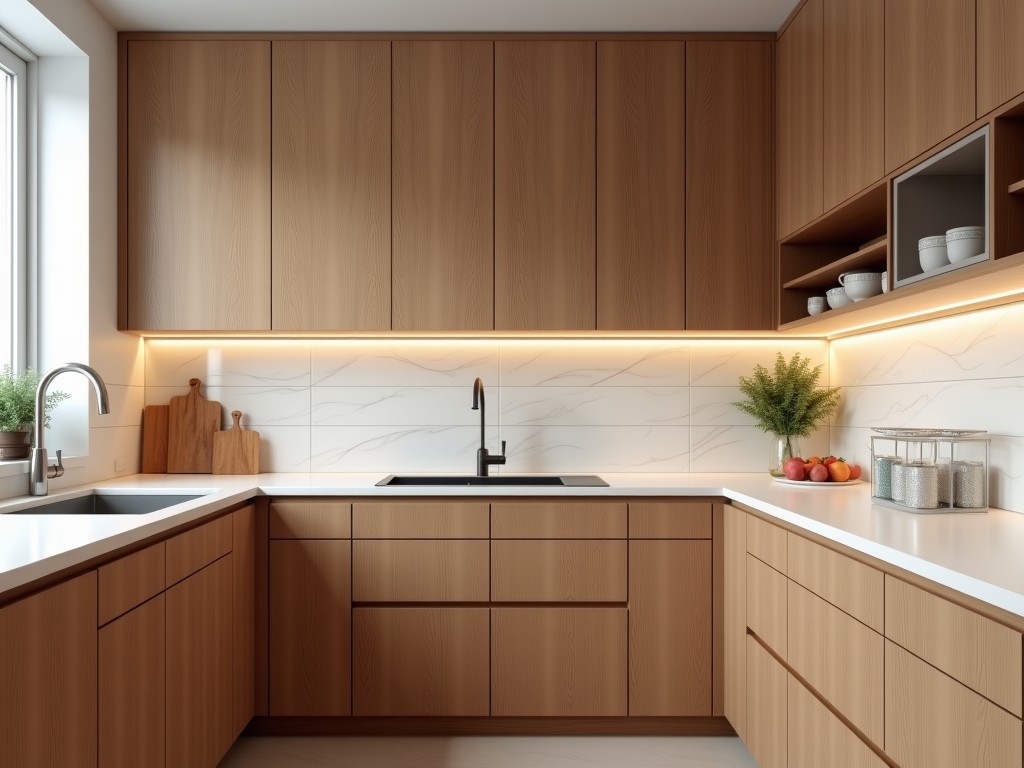
Veneer Wood Kitchen Cabinets
Veneer wood kitchen cabinets combine the visual appeal of natural wood grain with the dimensional stability and cost efficiency of engineered substrates. This construction method applies thin slices
- Category:
- Kitchen Cabinet
Veneer Wood Kitchen Cabinets
Veneer wood kitchen cabinets combine the visual appeal of natural wood grain with the dimensional stability and cost efficiency of engineered substrates. This construction method applies thin slices of real wood—typically 0.5 to 0.6 mm thick—onto core materials such as MDF, particleboard, or plywood, creating a surface that replicates solid wood aesthetics while minimizing movement, warping, and material waste.
Material Composition and Core Options
The performance of veneer cabinets depends significantly on the substrate beneath the veneer layer. Each core material offers distinct mechanical and environmental properties suited to different kitchen environments.
- MDF (Medium-Density Fiberboard): Provides a uniform, smooth surface ideal for thin veneer application; exhibits minimal telegraphing of grain or texture; density typically ranges from 600 to 800 kg/m³; offers excellent machinability for routed profiles and consistent screw holding.
- Particleboard: Cost-effective option with homogeneous structure; suitable for flat-panel designs where high screw retention is not critical; density usually between 450 and 650 kg/m³; requires edge sealing to prevent moisture ingress.
- Plywood: Constructed from cross-laminated wood veneers; delivers superior strength-to-weight ratio and resistance to delamination; common thicknesses include 12 mm, 15 mm, and 18 mm; preferred for humid environments or load-bearing applications.
Veneer Species and Surface Characteristics
The choice of wood veneer influences both appearance and long-term stability. Species are selected based on grain pattern, color consistency, and response to finishing processes.
| Veneer Species | Typical Grain Pattern | Color Stability (Indoor Use) | Common Applications |
|---|---|---|---|
| White Oak | Straight, prominent rays | Minimal yellowing; stable under UV | Modern, transitional kitchens |
| Walnut | Straight to wavy, coarse texture | Rich brown; deepens slightly with age | High-end residential designs |
| Maple | Fine, uniform; occasional birdseye or curl | Resists darkening; holds light finishes well | Scandinavian, minimalist styles |
| Ash | Bold, open grain; similar to oak | Light tan to gray; resistant to fading | Contemporary, industrial interiors |
| Cherry | Fine, straight grain; subtle figure | Deepens significantly over time; UV-sensitive | Traditional, warm-toned kitchens |
Adhesive and Pressing Technology
The bond between veneer and substrate is critical to long-term performance. Modern manufacturing uses heat-activated adhesives and precise pressing cycles to ensure durability under fluctuating humidity and temperature conditions.
Common adhesive types include:
- PVA (Polyvinyl Acetate): Water-based, low VOC, forms a flexible bond; suitable for interior dry environments; shear strength typically 15–25 MPa after curing.
- Contact Cement (Neoprene or SBR-based): Provides immediate handling strength; resists creep under load; often used for vertical surfaces and curved applications.
- UF (Urea-Formaldehyde) and MF (Melamine-Formaldehyde) Resins: Heat-cured; offer high rigidity and moisture resistance; require controlled pressing temperatures (120–140°C) and cure times (60–90 seconds per mm thickness).
Pressing is conducted in either cold or hot presses depending on adhesive type. Hot pressing activates thermosetting resins, ensuring full cure and eliminating voids. Pressure levels typically range from 8 to 12 bar, sufficient to achieve intimate contact without crushing the veneer or damaging the substrate.
Edge Treatment and Durability Considerations
Exposed edges are vulnerable to moisture absorption and mechanical damage. Proper edge treatment is essential to maintain appearance and structural integrity over the cabinet’s lifecycle.
Standard edge finishing methods include:
- Solid Wood Lipping: A strip of matching or complementary wood is applied to the edge, providing a seamless grain transition and impact resistance; typically 3–5 mm thick.
- Veneer Edge Banding: Pre-glued or raw veneer tape applied via hot-air or iron-on methods; thickness matches face veneer (0.5–0.6 mm); requires precise alignment and sealing.
- PVC or ABS Edge Banding: Synthetic alternative offering high moisture and impact resistance; available in wood-grain finishes; thickness usually 0.4–2.0 mm; applied with EVA-based hot-melt adhesives.
- Laser Edge Technology: Uses laser energy to activate a functional layer on pre-coated edge bands, creating a bond without visible adhesive; results in seamless, hygienic joints ideal for high-moisture zones.
All edges should be sealed with a compatible finish—such as polyurethane, lacquer, or UV-cured coating—to prevent moisture ingress. Edge sealing is particularly critical in zones near sinks, dishwashers, and steam-generating appliances.
Finishing Systems and Performance Coatings
The final coating protects the veneer surface from abrasion, moisture, and UV exposure while enhancing appearance. Industrial finishing systems are selected based on durability requirements, aesthetic goals, and regulatory compliance.
Common finishing options include:
- Polyurethane (PU) Coatings: Available in water-based or solvent-based formulations; provide excellent scratch and chemical resistance; typical dry film thickness: 35–50 microns; Shore D hardness: 75–85.
- Conversion Varnish (CV): Catalyzed finish offering high build and durability; resistant to household cleaners, alcohol, and heat; often used in premium cabinetry; solids content: 35–45%.
- UV-Cured Coatings: Instant curing under ultraviolet light; yields high hardness and clarity; low VOC emissions; film thickness: 20–30 microns; pencil hardness: 2H–4H.
- Melamine Lacquer: Cost-effective option for flat panels; provides moderate abrasion resistance; suitable for low-impact areas; requires careful application to avoid orange peel.
Finish selection should align with the expected wear environment. For example, cabinets adjacent to cooking zones benefit from higher chemical and heat resistance, while interior shelves may prioritize cost-effectiveness over extreme durability.
Dimensional Stability and Environmental Performance
One of the primary advantages of veneer over solid wood is reduced movement due to changes in relative humidity. The engineered substrate constrains the natural tendency of wood to expand and contract across the grain.
Typical dimensional change values:
- Veneer-faced MDF: Expansion/contraction: 0.02–0.04% per 10% RH change; minimal telegraphing of substrate movement.
- Veneer-faced Particleboard: Similar stability to MDF; edge sealing required to prevent localized swelling.
- Veneer-faced Plywood: Lower movement than solid wood due to cross-lamination; radial/tangential expansion reduced by 40–60% compared to solid sawn lumber.
These values assume proper edge sealing and finish application. Unsealed edges or damaged coatings can compromise stability by allowing moisture penetration into the substrate.
In controlled indoor environments (40–60% RH), veneer cabinets typically exhibit negligible visible movement over time. However, installations in unconditioned spaces or areas with frequent steam exposure require additional protective detailing.
Quality Control and Inspection Protocols
Consistent quality in veneer cabinets relies on standardized inspection at each production stage. Key control points include substrate flatness, veneer adhesion, edge integrity, and finish uniformity.
- Substrate Inspection: Flatness tolerance: ±0.5 mm over 1200 mm length; surface roughness (Ra) < 8 microns for optimal veneer bonding.
- Adhesion Testing: Cross-hatch test (ASTM D3359) minimum rating: 4B; no delamination after 24-hour water soak at 40°C.
- Thickness Verification: Total panel thickness variation: ±0.3 mm; face veneer thickness: 0.5–0.6 mm ±0.05 mm.
- Visual Inspection: Conducted under 5000K daylight simulation; acceptable defects: no blisters, bubbles, or gaps >0.5 mm; color variation within ΔE < 2.0 for matching sets.
- Finish Evaluation: Gloss uniformity: ±5 GU at 60° angle; dry-to-touch time < 30 minutes; full cure achieved in 7–14 days depending on coating type.
Packaging for shipment includes edge protection, corner boards, and moisture-barrier wrapping. Units are typically stacked horizontally on pallets with interleaving sheets to prevent surface abrasion during transit.
Applications in Kitchen Design
Veneer wood cabinets are selected when the aesthetic of natural wood is desired without the limitations of solid wood, such as cost, weight, or movement. They are particularly well-suited to specific kitchen environments and design approaches.
Ideal applications include:
- High-Humidity Zones: When paired with plywood substrates and sealed edges, veneer cabinets perform reliably near sinks and dishwashers, where solid wood might swell or joint gaps appear.
- Flat-Panel and Slab Styles: The uniform surface of MDF or particleboard substrates prevents telegraphing, allowing thin veneers to appear seamless—ideal for modern, handle-less designs.
- Cost-Sensitive Projects: Veneer reduces material usage by up to 90% compared to solid wood while preserving visual appeal, making it viable for large-scale residential or multi-unit developments.
- Custom Color Matching: Veneer allows consistent grain and tone across large surfaces, enabling architects and designers to match cabinetry to wall panels, doors, or furniture elements.
- Fire-Rated Assemblies: When combined with fire-retardant substrates (e.g., FR-MDF) and intumescent coatings, veneer cabinets can meet specific building code requirements for commercial kitchens or escape routes.
Conversely, solid wood may still be preferred for applications requiring exceptional impact resistance (e.g., butler’s pantries) or where repair and refinishing over decades is a priority. Veneer offers a balanced alternative where stability, consistency, and efficient resource use are valued.
Customization and Manufacturing Flexibility
Veneer cabinet systems support a wide range of dimensional, stylistic, and functional adaptations. Manufacturing processes are configured to accommodate project-specific requirements without compromising quality or lead time.
- Panel Dimensions: Standard widths: 150–600 mm in 50 mm increments; heights: 280–2200 mm; thicknesses: 12, 15, 16, 18, 22 mm ( substrate-dependent ). Custom sizes available upon request.
- Door and Drawer Profiles: Options include slab, shaker, raised panel, and ogee profiles; routed using CNC or spindle tooling; radius tolerances: ±0.2 mm.
- Hardware Integration: Pre-drilled for hinges, drawer runners, and handle systems; hole placement accuracy: ±0.5 mm; compatible with Blum, Hettich, Grass, and similar hardware lines.
- Accessories: Pull-out trays, corner carousels, vertical dividers, and internal lighting provisions can be incorporated during design phase.
- Finish Matching: Custom stains, glazes, or pigmented coatings can be formulated to match existing woodwork or architectural elements; requires sample approval and batch control.
Lead times are influenced by material availability, finish complexity, and order volume. Typical production cycles range from 10 to 25 working days after drawing approval and material confirmation. Expedited schedules are possible for standard configurations.
Sustainability and Material Efficiency
Veneer technology contributes to sustainable resource use by maximizing the yield from each log. A single cubic meter of timber can produce veneer for hundreds of square meters of panel surface, significantly reducing waste compared to solid lumber processing.
Additional sustainability factors include:
- Substrate Recycled Content: MDF and particleboard often incorporate post-consumer or industrial wood fibers; typical recycled content ranges from 10% to 30%, depending on regional supply chains.
- Low-Formaldehyde Adhesives: Available options meet CARB Phase 2, E0, or F★★★★ standards; critical for indoor air quality in residential installations.
- Energy-Efficient Pressing: Modern hot presses utilize heat recovery systems; specific energy consumption averages 0.8–1.2 kWh per square meter of panel produced.
- End-of-Life Options: While not typically recycled as a whole due to adhesive bonding, substrates can be processed for energy recovery or repurposed in non-structural applications where facilities exist.
Environmental product declarations (EPDs) and chain-of-custody certifications (e.g., FSC, PEFC) are available upon request for both veneer and substrate materials, supporting compliance with green building frameworks such as LEED, BREEAM, or WELL.
For project-specific consultations, including material selection, finish validation, or dimensional drawings, contact our technical team to discuss your requirements.



