Stainless Steel Kitchen Cabinets
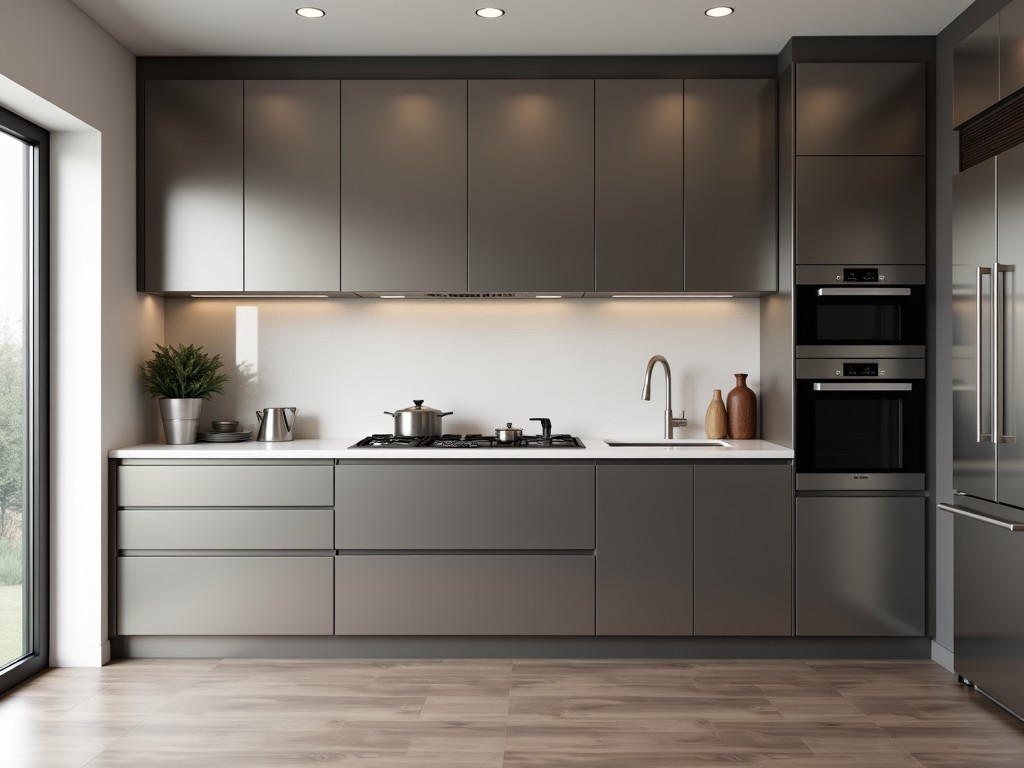
Stainless Steel Kitchen Cabinets
Stainless steel kitchen cabinets are engineered for environments requiring corrosion resistance, hygienic surfaces, and structural integrity under frequent cleaning and temperature fluctuations.
- Category:
- Kitchen Cabinet
Stainless Steel Kitchen Cabinets
Stainless steel kitchen cabinets are engineered for environments requiring corrosion resistance, hygienic surfaces, and structural integrity under frequent cleaning and temperature fluctuations. Unlike wood or laminate alternatives, they do not absorb moisture, support microbial growth, or degrade when exposed to acidic food residues or alkaline cleaning agents. Their non-porous finish meets food safety standards in commercial kitchens, laboratories, and pharmaceutical facilities where sanitation is critical.
The material base is typically austenitic grade 304 or 316 stainless steel, selected for its chromium-nickel alloy composition that forms a passive oxide layer preventing rust. Grade 304 offers sufficient resistance for most indoor food preparation areas, while grade 316 includes molybdenum for enhanced protection against chlorides found in salt, disinfectants, and coastal atmospheres. Cabinet frames and doors are constructed from 1.2mm to 2.0mm thick sheet metal, providing rigidity without excessive weight, and are joined using TIG welding or mechanical fastening to maintain surface continuity.
Surface finishes range from brushed No. 4 to mirror No. 8, each affecting both aesthetics and cleanability. Brushed finishes hide minor scratches and are standard in industrial kitchens, while mirror finishes are used in visible service areas requiring a clean, reflective appearance. All surfaces undergo passivation treatment post-fabrication to remove free iron and enhance the natural chromium oxide layer, ensuring long-term resistance to staining and pitting.
Engineering Characteristics
Load-bearing capacity is determined by panel thickness, reinforcement design, and mounting method. Wall-mounted cabinets typically support 40–60 kg per linear shelf meter when reinforced with internal brackets and secured to structural studs or concrete anchors. Base cabinets are designed to carry countertop loads exceeding 150 kg, with load distribution managed through full-height side panels and reinforced toe kicks. Deflection under load is limited to less than 2mm over 900mm span to prevent door misalignment.
Hinges and hardware are specified for cyclic durability, commonly rated for 50,000+ open/close cycles using 304 stainless steel components with nylon or PTFE bushings to prevent galling. Soft-close mechanisms incorporate hydraulic dampers sealed against moisture ingress. Handles are either integrated pull bars or recessed grips, fabricated from the same sheet metal as the door to eliminate crevices where contaminants can accumulate.
Thermal expansion is accommodated through floating panel designs and slotted mounting holes, allowing up to 1.5mm of movement per meter without stress buildup. This is critical in environments with steam cleaning or temperature cycling between -10°C and 80°C. Seams are continuously welded and ground smooth, then passivated to maintain a seamless, crevice-free surface that eliminates bacterial harborage points.
Material and Finish Options
| Property | Grade 304 | Grade 316 |
|---|---|---|
| Chromium Content | 18–20% | 16–18% |
| Nickel Content | 8–10.5% | 10–14% |
| Molybdenum Content | None | 2–3% |
| Pitting Resistance (PREN) | 18–20 | 24–26 |
| Typical Use Case | Indoor kitchens, dry processing | Marine, coastal, chemical washdown |
Surface finishes are defined by ASTM A480 standards. No. 4 brushed finish uses 120–180 grit abrasive belts, resulting in a unidirectional satin appearance with surface roughness Ra 0.4–0.8 μm. No. 8 mirror finish involves progressive polishing with finer abrasives and buffing compounds to achieve Ra <0.1 μm. Both finishes are passive and non-reactive, but No. 4 is preferred in high-abrasion zones due to its ability to mask wear patterns.
Customization and Integration
Cabinet dimensions are customized to match equipment layout, workflow clearance, and building constraints. Standard module widths increment in 150mm steps (300mm, 450mm, 600mm, 750mm, 900mm), but intermediate sizes are available upon request to accommodate uneven walls or appliance cutouts. Height is typically 720mm for base units and 300–400mm for wall units, adjusted to align with countertop thickness and ergonomic reach zones. Depth ranges from 500mm for wall cabinets to 600mm for base units, with options to reduce depth for aisle clearance in tight spaces.
Internal accessories include adjustable shelves, drawers with full-extension slides, and pull-out waste bins, all fabricated from stainless steel to maintain material consistency. Shelves are perforated or solid, with perforations sized to allow drainage while preventing small item loss. Drawers use ball-bearing slides rated for 40kg dynamic load, with front-mounted handles to avoid toe clearance issues. Integrated features such as towel bars, utensil rails, and lighting channels are welded or mechanically fastened during fabrication to avoid post-installation modifications.
Electrical and plumbing penetrations are pre-cut or formed during manufacturing based on client-provided schematics. Grommets and edge protection are added to prevent chafing of wires or tubes. Ventilation cutouts for range hoods or fan units are reinforced with flanged collars to maintain structural rigidity. All modifications are documented in shop drawings and validated against ASME BPE or 3-A Sanitary Standards where applicable.
Quality Control and Testing
Raw material inspection includes mill test certificates verifying chemical composition and mechanical properties of incoming coils. Thickness is validated using ultrasonic gauges at multiple points per sheet, with tolerance maintained within ±0.05mm. Surface finish is assessed visually and with profilometers to ensure Ra values match specification. Weld integrity is checked via dye penetrant testing on 10% of joints, focusing on heat-affected zones and root penetration.
Finished assemblies undergo functional testing: door alignment is verified using gap gauges (target <1.5mm variation), hinge operation is cycled 50 times to assess smoothness, and load tests are performed on shelves using calibrated weights. Final cleaning removes all particulates and oils using alkaline detergents and deionized water rinses, followed by air drying in controlled environments. Packaging uses corrugated dividers and corner protectors to prevent edge damage during transit, with units secured on pallets using stretch film and strapping.
Traceability is maintained through batch numbering on each cabinet, linking to material certificates, welding logs, and inspection records. This supports recall readiness and facilitates maintenance planning. While specific certifications vary by end-use, compliance with ISO 9001 for quality management and ISO 14001 for environmental practices is standard in manufacturing facilities serving food and pharmaceutical sectors.
Applications in Industrial Environments
In commercial kitchens, stainless steel cabinets provide a seamless interface with cooking equipment, resisting heat from nearby grills and steam from kettles. Their ability to withstand frequent washdowns with hot water and chemical sanitizers makes them ideal for food prep lines, pastry stations, and dish return areas where wood would swell or delaminate. The non-porous surface prevents absorption of oils, pigments, and allergens, supporting HACCP compliance by enabling effective cleaning verification.
Pharmaceutical and biotechnology labs use these cabinets for storing solvents, powders, and sterile components where off-gassing or particle shedding must be minimized. The inert nature of stainless steel ensures no interaction with sensitive compounds, and the smooth finish allows for effective vaporized hydrogen peroxide (VHP) decontamination. Wall-mounted units are often integrated into ISO Class 7 or 8 cleanrooms, with seams sealed to prevent particle accumulation.
Marine and offshore installations benefit from grade 316 construction, which resists pitting from salt spray and constant humidity. Cabinets in galley areas, wet labs, and medical facilities on vessels maintain structural integrity despite constant motion and condensation. Similarly, coastal food processing plants in tropical climates rely on molybdenum-enhanced grades to prevent rust formation where chlorine-based cleaners are used daily.
For technical specifications, customization requests, or project consultation, contact our engineering team to discuss material selection, dimensional tolerances, and integration requirements.
Request Technical Consultation


