Oem Premium Kitchen Cabinet Manufacturer Supply
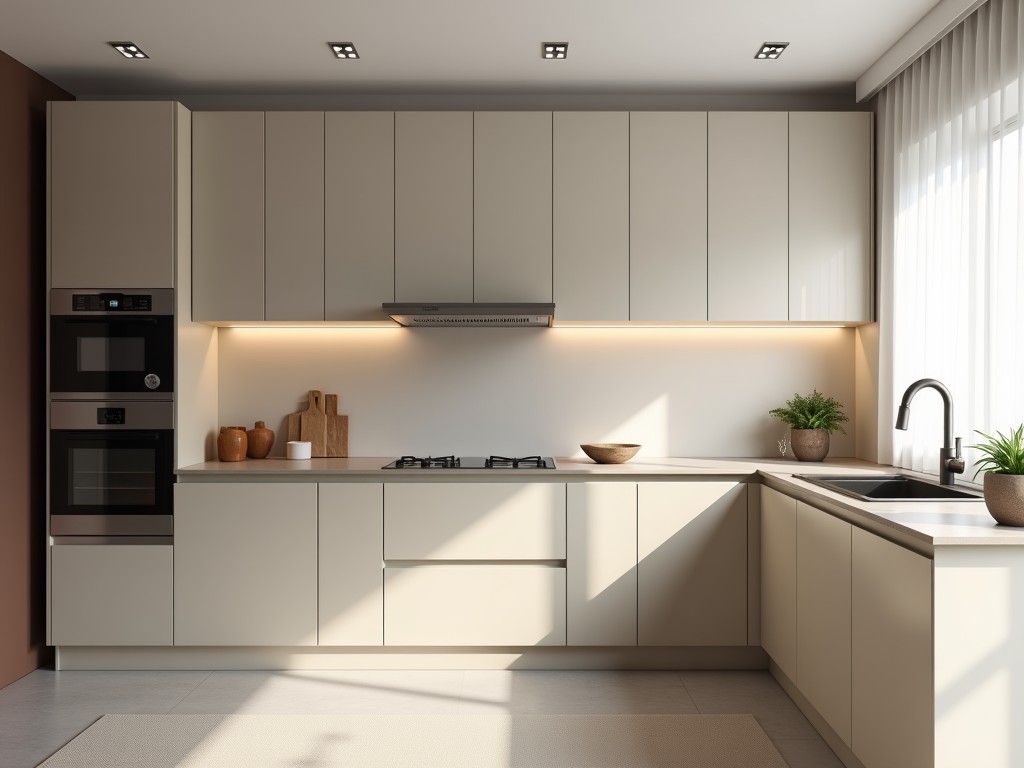
Oem Premium Kitchen Cabinet Manufacturer Supply
Cabinet carcass construction begins with substrate selection, where particleboard, MDF, and plywood each serve distinct performance profiles. 18mm European-grade particleboard with melamine facing
- Category:
- Kitchen Cabinet
OEM Premium Kitchen Cabinet Manufacturer Supply
Material Selection and Structural Integrity
Cabinet carcass construction begins with substrate selection, where particleboard, MDF, and plywood each serve distinct performance profiles. 18mm European-grade particleboard with melamine facing provides dimensional stability under 65% RH conditions and meets E1 formaldehyde emission standards, suitable for most residential applications. For high-moisture zones like sink bases, 12mm marine-grade plywood with phenolic backing resists delamination after 24-hour water soak tests per ASTM D1037. Frame-and-panel doors utilize 5-piece construction with 3mm solid wood stiles and rails joined via cope-and-stick joinery, minimizing seasonal movement compared to slab designs. All substrates undergo vacuum pressing at 0.8 MPa for 45 seconds to ensure adhesive bond strength exceeding 1.2 MPa, critical for long-term joint integrity under cyclic loading.
Hardware and Functional Systems
Blumotion soft-close hinges incorporate hydraulic damping with 0.5-second closing delay, tested to 80,000 cycles without performance degradation per EN 15570. Drawer systems use concealed full-extension slides with 35kg dynamic load capacity, featuring anti-rebound mechanisms that limit bounce to <2mm after full extension. Adjustable shelving employs 5mm diameter steel pins with nylon inserts, allowing 25mm vertical increments while supporting 15kg per shelf without sag. Pull-out pantry units integrate synchronized roller mechanisms with 0.3mm lateral tolerance, ensuring smooth operation even when loaded to 60kg. All hardware undergoes salt spray testing (ASTM B117) for 240 hours to verify corrosion resistance in coastal environments.
Surface Finishing and Durability
Thermofoil finishes apply 0.18mm PVC film via vacuum forming at 130°C, creating a seamless edge bond that resists delamination during 72-hour humidity cycling tests. High-pressure laminate (HPL) surfaces use 0.7mm thick decorative layers impregnated with melamine resin, achieving Taber abrasion resistance of >400 cycles before wear-through. UV-cured acrylic coatings on flat-panel doors provide 90% gloss retention after 500 hours of Xenon arc exposure (ASTM G155), outperforming conventional polyurethane in color stability. Edge banding uses 0.5mm thick ABS with laser etching precision, maintaining seal integrity after 1000 thermal shock cycles between -20°C and 70°C. All finishes undergo cross-hatch adhesion testing (ASTM D3359) requiring minimum 4B rating to prevent premature peeling.
Customization and Dimensional Flexibility
Standard base cabinets accommodate 34.5mm countertop overhang with 4.5mm toe kick clearance, adjustable via removable plastic clips. Wall cabinets offer 300mm, 350mm, and 400mm depth options to align with varying ceiling heights and appliance protrusions. Corner solutions include blind corner units with 90° swing-out trays (requiring 450mm minimum clearance) and diagonal lazy Susans with 700mm diameter rotating shelves. Interior accessories such as spice racks, cutlery dividers, and tray organizers are designed as modular inserts with 3mm tolerance slots, enabling field installation without tools. All custom dimensions are calculated using CNC nesting software that optimizes sheet utilization to >85% while maintaining 0.1mm positional accuracy.
Quality Control and Testing Protocols
Incoming raw material inspection includes moisture content verification via capacitance meters (target: 6-8% for wood substrates) and thickness gauging with ±0.01mm accuracy. During assembly, each cabinet undergoes racking resistance testing where diagonal displacement is measured under 150N lateral load; acceptable deviation is <1.5mm. Finish quality is assessed under 500 lux D65 lighting using spectrophotometers to confirm ΔE<1.5 color matching across batches. Final random audits perform 10,000-cycle operation tests on doors and drawers, logging any binding, squeaking, or misalignment. Non-conforming units are segregated and traced to specific process steps using barcode-linked production logs, enabling root cause analysis within 24 hours.
Packaging and Logistics Optimization
Flat-pack configuration uses 7mm triple-wall corrugated cartons with edge protectors, reducing volume by 60% compared to pre-assembled units. Each carton includes corner braces made from recycled HDPE, capable of withstanding 500N compressive force during stacking. Internal stabilization employs die-cut foam inserts that immobilize panels and hardware, limiting vibration transmission to <0.3g during transit. Labeling incorporates QR codes linking to assembly instructions and material safety data sheets (MSDS), accessible via smartphone. Export packaging complies with ISPM 15 standards for wood packaging materials, with all pallets heat-treated to 56°C core temperature for 30 minutes.
Applications Across Residential and Light Commercial Projects
Multi-family developments benefit from standardized cabinet modules that reduce on-site variation, allowing trade crews to install units at 2.3 units per person-hour versus 1.7 for custom-built alternatives. Senior living facilities specify 450mm high base cabinets with 100mm toe clearance to accommodate wheelchair access, paired with pull-out shelves requiring <5N actuation force. Healthcare environments specify seamless edges and non-porous surfaces to meet infection control protocols, utilizing thermofoil or solid acrylic finishes with zero grout lines. Retail kitchens in convenience stores opt for 600mm wide base cabinets with integrated power channels, enabling rapid reconfiguration of service lines without electrical rewiring. Each application leverages specific dimensional, material, or hardware adaptations rather than generic suitability claims.
Comparison of Common Cabinet Construction Methods
| Feature | Frame-and-Panel | Slab Door | Thermofoil Wrap |
|---|---|---|---|
| Substrate Movement | Low (jointed construction) | High (monolithic panel) | Medium (film over substrate) |
| Edge Durability | High (solid wood edge) | Medium (exposed core) | High (seamless film) |
| Refinish Potential | Yes (sanding possible) | Limited (surface only) | No (film cannot be stripped) |
| Typical Lead Time | 4-5 weeks | 3-4 weeks | 3-4 weeks |
Environmental and Regulatory Compliance
All composite panels carry CARB Phase 2 and TSCA Title VI certification, verified through quarterly third-party testing of formaldehyde emissions. Wood sourcing follows FSC-controlled standards, with chain-of-custody documentation available for projects requiring LEED v4.1 MR credit contribution. Finishing systems are VOC-compliant under SCAQMD Rule 1113, with water-based alternatives available for projects demanding <50g/L emissions. Recycling programs accept end-of-life units for material separation, achieving 85% diversion from landfill through particleboard reprocessing and metal hardware recovery. Compliance documentation is provided with each shipment, including material declarations and test reports upon request.
Ordering Process and Lead Time Management
Quotation requires submission of cabinet schedules in Excel or CSV format, including item codes, dimensions, quantities, and finish specifications. Upon receipt, engineering review validates dimensional compatibility with appliances and architectural constraints within 2 business days. Approved drawings are generated in PDF and DXF formats for client confirmation before production release. Standard lead time is 25-30 days from drawing approval to ex-factory, with expedited options available for critical path items at +15% cost. Changes after production commencement incur restocking fees based on material state: 20% for cut panels, 50% for assembled units. Progress updates are provided via automated email at cutting, assembly, and packaging stages.
Technical Support and Documentation
Installation manuals include exploded views with torque specifications for cam locks (12-15N·m) and confirmation screws (3.5x15mm, #2 Phillips). Troubleshooting guides address common field issues such as door misalignment (corrected via hinge adjustment screws) and drawer binding (resolved by checking slide parallelism within 0.5mm). Spare parts lists identify interchangeable hardware components by OEM part number, enabling local sourcing of hinges, slides, and shelf pins. Warranty coverage extends 5 years on hinges and slides, 2 years on finish adhesion, subject to proper installation and environmental conditions. Technical inquiries are routed to application engineers with average response time under 4 hours during business hours.
Next Steps for Project Integration
Begin the procurement process by preparing a detailed cabinet schedule that specifies room locations, appliance clearances, and accessibility requirements. Include elevation drawings showing upper and lower cabinet alignments to validate reach zones and countertop workflows. Submit these documents through our project inquiry form to initiate engineering review and quotation preparation. Our technical team will assess compatibility with your specified appliances, ventilation systems, and electrical layouts to prevent costly field modifications. This structured approach ensures that the supplied cabinets meet functional, dimensional, and performance expectations from day one of installation.
For projects requiring physical validation, we offer sample doors and drawer fronts in your selected finish and material, shipped via courier within 5-7 business days. Samples include full-size sections showing edge treatment, surface texture, and color consistency, allowing side-by-side comparison with existing materials or competitor products. Upon sample approval, we proceed to final drawing preparation and production scheduling. This step minimizes the risk of aesthetic mismatches in large-scale installations where visual continuity is critical.
To discuss your specific project requirements, material options, or customization possibilities, contact our technical sales team. Provide your project timeline, approximate cabinet count, and any known constraints such as ceiling heights, door swings, or utility penetrations. Our engineers will respond with feasibility feedback, alternative solutions, and a detailed quotation within one business day. We specialize in supporting OEMs, contractors, and distributors who require precise, repeatable cabinet solutions that integrate seamlessly into broader construction schedules.