Natural Wood Navy Blue Kitchen Cabinets
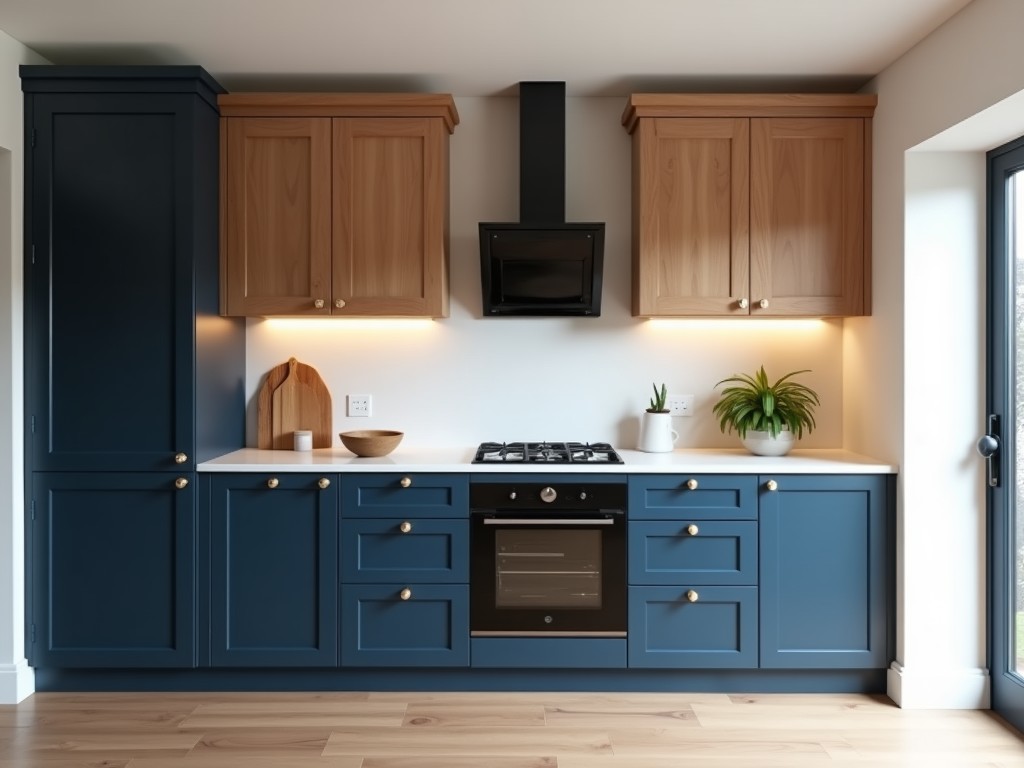
Natural Wood Navy Blue Kitchen Cabinets
Navy blue kitchen cabinets made from natural wood combine the structural integrity of solid timber with a durable, moisture-resistant finish suitable for commercial and residential kitchens. The
- Category:
- Kitchen Cabinet
Natural Wood Navy Blue Kitchen Cabinets
Navy blue kitchen cabinets made from natural wood combine the structural integrity of solid timber with a durable, moisture-resistant finish suitable for commercial and residential kitchens. The color is achieved through a multi-layer coating system applied to carefully selected wood substrates, ensuring consistent appearance and long-term stability under varying humidity and temperature conditions.
Material Composition and Substrate Options
The core material for these cabinets is typically hardwood such as maple, birch, or oak, selected for its uniform grain, minimal knot frequency, and dimensional stability. These species exhibit specific mechanical properties: maple has a Janka hardness of approximately 1450 lbf, birch around 1260 lbf, and white oak about 1360 lbf, providing resistance to dents and wear in high-traffic environments. Substrate thickness ranges from 18mm to 22mm for door panels and 15mm to 18mm for carcass components, depending on load requirements.
Alternative substrates include engineered wood products like MDF with a hardwood veneer face or plywood with cross-banded layers for enhanced stability. MDF offers a smooth, uniform surface ideal for paint adhesion, while plywood provides superior screw holding strength and resistance to warping. All substrates are conditioned to 6–8% moisture content before finishing to minimize post-installation movement.
Finishing System and Color Performance
The navy blue finish is a catalyzed polyurethane or UV-cured acrylic system applied in multiple stages: sanding sealer, base coat, color layer, and topcoat. Each layer is cured under controlled temperature and humidity to ensure full cross-linking. The total dry film thickness ranges from 80 to 120 microns, providing adequate barrier protection against moisture, steam, and cleaning agents.
Color consistency is maintained using spectrophotometric measurement with a Delta E value of less than 1.5 between batches, ensuring visual uniformity across cabinets supplied for the same project. The finish exhibits a gloss level of 20–30% (satin) or 70–85% (semi-gloss), measured at 60 degrees, balancing aesthetics with practical hide of surface imperfections. Accelerated weathering tests (QUV or Xenon arc) show no significant fading or chalking after 500 hours of exposure.
Construction and Joinery Methods
Cabinet bodies are assembled using a combination of mechanical fasteners and adhesive bonds. Cam locks, confirmat screws, or dowel joints are used for carcass assembly, providing tensile strength exceeding 800 N per joint in shear tests. Door frames utilize mortise-and-tenon or cope-and-stick joinery for frame-and-panel designs, while slab doors rely on edge banding with PVC, ABS, or wood veneer matched to the substrate.
Adjustable shelving is supported by metal pins or plastic shelf rests inserted into pre-drilled 5mm holes, allowing vertical adjustment in 32mm increments. Back panels are typically 3mm HDF or plywood, secured with staples or nails into a dado groove, contributing to lateral stability. All edges are sealed with edge banding or finish to prevent moisture ingress.
Hardware Integration and Functional Specifications
Hinges are concealed, soft-close types with 3-way adjustment (depth, side, height), capable of supporting doors up to 24kg and enduring 50,000 cycles. Drawer slides are full-extension, ball-bearing mechanisms with dynamic load ratings of 30kg or 50kg, depending on application, and feature soft-close or push-to-open options. All hardware is pre-drilled and installed using CNC-guided systems to ensure alignment within ±0.5mm tolerance.
Interior accessories such as pull-out trays, lazy Susans, or spice racks are available as modular additions, mounted to the carcass using standardized mounting plates. These components are designed to maintain full accessibility without compromising structural integrity. Load testing confirms that installed accessories do not exceed the safe working load of the cabinet frame under normal use conditions.
Environmental and Safety Compliance
The finishing system complies with REACH and CARB Phase 2 regulations for volatile organic compound (VOC) emissions, with cured coatings emitting less than 0.05 mg/m³ of formaldehyde. Substrates are sourced from FSC-certified or PEFC-controlled forests, with chain-of-custody documentation available upon request. The product does not contain added urea-formaldehyde resins in the core material when using solid wood or low-emission MDF.
Surface hardness of the finished coating exceeds 2H on the pencil hardness scale, resisting scratches from normal kitchen utensils. Impact resistance is tested via falling ball method (ASTM D2794), with no cracking or delamination observed at 50 inch-pounds of impact energy. The finish is also resistant to common household chemicals including ethanol, ammonia, and sodium hydroxide solutions at 10% concentration for 24 hours without visible damage.
Customization and Dimensional Flexibility
Cabinet dimensions are fully customizable to suit project-specific layouts. Standard base cabinet height is 720mm (including legs), wall cabinets range from 300mm to 900mm in height, and tall units extend up to 2400mm. Depth options include 300mm for wall cabinets, 600mm for base units, and 300–600mm for tall cabinets, with adjustments possible in 10mm increments. All dimensions are subject to structural validation for spans exceeding 900mm without intermediate support.
Door and drawer front profiles can be customized: slab, shaker, raised panel, or inset styles are available, each requiring specific substrate preparation and machining. Edge treatments include square, beveled, or radius profiles, with matching edge banding applied to all exposed surfaces. Interior finishes can be specified as matching exterior or in a contrasting neutral tone (e.g., white, gray) for brightness.
Quality Control and Inspection Protocol
Each cabinet undergoes a multi-stage inspection process. Incoming material is checked for moisture content, grain orientation, and surface defects. During production, dimensions are verified at critical stages using calipers and templates, with tolerances maintained within ±1mm for visible surfaces and ±2mm for non-critical areas. Finish quality is assessed under 500 lux daylight simulation lighting for color uniformity, gloss consistency, and absence of runs, sags, or orange peel.
Functional testing includes door alignment (gap uniformity <1.5mm), drawer smoothness (no binding or racking over full extension), and hardware torque validation. Final inspection confirms correct hardware installation, accessory inclusion, and packaging integrity. AQL (Acceptable Quality Level) standards are applied, with Level II sampling for major defects and Level I for minor defects.
Packaging and Logistics
Cabinets are packaged in a knock-down (KD) or pre-assembled configuration based on project requirements and shipping distance. KD units are packed in 5mm corrugated cardboard boxes with corner protectors, edge guards, and internal dividers to prevent movement. Each box includes a packing list, installation manual, and hardware kit labeled by cabinet code. Pre-assembled units are wrapped in stretch film, placed on pallets, and secured with straps and corner boards.
Export shipments comply with ISPM 15 standards for wood packaging, using heat-treated or fumigated pallets. Moisture barrier desiccants are included in tropical climates to prevent condensation damage during transit. Stacking height is limited to 1.5 meters for KD packs and 1.0 meter for assembled units to avoid deformation. All packages are labeled with handling symbols: “Keep Dry,” “This Side Up,” and “Fragile – Handle With Care.”
| Parameter | Typical Value | Notes |
|---|---|---|
| Substrate Moisture Content | 6–8% | Measured at time of finishing |
| Finish Dry Film Thickness | 80–120 microns | Total cured coating |
| Color Consistency (Delta E) | <1.5 | Between batches, D65 lighting |
| Door Weight Capacity (Hinge) | Up to 24kg | Per pair, 50,000 cycles |
| Drawer Dynamic Load | 30–50kg | Ball-bearing slides, full extension |
| Surface Hardness | 2H+ (pencil) | Scratch resistance |
| Formaldehyde Emission | <0.05 mg/m³ | CARB Phase 2 compliant |
Natural wood navy blue kitchen cabinets offer a balance of material performance, finish durability, and design flexibility suitable for institutional, hospitality, and high-end residential projects. The use of stable substrates, proven finishing systems, and precision manufacturing ensures long-term functionality in demanding environments. Technical specifications are available for review to support project planning and compliance verification.
For technical inquiries, customization requests, or project-specific quotations, contact our engineering team to discuss substrate selection, finish options, dimensional requirements, and logistics support. Provide project dimensions, desired layout, and any regulatory constraints to receive a detailed feasibility assessment and lead time estimate.
Request Technical Consultation


