Minimalist Cream Style Kitchen Cabinets
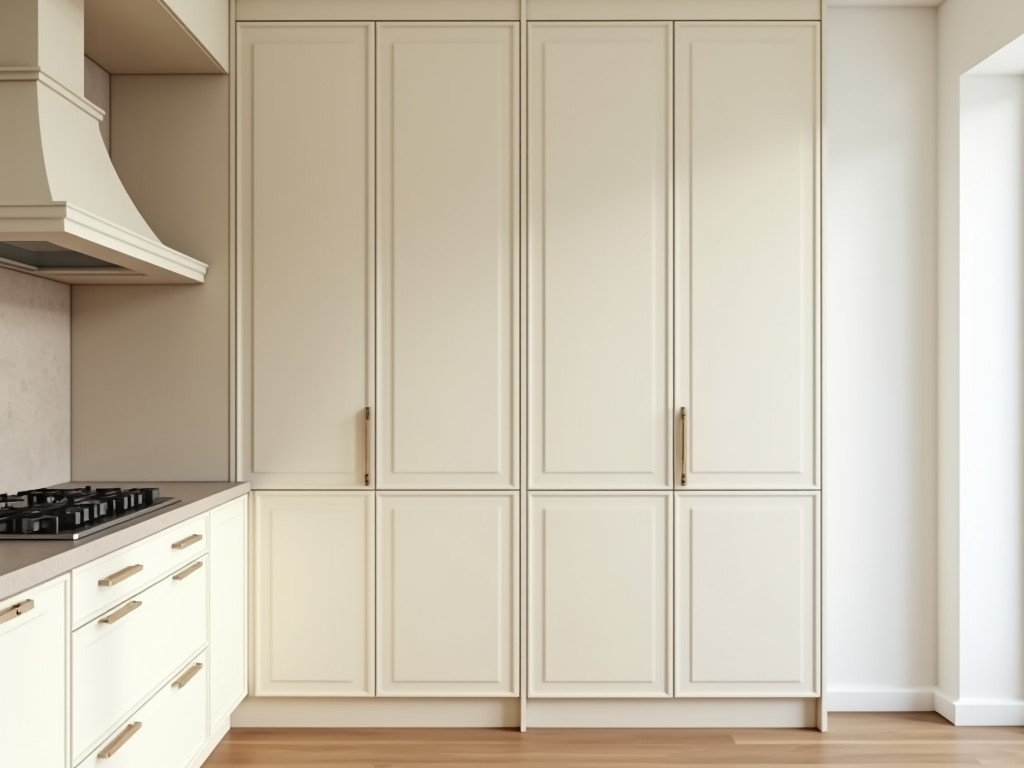
Minimalist Cream Style Kitchen Cabinets
Minimalist cream style kitchen cabinets represent a design approach that combines neutral color palettes with clean lines and reduced visual complexity. The cream finish typically falls within the
- Category:
- Kitchen Cabinet
Minimalist Cream Style Kitchen Cabinets
Minimalist cream style kitchen cabinets represent a design approach that combines neutral color palettes with clean lines and reduced visual complexity. The cream finish typically falls within the L*a*b* color space range of L=85-92, a=-2 to 2, b=8 to 15, providing a warm neutral that avoids yellow undertones while maintaining brightness. This specific tonal range ensures compatibility with both cool and warm accent materials commonly used in commercial kitchen environments.
The minimalist aspect focuses on eliminating decorative elements such as raised panels, moldings, or excessive hardware. Door styles commonly include slab (flat panel) or shallow recessed panels with reveals under 3mm. Frame construction typically uses 19mm thick engineered wood substrates with edge banding applied to all exposed surfaces. This approach reduces dust accumulation points and simplifies cleaning protocols in high-hygiene environments.
Surface finishes for cream cabinets in industrial applications commonly utilize UV-cured polyurethane or acrylic lacquers with gloss levels between 15-25 GU (measured at 60° angle). These finishes provide sufficient durability for repeated cleaning with neutral pH detergents while maintaining color stability under LED lighting spectra (4000K-5000K). Edge sealing is critical to prevent moisture ingress at substrate joints, particularly in areas adjacent to sinks or steam-generating equipment.
Material Selection and Substrate Performance
Substrate selection directly impacts long-term dimensional stability and resistance to environmental stressors in kitchen applications. Common options include moisture-resistant MDF (MR-MDF) with density 650-750 kg/m³, particleboard with melamine facing, or plywood with phenolic backing. MR-MDF is frequently specified for painted finishes due to its uniform surface and minimal telegraphing of grain patterns through the coating.
For environments with frequent temperature fluctuations or humidity cycling (such as commercial kitchens with HVAC limitations), plywood substrates with cross-banded construction offer superior resistance to warping. Birch or poplar plywood with 3-5 plies and phenolic resin adhesive provides edge screw holding strength exceeding 1200N while maintaining minimal creep under sustained load. Edge sealing with polyurethane hot-melt adhesive achieves water vapor transmission rates below 5 g/m²/24h.
When specifying cream finishes, substrate surface roughness (Ra) must be controlled below 0.8μm prior to coating application to prevent telegraphing imperfections. Primer systems typically consist of sandable polyester or urethane-based formulations with solids content 55-65% by volume. Topcoat application requires viscosity control between 25-35 seconds (Ford #4 cup) to ensure proper film formation and leveling.
Dimensional Standards and Modularity
Modular cabinet systems for minimalist cream styles typically follow 300mm increments for width, with standard heights of 720mm (base), 360mm (wall), and 900mm (tall units). Depth dimensions are standardized at 560mm for base cabinets and 320mm for wall units to accommodate standard appliance clearances and ergonomic reach zones. These dimensions align with ISO 28802:2012 guidelines for kitchen workspace layout.
Tolerance control is critical for maintaining the minimalist aesthetic. Door and drawer front gaps are typically maintained at 2mm ±0.5mm for consistent reveal lines. Cabinet carcass squareness is held to <1mm deviation over 1m diagonal measurement. These tolerances require CNC machining with positioning accuracy ±0.1mm and regular tool wear monitoring to prevent cumulative errors in high-volume production.
Adjustable shelving systems use 5mm diameter holes drilled at 32mm intervals (European system) with shelf pins capable of supporting 25kg point load per pin. Full-extension soft-close drawer runners are rated for 30-40kg dynamic load with 50,000 cycle endurance. Hinge selection for overlay doors commonly uses 110° opening angle with 3-way adjustment (±2mm lateral, ±1mm depth, ±1.5mm height) to maintain alignment over time.
Surface Finish Durability and Maintenance
Cream finish durability is evaluated through standardized testing protocols. Cross-hatch adhesion testing (ASTM D3359) typically shows 5B rating (no peeling) after 24-hour cure. Pencil hardness reaches 2H-3H for UV-cured acrylics. Chemical resistance testing with 10% citric acid, 5% vinegar, and common kitchen detergents shows no visible change after 24-hour exposure at 23°C.
Abrasion resistance is measured using Taber Abraser (CS-10 wheels, 500g load, 1000 cycles) with weight loss typically <15mg for high-performance coatings. This ensures the finish withstands routine cleaning with microfiber cloths and non-abrasive cleaners. UV stability testing (ASTM G154, UVA-340 lamps, 8 hours UV/4 hours condensation at 50°C) shows ΔE<2 after 200 hours, indicating minimal color shift under prolonged LED exposure.
Maintenance protocols recommend cleaning with pH-neutral solutions (pH 6-8) and microfiber cloths. Avoidance of abrasive pads, solvent-based cleaners, or excessive moisture prevents premature finish degradation. For touch-up applications, UV-curable repair kits matched to the original batch number are recommended to maintain color and gloss consistency. Field repairs should be conducted in controlled dust-free environments to prevent particulate embedding.
Installation Considerations and Field Adjustments
Proper installation is essential to maintain the minimalist appearance and functional integrity of cream cabinets. Wall cabinets require secure fastening to structural studs or reinforced backing with minimum 25mm penetration depth. Load calculations should account for 40kg/m² uniform distributed load plus concentrated loads from appliances. Shim materials must be non-compressible (e.g., PVC or HDPE) to prevent long-term settling.
Base cabinets require level installation within 3mm over 2m length to ensure proper door alignment and countertop support. Adjustable legs (typically 100-150mm range) accommodate floor unevenness while maintaining toe-kick clearance. Countertop overhangs should be limited to 25mm unsupported length for stone or quartz materials to prevent sagging under load.
Field adjustments are facilitated through European-style hinges and drawer runners. Door alignment requires checking reveal consistency at top, bottom, and sides. Hinge adjustments should be made in small increments (0.5mm turns) to avoid over-correction. After installation, a 24-hour settling period is recommended before final adjustment to allow for any minor substrate relaxation.
Typical Specifications
| Parameter | Typical Value | Notes |
|---|---|---|
| Door Thickness | 18-19mm | Substrate + finish |
| Finish Gloss (60°) | 15-25 GU | Matte to low-sheen |
| Edge Sealing | PU hot-melt | Water vapor transmission <5 g/m²/24h |
| Shelf Load Capacity | 25kg/pin | 5mm pin, 32mm spacing |
| Drawer Dynamic Load | 30-40kg | Full-extension, soft-close |
| Hinge Adjustment Range | ±2mm lateral | ±1mm depth, ±1.5mm height |
| Color Stability (ΔE) | <2 after 200h UV | ASTM G154, UVA-340 |
Customization Options
While the minimalist cream style emphasizes consistency, certain parameters can be adapted to project-specific requirements without compromising the core aesthetic. Door styles can be modified between true slab, shallow recessed panel (2-3mm depth), or integrated handle designs where the grip is routed into the top or bottom edge. These variations maintain the clean line appearance while offering functional differences in handling and cleaning.
Interior configurations can be adjusted to accommodate specific storage needs. Options include pull-out waste bins (15-40L capacity), spice pull-outs (100-150mm width), appliance garages with tambour doors, or customized drawer layouts for utensils, cutlery, or bulk items. Interior finishes typically match the exterior cream or use a complementary light gray (L=70-75) for reduced visual contrast.
Hardware selection influences both function and appearance. While minimalist designs often favor integrated handles or touch-latch systems, optional hardware includes slim-profile pulls (128-160mm centers), cylindrical knobs (25-30mm diameter), or recessed edge grips. All hardware must be compatible with the 2mm reveal standard and constructed from corrosion-resistant materials (e.g., zinc alloy with nickel plating or stainless steel) for kitchen environments.
Quality Control and Testing
Quality assurance begins with incoming material inspection. Substrate moisture content is verified at 4-8% for MDF and 6-10% for plywood using pin-type or capacitance meters. Surface roughness is measured with profilometers to ensure Ra<0.8μm before coating. Primer and topcoat viscosity, solids content, and pH are checked batch-to-batch using calibrated Zahn cups and spectrophotometers.
In-process checks include coating thickness measurement (wet film gauges and dry film DFT meters targeting 40-60μm total), flash-off time verification, and UV lamp intensity monitoring (mW/cm² sensors). Post-cure inspection involves 10x magnification visual checks for defects (pinholes, bubbles, dust nibs) and gloss uniformity assessment across multiple angles (20°, 60°, 85°).
Finished goods undergo functional testing: door alignment (gap consistency <0.5mm variation), drawer smoothness (pull force <15N initiation, <8N sustained), hinge cycle testing (25,000 open/close cycles), and load testing (shelves to 110% rated capacity for 24 hours). Random sampling includes adhesion (cross-hatch), hardness (pencil), and chemical resistance (spot testing with common agents). Final random audits verify dimensions, squareness, and surface finish before packaging.
For project-specific consultations regarding minimalist cream style kitchen cabinets, including technical drawings, material samples, or detailed specification sheets, please contact our technical team. We provide engineering support for layout optimization, substrate selection based on environmental conditions, and finish compatibility with adjacent materials. Accurate quotations require detailed dimensions, layout plans, and any specific regulatory or hygiene requirements applicable to your installation environment.
To initiate a discussion or request technical documentation, visit our contact page or reach out directly to our specification department.
Contact Technical Team


