Mdf Lacquer Kitchen Cabinets Factory
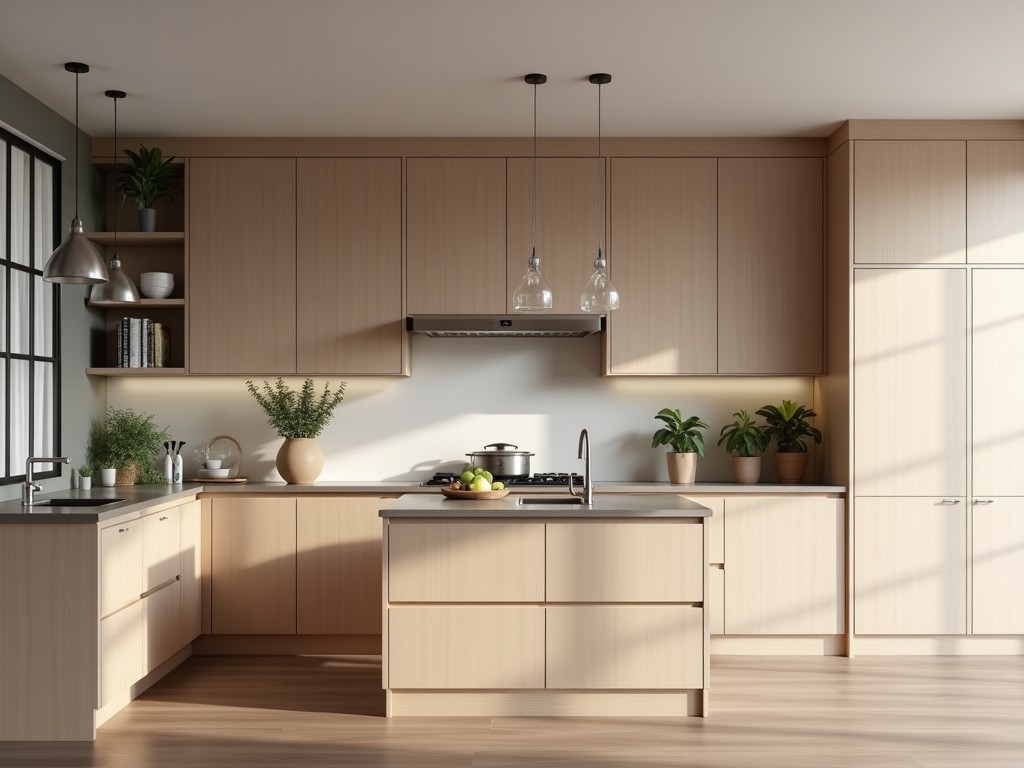
Mdf Lacquer Kitchen Cabinets Factory
Medium-density fiberboard (MDF) with a lacquer finish is a common substrate for kitchen cabinet doors and panels in industrial production. The material consists of wood fibers bonded with synthetic
- Category:
- Kitchen Cabinet
MDF Lacquer Kitchen Cabinets Factory
Medium-density fiberboard (MDF) with a lacquer finish is a common substrate for kitchen cabinet doors and panels in industrial production. The material consists of wood fibers bonded with synthetic resin under heat and pressure, providing a uniform, stable core free of knots or grain variation. Lacquer coating is applied in multiple thin layers, typically via spray or curtain coater, then cured under UV or thermal conditions to form a hard, seamless surface. This combination yields a substrate suitable for high-volume manufacturing where dimensional consistency and surface finish are critical.
Material Composition and Stability
Industrial MDF used for lacquer cabinets typically has a density between 650–800 kg/m³, measured per EN 622 standards. This range balances machinability with resistance to sagging in long spans, such as wall cabinets exceeding 800 mm in width. Lower density boards (<600 kg/m³) are prone to edge crushing during handling, while higher densities (>850 kg/m³) increase tool wear and machining time without proportional gain in stability. Resin content is generally 8–12% by weight, using urea-formaldehyde (UF) or melamine-urea-formaldehyde (MUF) binders, with MUF offering improved moisture resistance for humid environments.
Lacquer System Specifications
Factory-applied lacquer systems for MDF cabinets are predominantly polyurethane (PU) or acrylic-based, selected for hardness, chemical resistance, and clarity. PU lacquers achieve pencil hardness of 2H–3H after curing, suitable for resisting scratches from utensils and cleaning tools. Acrylic lacquers provide superior UV stability, with less than 5% yellowing after 1,000 hours of Xenon arc exposure (ASTM G155), making them ideal for white or light-colored finishes in sunlit kitchens. Solid content typically ranges from 30–40%, influencing film build per coat; standard production applies 3–4 coats to achieve a dry film thickness of 35–50 µm.
Edge Sealing and Moisture Protection
Unsealed MDF edges absorb moisture rapidly, leading to swelling and delamination of the lacquer film. Industrial edge treatment involves applying hot-melt PVC, ABS, or PMMA edge bands, typically 0.5–2.0 mm thick, using EVA or PUR adhesives. PUR adhesive offers superior heat and water resistance, maintaining bond strength after 100 hours of boiling water exposure (EN 204 D4 classification). Edge bands are pre-finished to match the door lacquer color, eliminating the need for post-edge painting and reducing variation in gloss and hue across the panel perimeter.
Manufacturing Process Flow
Production begins with MDF board cutting to size using CNC saws or panel saws with laser guides for ±0.5 mm accuracy. Doors and panels are routed for hinges, handles, and panel grooves using 3-axis CNC routers with diamond-tipped bits to minimize tear-out on the lacquered surface. After machining, parts undergo cleaning via compressed air and ionized air blowers to remove dust before lacquering. Lacquer is applied in a climate-controlled booth (20–25°C, 40–60% RH) to prevent dust nibs and ensure even flow. Curing occurs in UV tunnels or convection ovens, depending on chemistry, with line speeds typically 5–10 m/min for PU and 2–5 m/min for UV-cured acrylic systems.
Quality Control and Testing
Incoming MDF is checked for density variation (±10% tolerance), formaldehyde emission (EN 717-1 E1 or CARB Phase 2 compliant), and thickness consistency. Lacquer adhesion is tested via cross-hatch test (ASTM D3359) requiring 5B rating (no peeling) after 24-hour cure. Film hardness is verified with pencil hardness test; gloss is measured at 60° angle, targeting 85–95 GU for high-gloss finishes or 20–30 GU for matte. Color consistency is monitored using spectrophotometry, with ΔE < 1.5 acceptable for batch-to-batch variation under D65 lighting. Final inspection includes visual checks for orange peel, pinholes, and edge bonding defects under 500 lux illumination.
Customization Capabilities
Factories accommodate custom dimensions, with standard door heights ranging from 200 mm to 2,400 mm and widths from 150 mm to 600 mm, limited by press size and handling constraints. Non-standard shapes, such as arched or curved panels, require custom molds and increase lead time by 3–5 weeks. Lacquer color is customizable via RAL, NCS, or Pantone references; metallic and pearlescent effects require additional clear coat layers and specialized application techniques. Hardware compatibility is pre-drilled for standard hinge plates (e.g., Blum, Hettich) and drawer systems, with hole patterns confirmed via CNC templates to ensure alignment across production batches.
Packaging and Logistics
Finished cabinets are packaged to prevent surface damage during transit. Doors and panels are separated by PE foam sheets or corrugated cardboard dividers, stacked flat on pallets with edge protectors on all corners. Pallets are stretch-wrapped and secured with PET straps; export shipments include moisture barrier lining and corner boards. Standard pallet dimensions are 1,100 mm × 1,100 mm × 2,200 mm (L×W×H), holding approximately 20–30 m² of cabinet area depending on thickness. Fragile items, such as glass inserts or ornamental moldings, are packed in individual crates with foam inlay.
| Parameter | Typical Range | Test Standard |
|---|---|---|
| MDF Density | 650–800 kg/m³ | EN 622 |
| Lacquer Film Thickness | 35–50 µm | ISO 2808 |
| Pencil Hardness | 2H–3H | ASTM D3363 |
| Gloss (60°) | 20–95 GU | ASTM D523 |
| Adhesion (Cross-Hatch) | 5B | ASTM D3359 |
| Formaldehyde Emission | E1 / CARB Phase 2 | EN 717-1 |
Applications in Kitchen Manufacturing
MDF lacquer cabinets are selected for projects requiring a seamless, uniform appearance without the variability of natural wood grain. This is particularly relevant in multi-unit residential developments, hospitality interiors, and retail fit-outs where visual consistency across dozens or hundreds of units is essential. The substrate’s stability minimizes callback issues related to warping or joint movement in environments with fluctuating humidity, such as coastal installations or buildings with limited HVAC control. Additionally, the ability to match lacquer color to wall finishes, appliances, or branding elements supports integrated design schemes where cabinets must blend with surrounding surfaces rather than contrast as a focal point.
For technical inquiries, custom specifications, or sample requests, contact our engineering team to discuss material options, tolerances, and production timelines. Get in touch



