Matte Black Kitchen Cabinet Design
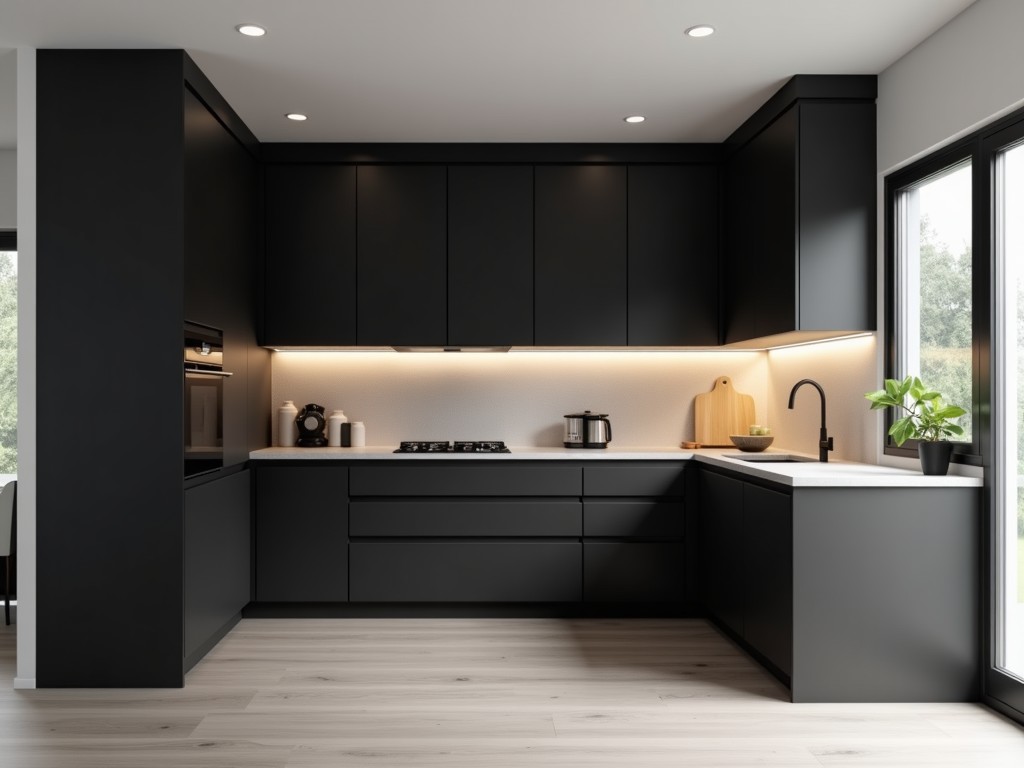
Matte Black Kitchen Cabinet Design
Matte black kitchen cabinet design refers to cabinetry finished with a non-reflective, low-gloss coating applied to substrate materials such as medium-density fiberboard (MDF), plywood, or
- Category:
- Kitchen Cabinet
Matte Black Kitchen Cabinet Design
Matte black kitchen cabinet design refers to cabinetry finished with a non-reflective, low-gloss coating applied to substrate materials such as medium-density fiberboard (MDF), plywood, or particleboard. The finish achieves a visual light reflectance value typically below 10%, distinguishing it from glossy or satin alternatives. This specification influences both aesthetic perception and surface interaction with light, cleaning agents, and mechanical wear in residential and light commercial environments.
Material Substrates and Finish Compatibility
The performance of a matte black finish depends critically on substrate stability and surface preparation. MDF provides uniform density and minimal grain show-through, making it suitable for painted finishes where edge sealing is critical to prevent moisture ingress. Plywood offers superior screw retention and structural rigidity but requires careful veneer selection to avoid telegraphing through the finish. Particleboard, while cost-effective, exhibits higher swelling potential and demands edge banding with PVC or ABS to maintain finish integrity in humid conditions.
Surface preparation involves sanding to 120–150 grit, followed by cleaning to remove dust and oils. A primer-sealer compatible with both substrate and topcoat is applied to ensure adhesion and block tannins or resins. The matte black topcoat is typically a catalyzed polyurethane or acrylic lacquer formulated with flattening agents such as silica or wax dispersions to achieve a 2–5% gloss level at 60°, measured per ASTM D523. Film thickness averages 25–35 microns dry, balancing durability and flexibility.
Durability and Environmental Resistance
Matte black finishes are more susceptible to visible marking than glossier alternatives due to the lack of light diffusion that masks surface imperfections. Fingerprints, light scratches, and cleaning residues appear more prominently, necessitating specific maintenance protocols. However, modern formulations incorporate UV stabilizers and crosslinkers to resist fading and yellowing under prolonged LED or fluorescent exposure, with typical color stability exceeding 5 years at ΔE < 3 under indoor conditions.
Chemical resistance is evaluated per ASTM D1308, with exposure to common kitchen agents such as citrus juices, vinegar, and diluted detergents. A properly cured matte black coating shows no blistering, whitening, or loss of adhesion after 24-hour immersion. Thermal cycling performance is validated through repeated exposure to 40°C and 90% RH, followed by 20°C and 30% RH, with no cracking or delamination observed in quality-controlled batches over 10 cycles.
Design Integration and Functional Considerations
The low reflectance of matte black surfaces reduces glare under direct lighting, making it advantageous in kitchens with under-cabinet LEDs or pendant fixtures. This property enhances visual comfort during food preparation by minimizing reflected light that can cause eye strain. Conversely, the finish absorbs more visible light, potentially increasing surface temperature under intense illumination—a factor to consider in proximity to ovens or cooktops where radiant heat may exceed 60°C.
Edge detailing becomes more critical in matte black designs due to the heightened visibility of sealant lines and joint gaps. Precision machining tolerances of ±0.1 mm are recommended for frameless constructions to maintain consistent reveal lines. Interior finishes are often specified in contrasting tones—such as light gray or natural wood—to improve visibility of contents and reduce the cave-like effect that can occur in fully dark enclosures.
Customization and Manufacturing Variables
Customization extends beyond color to include texture modulation through additives like fine polyethylene wax or micronized silica, which can impart a soft-touch or slightly velvety feel without increasing gloss. These modifications affect coefficient of friction (COF), typically raising it from 0.4–0.6 (standard matte) to 0.6–0.8 (textured variants), influencing slip resistance and cleaning effort. Edge treatments—such as laser-sealed, ABS-band, or polyurethane-pulltruded options—are selected based on exposure risk and design continuity requirements.
Module tolerances, hinge clearance, and drawer slide alignment must account for finish thickness buildup, particularly in inset door configurations. A typical paint film adds 0.05–0.07 mm per side, requiring compensatory adjustments in carcass dimensions to maintain consistent 2 mm reveals. Manufacturers often provide digital templates with finish thickness pre-adjusted to prevent binding or gaps during assembly.
Quality Control and Inspection Protocols
Inspection begins with substrate verification—checking for voids, delamination, or moisture content above 8% (MDF) or 12% (plywood) using pin-type meters. Post-coating, gloss uniformity is assessed across multiple points per panel using a 60° gloss meter, with acceptance criteria of 2–5% and deviation <10% mean. Color consistency is verified via spectrophotometer against a master batch, with ΔE < 1.5 required for panel-to-panel match and <2.0 for batch-to-batch.
Adhesion is tested via cross-hatch (ASTM D3359) with 5B rating as minimum pass. Impact resistance uses a falling ball test (ASTM D2794), with no cracking or delamination at 50 in-lbs. Accelerated aging via QUV-B exposure for 1000 hours validates UV stability, with post-test gloss and color change monitored. Final inspection includes tactile evaluation for orange peel, dust nibs, or pinholes under 500 lux illumination at 45° viewing angle.
Packaging and Logistics Considerations
Matte black finishes require protective packaging to prevent abrasion during transit. Standard practice involves wrapping individual panels in polyethylene film with low-tack adhesive, followed by corner protectors and edge foam. Stacking is limited to prevent pressure marks, with interleaving sheets of kraft paper or corrugated board between layers. Humidity-controlled storage (40–50% RH) is recommended pre-installation to avoid substrate movement that could stress the finish.
Handling protocols mandate gloves with lint-free properties to avoid oil transfer. Lifting equipment should use vacuum pads or padded clamps to prevent point loading. For export shipments, desiccant packs and sealed barrier bags are added to mitigate moisture ingress during transit through varying climatic zones. Land transport is preferred over prolonged sea freight for high-gloss or matte finishes due to reduced vibration and condensation risk.
Applications in Residential and Light Commercial Settings
Matte black kitchen cabinets are specified in designs where visual weight reduction and modern minimalism are priorities. The non-reflective surface integrates well with concrete countertops, brushed metal fixtures, and wood accents, creating depth without visual competition. In open-plan layouts, the finish helps define the kitchen zone without overwhelming adjacent spaces, particularly when paired with lighter wall tones or backsplashes.
In light commercial environments such as boutique cafes or office kitchenettes, matte black offers a durable, low-maintenance appearance that conceals minor wear better than high-gloss white or light wood finishes. The finish complements stainless steel appliances and black oxide hardware, supporting cohesive design themes. However, areas with high touch frequency—such as fridge handles or cabinet pulls—may benefit from anti-fingerprint coatings or textured variants to reduce visible soiling.
| Parameter | Typical Value | Test Method / Reference |
|---|---|---|
| Gloss Level (60°) | 2–5% | ASTM D523 |
| Dry Film Thickness | 25–35 microns | ASTM D1186 (magnetic) |
| Adhesion (Cross-Hatch) | 5B (no peeling) | ASTM D3359 |
| Color Stability (ΔE) | < 1.5 (panel-to-panel) | Spectrophotometer (D65/10°) |
| Impact Resistance | No failure at 50 in-lbs | ASTM D2794 |
| Chemical Resistance (24h) | No blistering/whitening | ASTM D1308 (vinegar, citrus, detergent) |
Ordering and Technical Support
Procurement requires submission of detailed specifications including substrate type, door style (overlay, inset, frameless), edge treatment, hinge and slide compatibility, and interior finish preferences. Digital files should include panel dimensions, bore patterns for hardware, and cutouts for sinks or appliances. Tolerance expectations must be clarified—particularly for reveal consistency in frameless assemblies—since finish thickness can affect perceived alignment.
Sample requests should specify full-size door sections (minimum 300x500 mm) to evaluate finish uniformity, edge quality, and color under intended lighting. Lead times typically range from 4–6 weeks for standard configurations, extending to 8–10 weeks for custom textures, non-standard sizes, or specialized edge treatments. Export orders require additional time for compliance documentation and phytosanitary packaging if applicable.



