Kitchen Cabinets With Quartz Countertops
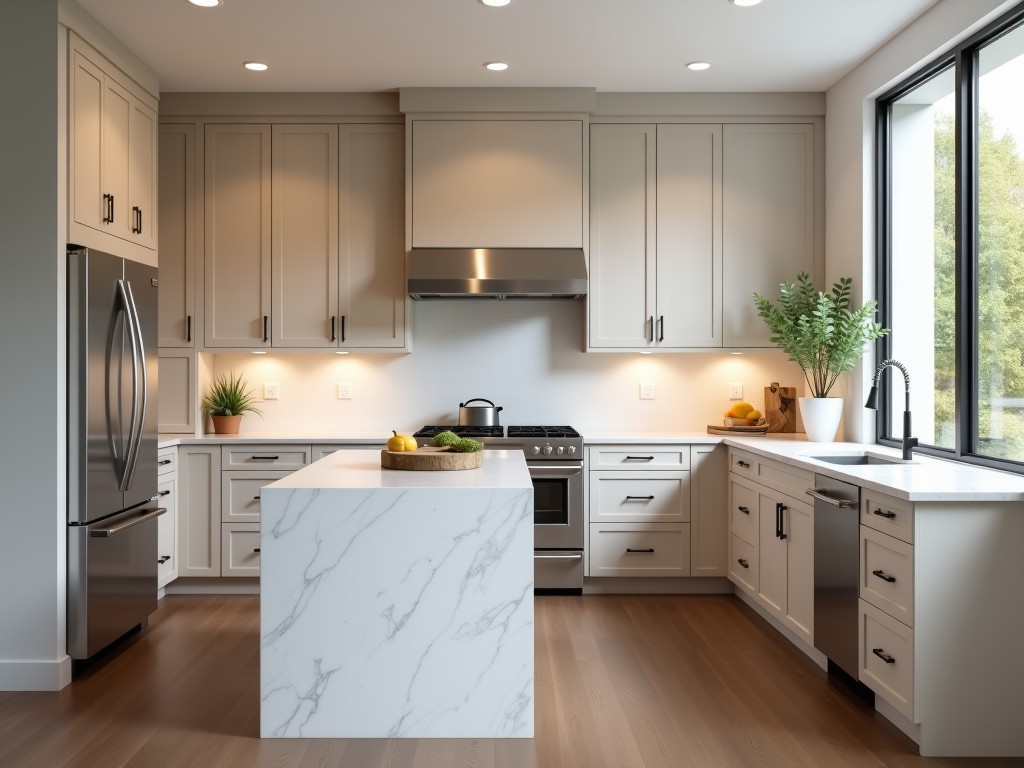
Kitchen Cabinets With Quartz Countertops
Kitchen cabinets paired with quartz countertops form a durable, low-maintenance surface system widely specified in commercial and institutional food preparation environments. The combination
- Category:
- Kitchen Cabinet
Kitchen Cabinets with Quartz Countertops
Kitchen cabinets paired with quartz countertops form a durable, low-maintenance surface system widely specified in commercial and institutional food preparation environments. The combination integrates structural storage with a non-porous, engineered stone work surface, meeting hygiene and load-bearing requirements in high-traffic settings.
Quartz countertops consist of 90–95% ground natural quartz aggregate bound with polymer resins and pigments, resulting in a material with consistent density and minimal variation across slabs. This composition eliminates the need for sealing and provides resistance to staining from common food acids, oils, and dyes encountered in culinary operations.
Cabinet carcasses are typically constructed from 18mm industrial-grade particleboard or moisture-resistant MDF, faced with thermally fused laminate or 2mm PVC edge banding to prevent delamination in humid conditions. Hinges and drawer slides are rated for 50,000+ cycles, ensuring longevity under frequent use.
Structural and Material Characteristics
Quartz countertops exhibit a flexural strength of approximately 50–70 MPa and a compressive strength exceeding 200 MPa, allowing them to support concentrated loads from heavy equipment without cracking. The material’s Mohs hardness of 7 provides scratch resistance comparable to granite, though it is not impervious to damage from sharp carbide tools.
Thermal expansion coefficient of quartz countertops averages 20–25 × 10⁻⁶/°C, necessitating expansion gaps of 3–6 mm at walls and fixed structures to prevent stress buildup during temperature fluctuations. Direct exposure to temperatures above 150°C may cause resin discoloration, so trivets are recommended for hot pans.
Cabinet load capacity depends on wall anchoring and shelf thickness; standard 18mm shelves support up to 40 kg uniformly distributed load when properly secured to studs or blocking. Over-shelf spans exceeding 900mm require intermediate supports or thicker shelving to limit deflection under load.
Hygiene and Maintenance Properties
The non-porous nature of quartz inhibits microbial penetration, reducing harborage points for bacteria and mold compared to natural stone or wood surfaces. Independent testing shows quartz achieves a 99.9% reduction in surface contaminants after standard cleaning with neutral pH detergents.
Cleaning requires only warm water and mild soap; abrasive pads or alkaline cleaners above pH 10 may dull the finish over time. Unlike granite, quartz does not require periodic sealing, eliminating a recurring maintenance task in regulated food service environments.
Cabinet interiors feature smooth, wipe-clean laminates with sealed edges to prevent moisture ingress and pest harborage. Adjustable shelving allows reconfiguration to accommodate changing equipment layouts without tools.
Customization and Integration Options
Quartz slabs are available in thicknesses of 12mm, 20mm, and 30mm, with 20mm being standard for horizontal countertops and 30mm used for overhangs or breakfast bars requiring unsupported spans. Edge profiles include eased, beveled, bullnose, and ogee, each affecting stress distribution and cleanability.
Cabinet dimensions are modular, typically in 150mm increments, allowing alignment with standard appliance widths (600mm for ovens, 900mm for ranges). Filler panels and end panels accommodate irregular wall conditions, while toe kicks provide 100mm clearance for floor cleaning equipment.
Integrated features such as undermount sinks, drainboards, and backsplashes are fabricated from the same quartz slab, eliminating seams that could trap contaminants. Backsplash height is commonly 100mm or 150mm, extending vertically to protect wall finishes from splashes.
Typical Applications in Industrial and Commercial Settings
These systems are specified in commercial kitchens, food processing plants, hospital dietary departments, and institutional cafeterias where durability, sanitation, and resistance to chemical exposure are critical. The seamless quartz surface supports HACCP-compliant workflows by minimizing crevices where allergens or pathogens could accumulate.
In laboratories and pharmaceutical prep areas, quartz’s resistance to common solvents and disinfectants (e.g., isopropyl alcohol, hydrogen peroxide) makes it suitable for non-sterile compounding zones. Cabinet materials are selected based on chemical resistance ratings of the laminate finish to withstand occasional spills.
Retail food environments such as bakeries and delis benefit from the aesthetic consistency of quartz, which maintains color uniformity over time under UV exposure, unlike some natural stones that may fade or discolor. The material’s uniformity also simplifies replacement of damaged sections without noticeable visual mismatch.
| Property | Typical Value | Relevance to Application |
|---|---|---|
| Quartz Content | 90–95% by weight | Determines hardness and chemical resistance |
| Flexural Strength | 50–70 MPa | Supports equipment loads without cracking |
| Water Absorption | <0.05% | Prevents swelling and microbial growth |
| Cabinet Shelf Load (UDL) | 40 kg (18mm shelf) | Guides shelving spacing for inventory |
| Thermal Expansion | 20–25 × 10⁻⁶/°C | Requires expansion gaps at fixed edges |
| Surface Hardness (Mohs) | 7 | Resists scratching from utensils and cookware |
Quality control begins with slab inspection for color consistency, thickness tolerance (±0.3mm), and absence of resin pockets or cracks. CNC cutting tolerances are held to ±0.5mm for cutouts and edges, ensuring seamless fit during installation.
Cabinet assemblies undergo squareness and alignment checks, with diagonal deviation limited to 3mm per meter. Door and drawer adjustments are verified for even reveal and smooth operation before shipment. Packaging includes corner protectors and horizontal bracing to prevent racking during transit.
Lead times typically range from 3–6 weeks for standard configurations, depending on quartz color availability and cabinet finish selection. Custom edge profiles or integrated features may extend timelines by 1–2 weeks due to additional fabrication steps.
For technical specifications, customization options, or project-specific quotations, contact our engineering team to discuss your requirements.
Request Technical Consultation