High End Kitchen Cabinets
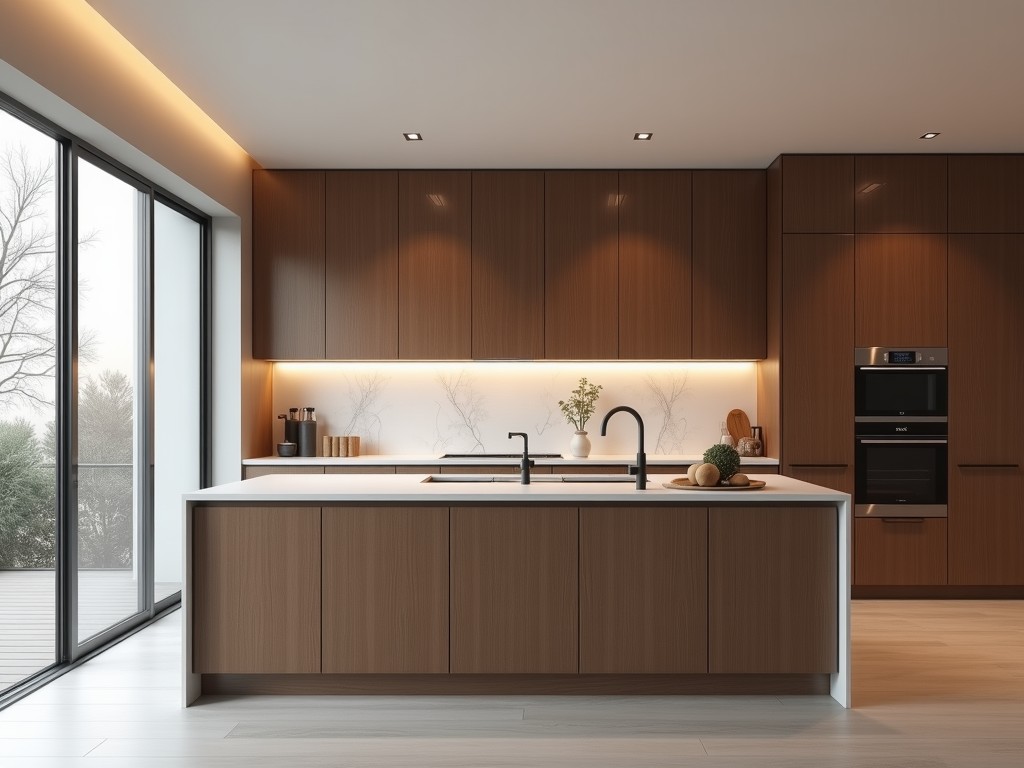
High End Kitchen Cabinets
These cabinets are engineered for demanding residential and light commercial environments where durability, dimensional stability, and finish integrity are critical. Construction emphasizes substrate
- Category:
- Kitchen Cabinet
High End Kitchen Cabinets
These cabinets are engineered for demanding residential and light commercial environments where durability, dimensional stability, and finish integrity are critical. Construction emphasizes substrate selection, joint methodology, and surface treatment to withstand daily use, moisture exposure, and thermal cycling without compromising alignment or appearance.
Core Construction Methodology
Cabinet boxes are built from 18mm thick, multi-layer hardwood plywood with cross-banded veneers to minimize warping. Panels are bonded with formaldehyde-free, moisture-resistant PVA adhesive cured under controlled pressure. All edges are sealed with 2mm PVC or wood veneer edge banding applied via hot-melt extrusion to prevent delamination at joints and cutouts.
Joinery employs a combination of blind dadoes for shelf support, reinforced with cam-lock fasteners and glue blocks at high-stress corners. Door frames use mortise-and-tenon or cope-and-stick construction with floating panels to accommodate seasonal wood movement. Hinge cups are bored to 35mm diameter with 8mm depth tolerance to ensure consistent overlay and prevent screw pull-out over time.
Material Selection and Performance
Substrate options include birch, maple, or walnut plywood for painted finishes, and veneer-grade oak, ash, or sapele for stained applications. Each species is selected for uniform grain, low extractive content, and compatibility with water-based coatings. Moisture content is stabilized to 6–8% prior to fabrication to reduce post-installation movement.
Finishes utilize catalyzed polyurethane or UV-cured acrylics with a minimum dry film thickness of 40µm. Surfaces are sanded to 220 grit before coating and polished to 600 grit after curing to achieve a uniform sheen level between 15–30° gloss, depending on specification. Edge sealing matches substrate permeability to prevent moisture ingress at vulnerable points.
Hardware and Functional Systems
Soft-close hinges are rated for 80,000 cycles with adjustable depth, side, and tilt mechanisms. Drawer systems use full-extension, ball-bearing slides with dynamic load capacity of 40kg and side clearance tolerance of ±0.5mm. Interior accessories such as pull-out trays and corner carousels are mounted on adjustable brackets to accommodate varying cabinet depths.
All hardware is pre-installed in factory-controlled conditions to ensure alignment accuracy. Adjustment points are accessible without disassembly, allowing on-site tuning for uneven floors or wall deviations. Load testing confirms zero sag in 600mm wide wall cabinets under 25kg uniform load after 500 cycles.
Customization and Dimensional Flexibility
Standard cabinet heights are 720mm (base), 900mm (tall), and 360mm (wall), with depths of 580mm and 350mm respectively. Widths are adjustable in 50mm increments from 150mm to 1200mm. Custom configurations include angled cabinets, curved panels, and integrated appliance garages requiring template-based fabrication.
Interior layouts are defined through modular grid systems allowing repositioning of shelves, dividers, and hardware mounts. Cutouts for sinks, cooktops, and electrical conduits are CNC-machined to ±0.3mm tolerance. Finish matching is maintained across all visible surfaces, including interior cabinets and filler strips.
Quality Control and Testing
Each unit undergoes dimensional verification at five critical points: diagonal squareness (≤2mm deviation), door gap uniformity (±0.5mm), shelf load deflection (<1.5mm under 20kg), hinge alignment (parallel within 1°), and finish adhesion (cross-hatch test per ASTM D3359). Random samples are subjected to 48-hour humidity cycling at 70% RH and 38°C to assess coating stability.
Packaging includes corner protectors, edge guards, and moisture-barrier wrap. Units are packed in 5mm double-wall cartons with internal bracing to prevent racking during transit. Labels include batch numbers, material codes, and finish specifications for traceability.
| Parameter | Typical Value | Test Method / Standard |
|---|---|---|
| Panel Thickness | 18mm | Caliper measurement |
| Moisture Content | 6–8% | Oven-dry method |
| Finish Thickness | ≥40µm | DFT gauge |
| Hinge Cycle Life | 80,000 cycles | ANSI/BHMA A156.9 |
| Drawer Dynamic Load | 40kg | ANSI/BHMA A156.9 |
| Edge Bond Strength | >1.8 N/mm | ASTM D903 |
Applications and Environmental Suitability
These cabinets are specified in high-end residential kitchens, boutique hospitality suites, and executive office pantries where long-term appearance retention and structural reliability reduce lifecycle cost. The substrate and finish system resist staining from common kitchen agents such as oils, acids, and alcohols, making them suitable for environments with frequent cleaning cycles.
In multi-unit developments, dimensional consistency ensures seamless alignment across adjacent units, minimizing on-site adjustment time. The modular design supports phased installation and future reconfiguration without requiring custom replacement parts. All materials comply with CARB Phase 2 and TSCA Title VI formaldehyde emission limits.