European Style Kitchen Cabinets
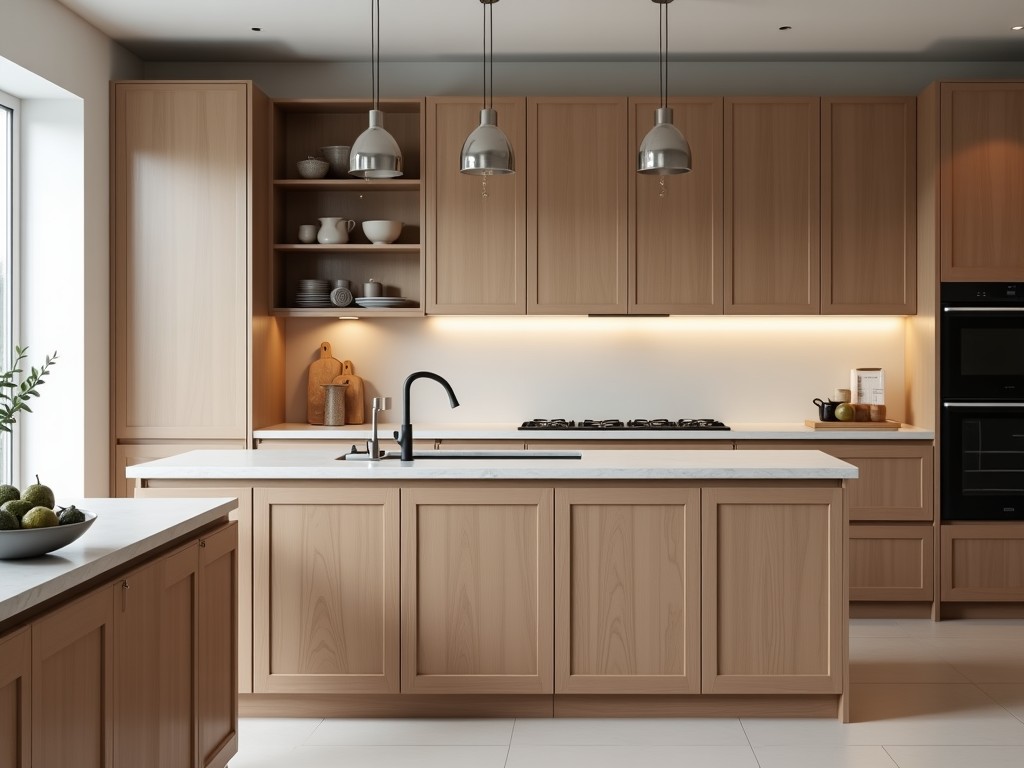
European Style Kitchen Cabinets
European style kitchen cabinets are defined by frameless construction, full-overlay doors, and concealed hinges, resulting in a seamless, continuous surface with minimal visible hardware. This design
- Category:
- Kitchen Cabinet
European Style Kitchen Cabinets
European style kitchen cabinets are defined by frameless construction, full-overlay doors, and concealed hinges, resulting in a seamless, continuous surface with minimal visible hardware. This design approach maximizes interior storage volume by eliminating the face frame found in traditional American cabinets, allowing drawers and doors to extend to the outer edges of the cabinet box. The absence of a face frame also enables thinner side panels, typically 16mm or 18mm thick, while maintaining structural integrity through precision joinery and material selection. These cabinets are commonly manufactured using engineered wood substrates such as particleboard, MDF, or plywood, finished with durable surface materials like melamine, lacquer, or wood veneer. The aesthetic emphasizes clean lines, handle-less operation, and integration with modern kitchen appliances and countertops.
Core Construction Principles
The frameless design relies on accurate panel cutting and edge banding to ensure alignment and durability. Side panels, tops, bottoms, and shelves are typically joined using cam locks, dowels, or confirmat screws, which provide strong, repeatable connections suitable for flat-pack shipping and on-site assembly. Adjustable shelving systems use metal pins inserted into pre-drilled holes, allowing vertical reconfiguration in 32mm increments—a standard known as the 32mm system or European boring system. This modularity supports customization for varying storage needs without compromising structural stability. The cabinet box is engineered to withstand typical kitchen loads, including dynamic forces from door operation and static loads from countertops and appliances.
Door and drawer fronts are attached via concealed hinges and drawer slides that are mounted inside the cabinet box, preserving the uninterrupted exterior surface. Hinges are typically cup-style, installed in a 35mm bore hole in the door, and allow for six-way adjustment (horizontal, vertical, depth, tilt, and spring tension) to ensure precise alignment over time. Drawer systems often use undermount slides with soft-close mechanisms, rated for dynamic loads of 30kg or more, and feature full-extension travel for complete access to the drawer interior. These hardware components are selected for cycle life, commonly tested to 50,000+ operations, to ensure long-term performance in high-use environments.
Material and Finish Options
Substrate materials are chosen based on balance of cost, stability, and finish compatibility. Particleboard is widely used for its uniform density and cost-effectiveness, typically rated at 600–700 kg/m³, with melamine-faced variants offering resistance to moisture, stains, and abrasion. MDF provides a smoother surface for painted or lacquered finishes, with better screw holding strength than particleboard but higher susceptibility to edge swelling if exposed to moisture. Plywood, particularly birch or poplar core, offers superior strength-to-weight ratio and dimensional stability, making it suitable for humid environments or heavy-load applications, though at a higher material cost.
Surface finishes are applied to protect the substrate and achieve the desired aesthetic. Melamine foil is thermally fused to the substrate, providing a hard, non-porous surface available in solid colors, wood grains, or abstract patterns, with typical abrasion resistance ratings of 150–300 cycles under Taber testing. Lacquer finishes, applied in multiple coats and cured via UV or thermal processes, offer high gloss or matte appearances with excellent depth and clarity, though they require careful handling during installation to avoid scratching. Wood veneer finishes use real wood slices, typically 0.6mm thick, applied over MDF or particleboard and sealed with clear coat, providing natural grain variation while maintaining substrate stability. Edge banding, usually PVC or ABS, is applied to all exposed panel edges to seal against moisture ingress and ensure finish continuity.
Design Flexibility and Customization
The modular nature of frameless cabinets allows for extensive customization to fit specific kitchen layouts and user requirements. Standard cabinet widths increase in 100mm increments (e.g., 300mm, 400mm, 500mm), while heights are typically 720mm for base units and 360mm or 720mm for wall units, though custom dimensions are available to accommodate non-standard spaces or appliance integrations. Interior accessories such as pull-out trays, corner carousels, waste bin systems, and spice racks can be incorporated during design, with mounting points pre-installed in the cabinet box during manufacturing. This enables seamless integration of functional elements without compromising the clean exterior appearance.
Handle-less operation is achieved through integrated grips, such as vertical channels milled into the door edge or horizontal recesses at the top or bottom of the door, allowing fingers to engage the surface directly. Alternatively, touch-latch or push-to-open mechanisms can be installed, using magnetic or mechanical triggers to release the door with light pressure. These systems are designed to prevent accidental opening while maintaining ease of use, with release forces typically calibrated between 1.5N and 3.0N. The choice of access method influences both ergonomics and the visual profile of the cabinetry, allowing designers to tailor the user interaction to the overall kitchen concept.
Quality Control and Manufacturing Considerations
Dimensional accuracy is critical in frameless cabinetry, as even minor deviations can affect door alignment and reveal consistency. Manufacturing tolerances are typically held to ±0.5mm for panel dimensions and ±0.25mm for hinge bore placement, ensuring that assembled cabinets maintain uniform gaps (usually 2mm) between doors and drawers. Edge banding adhesion is verified through peel and shear tests, with minimum bond strength of 1.0 N/mm required to prevent delamination under thermal cycling or moisture exposure. Surface finish quality is assessed for gloss uniformity, adhesion (cross-hatch test), and resistance to household chemicals such as vinegar, alcohol, and cleaning agents.
Packaging for flat-pack shipment includes corner protectors, edge guards, and moisture barriers to prevent damage during transit. Each panel is labeled with a unique identifier matching the assembly drawing, and hardware packs are segregated by cabinet type to reduce on-site sorting time. Assembly instructions include torque specifications for cam locks (typically 0.8–1.2 Nm) and hinge adjustment procedures to ensure proper function. For installed cabinets, load testing of wall-mounted units is recommended, with standard wall cabinets designed to support up to 40kg when properly secured to studs or load-bearing substrates using appropriate fasteners.
Typical Specifications
| Parameter | Typical Value | Notes |
|---|---|---|
| Side Panel Thickness | 16mm or 18mm | Particleboard, MDF, or plywood substrate |
| Cabinet Height (Base) | 720mm | Excludes countertop thickness |
| Cabinet Depth | 560mm or 580mm | Standard depth for appliance compatibility |
| Hinge Bore Diameter | 35mm | For concealed cup hinges |
| Shelf Adjustment Increment | 32mm | European boring system standard |
| Drawer Dynamic Load | 30kg–40kg | Undermount slides with soft-close |
| Door Adjustment Range | ±2mm (6-way) | Horizontal, vertical, depth, tilt, spring |
| Edge Banding Thickness | 0.5mm–2.0mm | PVC or ABS, matched to finish |
Applications in Commercial and Residential Kitchens
European style cabinets are widely adopted in both residential and commercial kitchens due to their space efficiency, ease of cleaning, and compatibility with integrated appliances. In residential settings, the frameless design allows for wider drawers and unobstructed access to storage, improving usability in compact urban kitchens where every millimeter counts. The flat surfaces and minimal crevices reduce accumulation of dirt and grease, simplifying maintenance in high-use environments. In commercial applications such as cafes, boutique hotels, or office pantries, the clean aesthetic aligns with modern interior design trends, while the modular construction supports reconfiguration or relocation as needs evolve.
The system’s compatibility with integrated appliances—such as slide-in ovens, flush-mounted refrigerators, and concealed dishwashers—enables a built-in appearance that enhances visual continuity. This is particularly valuable in open-plan living spaces where the kitchen is visible from adjacent areas. The ability to specify consistent panel finishes across cabinets, appliances, and wall panels allows designers to create a cohesive material palette. Additionally, the use of standardized hardware and boring patterns facilitates third-party accessory integration, such as interior lighting systems or motorized lifts, without requiring custom fabrication.
Environmental and Lifecycle Factors
Material selection influences the environmental footprint of kitchen cabinets over their lifecycle. Particleboard and MDF often incorporate recycled wood fibers, reducing demand for virgin timber, while formaldehyde emissions are regulated through CARB Phase 2 or E1 standards, with many manufacturers offering ultra-low emitting (ULEF) or no-added formaldehyde (NAF) variants. Plywood sourcing can be certified under FSC or PEFC programs to ensure responsible forest management. Surface finishes such as water-based lacquers or UV-cured melamine reduce volatile organic compound (VOC) emissions during production and curing.
At end of life, the separability of materials affects recyclability. Cabinets with mechanically fastened components (e.g., cam locks, screws) allow for easier disassembly and material sorting compared to those with permanent adhesives. Metal hardware (hinges, slides, shelf pins) is readily recyclable, while plastic edge banding and foil finishes may require specialized processing. Designing for disassembly and labeling material types can support circular economy initiatives, particularly in commercial projects where renovation cycles are frequent. Some manufacturers offer take-back programs or provide material data sheets to assist in recycling planning.
For project-specific configurations, material options, or technical drawings, contact our team to discuss your requirements. We provide detailed submittals, assembly guidance, and support for custom kitchen cabinet solutions tailored to European standards.
Request Technical Consultation