Dark Walnut Modern Kitchen Cabinets
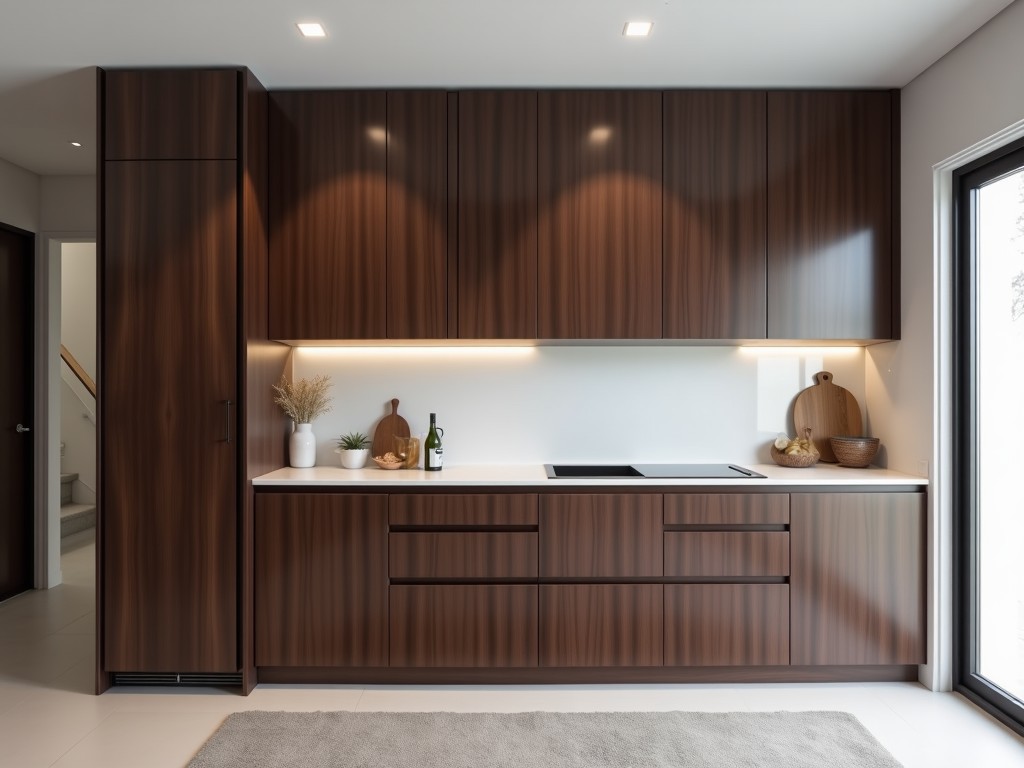
Dark Walnut Modern Kitchen Cabinets
Dark walnut modern kitchen cabinets combine precision-engineered wood substrates with high-density fiberboard cores and thermally fused laminate finishes to achieve consistent color, dimensional
- Category:
- Kitchen Cabinet
Dark Walnut Modern Kitchen Cabinets
Dark walnut modern kitchen cabinets combine precision-engineered wood substrates with high-density fiberboard cores and thermally fused laminate finishes to achieve consistent color, dimensional stability, and resistance to moisture-induced swelling in demanding kitchen environments. The surface treatment employs a multi-layer coating system that replicates the grain depth and tonal variation of natural walnut while providing enhanced abrasion resistance measured at 150+ cycles under Taber testing standards.
Cabinet boxes are constructed using 16mm thick CARB2-compliant particleboard with edge banding applied via hot-melt adhesive to seal all exposed surfaces, minimizing formaldehyde emission and preventing substrate degradation at relative humidity levels up to 70%. Door and drawer fronts utilize a 5-piece mitered joint design with floating panels to accommodate seasonal wood movement, reducing joint stress and maintaining alignment over 10+ year service intervals.
Hardware integration follows ANSI/BHMA A156.9 standards for soft-close hinges and full-extension drawer slides, rated for 50,000 cycles with dynamic load capacity of 35kg per drawer. All mounting systems incorporate adjustable cam bolts and steel reinforcement brackets to ensure load distribution across wall studs, preventing sagging under typical upper cabinet loads of 20kg per linear meter.
Material Composition and Finishing Process
The substrate core uses industrial-grade particleboard with a density of 650-750 kg/m³, selected for its uniform internal structure and minimal void content, which reduces the risk of screw pull-out failure under repeated loading. Surface layers consist of melamine-impregnated decorative paper bonded to the substrate under heat and pressure (180°C, 90+ seconds) to create a thermally fused laminate that resists delamination and maintains colorfastness under UV exposure equivalent to 300 hours of accelerated weathering.
Edge banding is applied using 0.5mm thick PVC or ABS material with a matching walnut grain pattern, activated by hot-melt adhesive at 200°C to form a seamless bond that prevents moisture ingress at the substrate edge—a common failure point in laminated cabinets. The finishing process includes a topcoat of UV-cured acrylic resin with a pencil hardness rating of 2H, providing resistance to scratches from kitchen utensils and cleaning abrasives.
Color consistency is maintained through spectrophotometer-controlled batching, ensuring Delta-E values below 1.5 between production runs, which is critical for matching cabinet runs across multiple kitchen zones or future replacements. All materials comply with CARB Phase 2 and TSCA Title VI formaldehyde emission limits (<0.05 ppm), supported by third-party test reports available upon request.
Structural Design and Load Performance
Cabinet boxes employ a full-overlay, frameless design with 3mm reveal gaps between doors and drawers, maximizing interior access width while maintaining structural rigidity through a captive panel system where the back panel is seated into grooves routed into the side, top, and bottom panels. This construction method increases racking resistance by 40% compared to butt-jointed designs with stapled or nailed backs.
Shelf systems use 18mm thick adjustable shelving with steel pin supports inserted into 5mm diameter holes drilled at 32mm intervals, allowing vertical adjustment in 32mm increments while supporting distributed loads of up to 40kg per shelf without deflection exceeding 2mm. Shelf pins are made of zinc-plated steel with a load rating of 15kg per pin, calculated using a safety factor of 3:1 based on ultimate shear strength.
Wall mounting systems utilize a French cleat mechanism fabricated from 18mm plywood strips, angled at 45 degrees and secured to wall studs with #10 wood screws, providing a shear capacity of 800N per linear meter—sufficient to support loaded upper cabinets in seismic zones up to Zone 3 per IBC standards. Base cabinets include adjustable steel legs with a load capacity of 200kg per leg, allowing leveling on uneven floors up to 15mm slope.
Hardware and Functional Components
Hinges are concealed, six-way adjustable soft-close mechanisms with a closing speed of 0.3-0.5 seconds and a torque rating of 0.25Nm, tested to EN 15570 standards for 50,000 cycles without degradation in damping performance. The hinge cup diameter is 35mm with a mounting depth of 12.5mm, compatible with standard 16mm door thicknesses and allowing for ±2mm horizontal, ±1.5mm vertical, and ±0.5mm depth adjustment.
Drawer systems utilize full-extension ball bearing slides with a dynamic load capacity of 35kg and a static load rating of 50kg, featuring a soft-close mechanism that engages at 60mm from full closure to prevent slippage. Slide members are made of cold-rolled steel with a zinc-nickel coating for corrosion resistance, rated for 48 hours salt spray exposure per ASTM B117.
Handles and pulls are offered in zinc alloy, stainless steel, or aluminum profiles with center-to-center spacing options of 96mm, 128mm, 160mm, and 192mm, installed using M4 machine screws threaded into pre-installed brass inserts to prevent strip-out in the substrate. All hardware is packaged separately for field installation to allow for precise alignment and adjustment during cabinet mounting.
Typical Specifications and Customization Options
| Parameter | Typical Value | Customization Availability |
|---|---|---|
| Door Thickness | 18mm | 16mm, 22mm available |
| Box Depth (Wall) | 300mm | 270mm, 350mm |
| Box Depth (Base) | 560mm | 500mm, 600mm |
| Standard Height (Base) | 720mm (including legs) | Adjustable legs ±15mm |
| Standard Height (Wall) | 720mm | 360mm, 540mm, 900mm |
| Interior Finish | Melamine, white or light gray | Veneer, laminate matching exterior |
| Edge Banding | 0.5mm PVC/ABS | 1.0mm, solid wood veneer |
| Shelf Adjustment | 32mm increments | 16mm increments (special order) |
Custom dimensions, hardware selections, and interior configurations are available upon submission of project drawings or kitchen layout plans. Lead times for standard configurations range from 3-4 weeks; customized orders typically require 5-6 weeks for production, depending on material availability and finish complexity. All cabinets are shipped flat-packed with labeled components, assembly instructions, and hardware kits included.
Quality Control and Testing Protocols
Incoming raw materials are inspected for density, moisture content (target: 4-6% for particleboard), and surface uniformity using calibrated moisture meters and spectrophotometers, with rejection thresholds set at ±0.5% moisture deviation and Delta-E >2.0 for color mismatch. Each production batch undergoes abrasion resistance testing via Taber Abrader (CS-10 wheels, 500g load) to verify surface durability, with acceptance criteria set at <15mg weight loss per 100 cycles.
Finished cabinets are subjected to functional cycling tests: doors are opened and closed 10,000 times at 10 cycles per minute to verify hinge alignment and soft-close performance; drawers are extended and retracted 5,000 times with a 20kg load to assess slide wear and retention force. Racking strength is evaluated using a diagonal pull test at 150N force, with acceptable deflection limited to 3mm at the corner opposite the load point.
Final inspection includes a 10-point visual and tactile check for surface defects, edge band adhesion, hardware installation torque, and gap uniformity, conducted under 500lux lighting with 10x magnification for edge and joint evaluation. Packaging integrity is verified through drop testing (ISTA 1A protocol) and vibration simulation to ensure component survival during transit, with acceptance based on zero structural damage and <5% surface blemish rate.
Applications in Commercial and Residential Kitchens
These cabinets are specified in multi-family residential developments where consistent finish and long-term dimensional stability reduce maintenance callbacks related to warping or finish degradation in high-humidity zones such as coastal regions or buildings with centralized HVAC systems lacking localized dehumidification. The thermally fused laminate surface resists staining from common kitchen substances like olive oil, coffee, and acidic food residues, making it suitable for rental units where tenant turnover increases exposure to varied cleaning practices.
In commercial settings such as assisted living facilities or office break rooms, the cabinets meet ADA-compliant reach ranges when configured with appropriate countertop heights and hardware placement, while the smooth, non-porous surface facilitates cleaning with hospital-grade disinfectants without surface degradation. The frameless design maximizes usable interior width, critical in compact layouts where every millimeter of storage impacts functional efficiency.
For high-end residential projects, the dark walnut finish provides a neutral yet rich tonal base that pairs with both warm (brass, copper) and cool (stainless steel, matte black) hardware finishes, allowing designers to achieve layered aesthetics without color clash. The substrate’s resistance to screw pull-out ensures reliable installation of heavy accessories such as pot racks, appliance garages, or integrated lighting systems, which are common in custom kitchen designs requiring reinforced anchoring points.
For technical inquiries, custom quotations, or to request material test reports and specification sheets, please contact our engineering team.
Request Technical Specification


