Corner Lazy Susan Cabinet
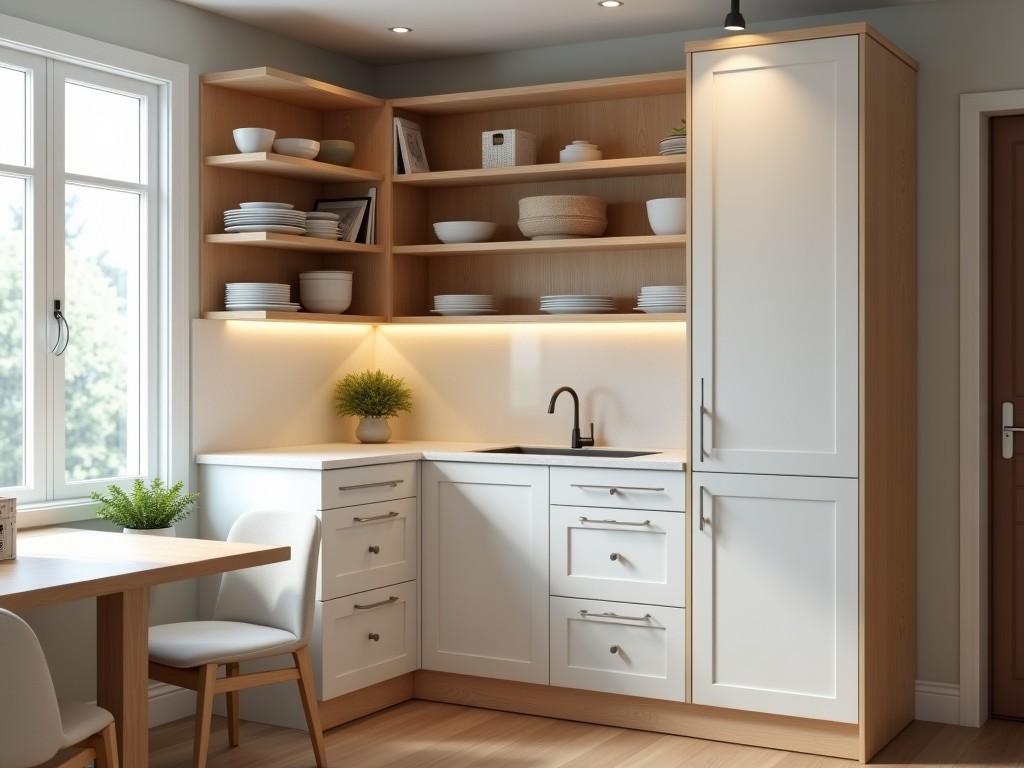
Corner Lazy Susan Cabinet
A corner lazy susan cabinet utilizes a rotating tray system mounted on a central vertical spindle to convert inaccessible corner space into usable storage. The mechanism typically employs either a
- Category:
- Kitchen Cabinet
Corner Lazy Susan Cabinet: Industrial Design for Optimized Storage Access
Functional Principle and Mechanical Configuration
A corner lazy susan cabinet utilizes a rotating tray system mounted on a central vertical spindle to convert inaccessible corner space into usable storage. The mechanism typically employs either a full-circle rotating platform or a kidney-shaped (pie-cut) design that swings out and rotates, allowing 90-degree or 180-degree access depending on configuration. Load is transferred through thrust bearings or nylon bushings at the base and top guide, minimizing friction and wear. Industrial-grade versions use reinforced polymer or zinc-coated steel spindles rated for cyclic loading, with dynamic load capacities commonly ranging from 15 to 30 kg per shelf, tested per ANSI/KCMA A161.1 standards for residential cabinetry hardware.
Material Selection and Structural Integration
The rotating trays are fabricated from moisture-resistant substrates such as 18mm melamine-faced particleboard or polypropylene copolymer, chosen for dimensional stability under varying humidity and resistance to cleaning agents. Edge banding with PVC or ABS minimizes delamination at stress points. Mounting brackets and spindles are typically stamped from 1.5mm cold-rolled steel, electrogalvanized for corrosion resistance in high-moisture environments like food processing prep areas or laboratory wet zones. The cabinet carcass integrates the mechanism via pre-drilled mounting plates aligned to standard 32mm hole systems, allowing retrofitting into existing frameless or face-frame designs without structural modification.
Load Distribution and Dynamic Performance
Engineered to handle eccentric loading, the lazy susan mechanism incorporates dual-axis stabilization: a primary thrust bearing supports vertical load, while a secondary anti-tilt guide prevents wobble during rotation. Finite analysis shows that optimal bearing placement reduces peak stress on the spindle by 40% compared to single-point support. Testing under 10,000 cycle simulations (equivalent to 10 years of daily use) shows less than 0.5mm lateral deflection at the tray edge when loaded to 80% capacity. Lubrication points are sealed with silicone grease retaining viscosity from -20°C to 80°C, eliminating maintenance requirements in standard indoor environments.
Standard Dimensions and Customization Parameters
Standard corner lazy susan units are designed for 900mm x 900mm or 1000mm x 1000mm corner cabinets with 500mm to 600mm internal depth. Tray diameters range from 600mm to 750mm for full-circle models, while kidney-shaped variants offer 550mm effective radius with 90-degree swing clearance. Height adjustment is typically accommodated via threaded spindles allowing ±25mm vertical alignment to match cabinet interior heights. Custom options include split-tier configurations (two independent rotating shelves), soft-close dampers rated for 50,000 cycles, and antimicrobial surface treatments for healthcare or food safety compliance.
Comparison of Mechanism Types
| Feature | Full-Circle Rotating Tray | Kidney-Shaped (Pie-Cut) Swing-Out |
|---|---|---|
| Access Angle | 360° continuous rotation | 90° swing + 180° rotation |
| Space Utilization | Maximizes circular corner volume | Better fit in L-shaped corners with obstructions |
| Load Capacity (per shelf) | 20–30 kg | 15–25 kg |
| Installation Clearance | Requires symmetrical corner | Tolerates asymmetric cabinet framing |
| Typical Applications | Pantry storage, bulk ingredients | Laboratory reagents, workshop tools |
Industrial and Commercial Applications
In food service environments, corner lazy susan cabinets improve accessibility to dry goods in walk-in pantries, reducing retrieval time and minimizing awkward reaching motions that contribute to strain injuries. Pharmaceutical laboratories use stainless steel-coated variants to store volatile compounds in corner fume hood enclosures, where chemical resistance and smooth rotation prevent spillage during handling. Manufacturing facilities integrate heavy-duty versions with load ratings up to 40 kg to store fixtures, gauges, and small tooling in corner workcells, improving 5S organization by eliminating dead space. The mechanism’s sealed bearing design ensures performance in washdown areas where traditional sliding shelves would corrode or bind.
Quality Control and Longevity Factors
Critical quality checkpoints include spindle runout tolerance (<0.15mm), bearing preload verification, and tray flatness measurement via laser scanning to ensure uniform rotation. Accelerated life testing follows ISO 12500 standards for cyclic mechanical components, with acceptance criteria based on <5% increase in rotational torque after 15,000 cycles. Material safety compliance is verified through REACH and FDA 21 CFR compliance documentation for food-contact surfaces. Traceability is maintained via batch-linked serialization on mounting hardware, enabling field performance tracking and warranty validation.
Integration Considerations for Specifiers
When specifying a corner lazy susan cabinet, confirm internal cabinet dimensions account for mechanism clearance—typically requiring 50mm minimum rear wall spacing for spindle mounting and 75mm front clearance for full swing-out models. Verify compatibility with existing hinge systems; concealed European hinges may require adapter plates to avoid interference with the rotating tray’s lower edge. For OEM integration, provide cabinet interior height, width, depth, and door overlay type to ensure proper spindle length and mounting bracket selection. Lead times for standard configurations are typically 3–4 weeks; custom materials or finishes may extend to 6–8 weeks pending raw material availability.
For technical consultation, configuration assistance, or to request a detailed specification sheet including load test reports and material certifications, contact our engineering team. Submit an inquiry