Contemporary Kitchen Cabinet Design
Contemporary Kitchen Cabinet Design
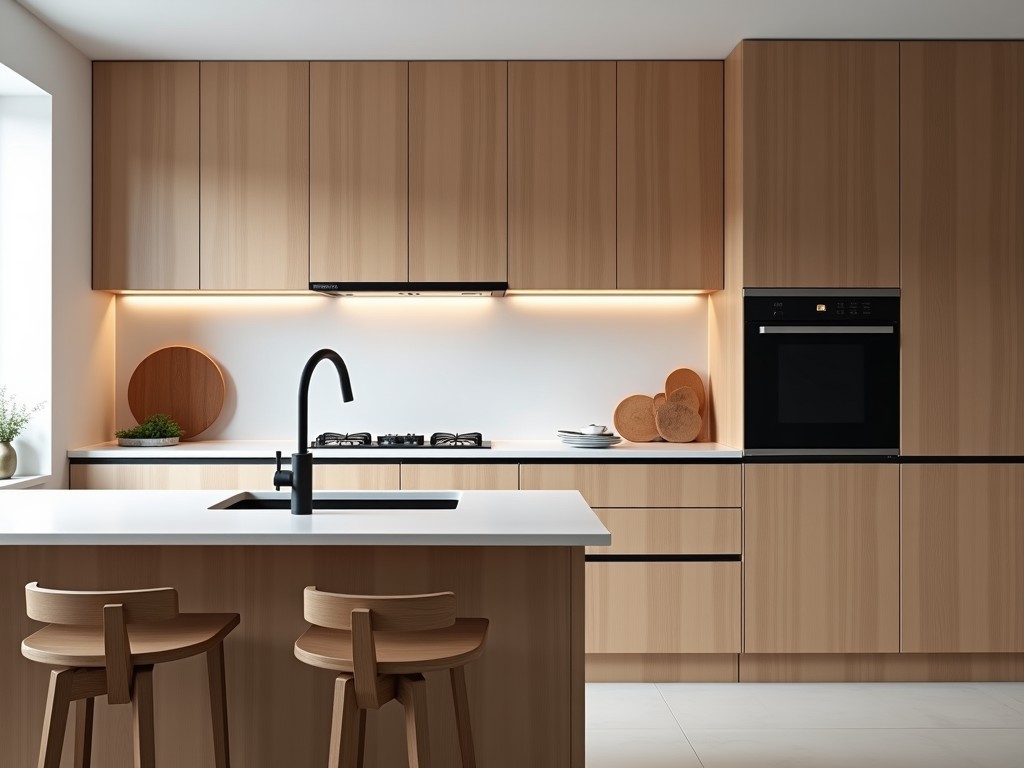
Contemporary kitchen cabinet design reflects evolving functional demands and aesthetic preferences in residential and commercial environments. These systems prioritize clean lines, minimal
- Category:
- Kitchen Cabinet
Contemporary Kitchen Cabinet Design
Contemporary kitchen cabinet design reflects evolving functional demands and aesthetic preferences in residential and commercial environments. These systems prioritize clean lines, minimal ornamentation, and integration with smart storage solutions while adhering to structural and material performance standards. Design decisions are driven by ergonomic workflows, material durability under cyclic loading, and compatibility with integrated appliances and hardware systems.
Manufacturing considerations include panel stability, edge sealing integrity, and hinge load distribution to ensure long-term dimensional stability in variable humidity conditions. Surface finishes must resist staining, abrasion, and chemical exposure from common kitchen agents while maintaining visual consistency over time. Design flexibility accommodates varying module widths, heights, and depths to suit spatial constraints and user-specific storage needs.
Core Design Principles
Contemporary cabinet systems are grounded in modularity, allowing standardized components to be configured into diverse layouts without compromising structural alignment. This approach reduces fabrication complexity and enables efficient field installation through pre-drilled mounting points and cam-lock joinery systems. Tolerance stacking is minimized via CNC-guided panel cutting and edge banding processes.
Visual continuity is achieved through consistent reveal gaps—typically 2mm between doors and drawers—and concealed hardware placement. Full-overlay door configurations eliminate visible frame members, maximizing accessible interior volume. Interior organization systems, such as pull-out trays and vertical dividers, are engineered to support specified dynamic loads (e.g., 25kg for pull-out shelves) without sag over 50,000 cycles.
Material Selection and Performance
Substrate materials are selected based on moisture resistance, screw holding strength, and surface flatness. Common options include CARB2-compliant particleboard (density 600–680 kg/m³), MDF (density 700–800 kg/m³), and plywood with cross-banded veneers for enhanced dimensional stability. Each substrate undergoes thickness tolerance control (±0.2mm) and moisture content stabilization (8–12% equilibrium) prior to processing.
Surface finishes range from low-pressure melamine (LPM) with abrasion resistance rated to 150 cycles (Taber CS-10 wheel, 500g load) to high-pressure laminate (HPL) exceeding 400 cycles under identical testing. Veneer options use UV-cured coatings with pencil hardness ≥2H and adhesion per ASTM D3359 Method B (5B rating). Edge sealing employs hot-melt PUR adhesive to prevent water ingress at cut edges, critical for longevity in high-humidity zones.
Hardware and Functional Integration
Hardware components are specified for load capacity, cycle life, and adjustment range. Soft-close hinges are rated for 40,000+ cycles at 25kg door weight with 3-dimensional adjustment (±2mm lateral, ±1.5mm height, ±0.5mm depth). Drawer systems use ball-bearing or undermount slides with dynamic load capacities of 30–40kg and vertical alignment tolerance <0.5mm under full extension.
Integration with appliances requires precise cutout tolerances (±1mm) and ventilation clearance planning. Electrical conduit channels and plumbing chases are incorporated into cabinet carcasses during design phase to avoid field modifications. Touch-latch mechanisms and push-to-open systems eliminate protrusions, maintaining flush surface geometry while meeting accessibility reach ranges (380–1200mm above finished floor).
Customization and Configuration Logic
Customization follows a parametric framework where module dimensions, door styles, and interior accessories are defined by user inputs and spatial constraints. Standard widths increment in 50mm steps (150mm to 600mm), heights in 100mm increments (300mm to 2100mm for tall units), and depths in 25mm steps (300mm to 650mm). Corner solutions include blind corners, magic corners, and diagonal pull-outs, each with defined clearance envelopes and operational swing paths.
Finish selection is decoupled from substrate to allow independent specification—e.g., a 18mm MDF core can be paired with HPL, veneer, or lacquer surfaces. This separation enables performance-based material matching: high-wear zones (e.g., near sink) may use HPL while upper cabinets use veneer for weight reduction. All configurations undergo virtual interference checking to prevent hardware collision and ensure proper door/drawer clearance.
Quality Control and Validation
Quality assurance begins with incoming material inspection: substrate density variation <±5%, moisture content uniformity, and surface defect limits (e.g., no blisters >2mm diameter in finish). In-process checks include panel squareness verification (<0.5mm deviation over 1m), edge band adhesion strength (>1.5 N/mm peel resistance), and hinge screw torque validation (2.0–2.5 Nm).
Finished units undergo functional cycling: 10,000 open/close operations for doors and drawers under specified load, followed by alignment re-check. Resistance to humid aging is evaluated via 48-hour exposure to 70% RH at 38°C, with post-test inspection for delamination, warpage (>1.5mm over 600mm span), or finish degradation. Packaging uses corner protectors, edge guards, and humidity-barrier wraps to prevent transit damage.
| Parameter | Typical Range or Specification | Validation Method |
|---|---|---|
| Door Weight Capacity (per hinge pair) | Up to 30kg | Static load test (EN 14749) |
| Drawer Dynamic Load | 30–40kg | 40,000 cycle test (ANSI/BIFMA X5.6) |
| Surface Abrasion Resistance (LPM) | ≥150 cycles | Taber Abraser (CS-10, 500g) |
| Edge Bond Strength (PUR) | ≥1.5 N/mm | Peel test (ASTM D903) |
| Humidity Stability (Δ thickness) | <0.8% after 48h @ 70% RH, 38°C | Dimensional measurement post-conditioning |
Design for manufacturability (DFM) principles guide component standardization to reduce SKU proliferation while maintaining aesthetic versatility. Common panel thicknesses (16mm, 18mm, 22mm) are optimized for fastener engagement and bending stiffness. Pre-drilled hole patterns follow the 32mm European system, enabling consistent hardware placement across units and facilitating future reconfiguration or service access.
Environmental considerations include low-VOC adhesives (≤50g/L), formaldehyde emissions compliance (CARB2, E1), and recyclable packaging materials. End-of-life disassembly is supported through mechanical fastening dominance over permanent bonding, allowing material separation for recycling streams. These attributes contribute to sustainable building certifications such as LEED and BREEAM when documented in project submittals.
For project-specific configurations, material options, or technical documentation including load test reports and finish certificates, contact our technical team to discuss your requirements.
Request Technical Consultation


