Black And White Kitchen Cabinets
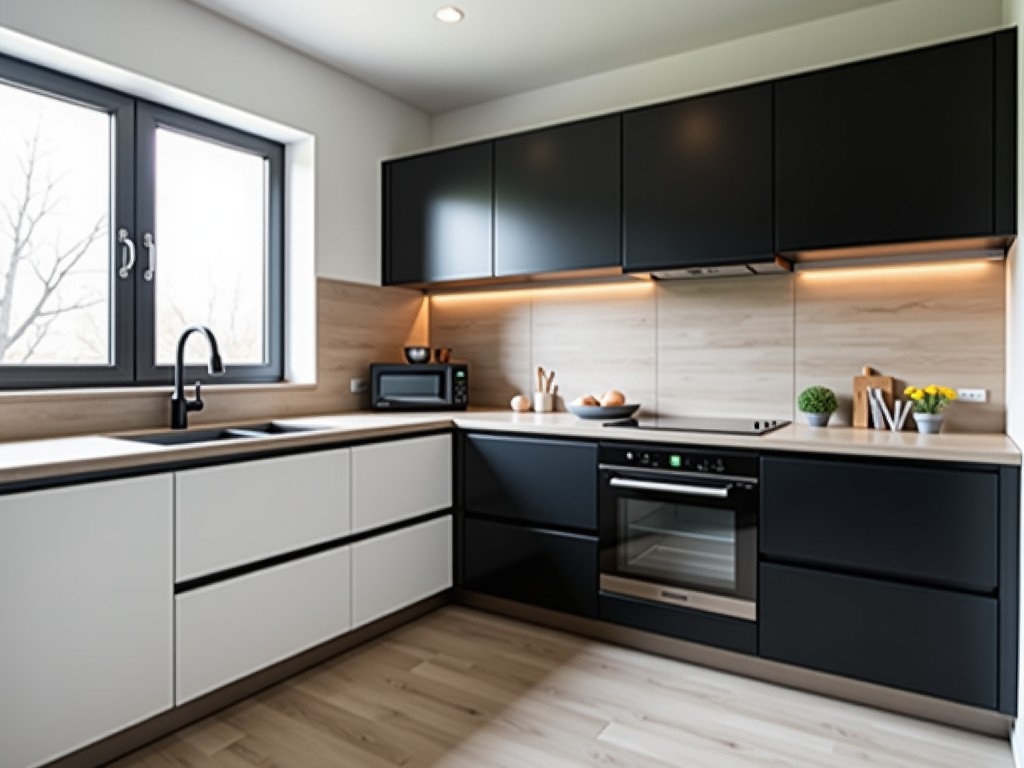
Black And White Kitchen Cabinets
Black and white kitchen cabinets combine contrasting finishes to create visual depth and functional clarity in commercial and residential environments. This dual-tone approach allows designers to
- Category:
- Kitchen Cabinet
Black and White Kitchen Cabinets
Black and white kitchen cabinets combine contrasting finishes to create visual depth and functional clarity in commercial and residential environments. This dual-tone approach allows designers to define zones, highlight work areas, and maintain material consistency while addressing both aesthetic and ergonomic requirements. The system relies on standardized panel construction, precise edge banding, and compatible hardware integration to ensure long-term performance under frequent use.
Material Construction and Finish Specifications
Cabinet boxes are typically manufactured from 18mm moisture-resistant MDF or particleboard core, faced with thermally fused laminate (TFL) or high-pressure laminate (HPL) in black and white variants. The core material meets ANSI A208.1 Grade M-2 standards for internal bond strength (>0.8 MPa) and screw holding capacity (>1100 N in face, >800 N in edge). Surface finishes are specified for abrasion resistance (ASTM D4060, Taber Abrader, <80 mg loss per 1000 cycles) and stain resistance (NEMA LD 3-2005, Test Method 3.3). Edge banding uses 1mm PVC or ABS with laser-etched grain matching, applied via hot-air activation to achieve peel strength >1.8 N/mm (ASTM D903).
White finishes utilize titanium dioxide-based pigments with UV stabilizers to prevent yellowing, maintaining ΔE < 2.0 under 1500 hours of xenon arc exposure (ASTM G155). Black finishes employ carbon black dispersions with matte or low-gloss modifiers to achieve 5–15% gloss units at 60° (ASTM D523), minimizing fingerprint visibility while ensuring consistent color matching across production batches (ΔE < 1.5). Both finishes undergo cross-hatch adhesion testing (ASTM D3359) to confirm coating integrity, requiring minimum 4B rating.
Structural Design and Load Performance
Wall cabinets are engineered for a maximum uniform load of 68 kg (150 lbs) when installed with four #10 wood screws into wall studs spaced at 16" oc, based on axial withdrawal testing per KCMA A161.1. Base cabinets support a distributed load of 136 kg (300 lbs) on the countertop surface, with stile and rail constructions designed to limit deflection to < L/200 under load. Full-extension drawer systems use ball-bearing slides rated for 45 kg dynamic load per pair, tested to 50,000 cycles (ANSI/BHMA A156.9).
Door alignment is maintained through concealed European-style hinges with 3-way adjustment (depth, side, height), capable of compensating for ±1.5 mm panel variation. Hinge cups are pressed into 35mm diameter bores with ±0.1 mm tolerance, ensuring consistent torque output (>0.25 Nm) across 100,000 cycles. Shelf pins utilize 5mm diameter steel with nylon collars, inserted into vertically spaced 32mm pattern holes, allowing incremental adjustment in 32mm increments while resisting pull-out forces >200 N.
Standard Dimensions and Modular Configuration
Standard cabinet heights are 30", 36", and 42" for wall units, and 34.5" for base units (excluding countertop thickness). Depths are 12" for wall cabinets and 24" for base cabinets, with optional 27" deep base units available for appliance garages or pantry extensions. Widths follow 3" increments from 9" to 48", accommodating standard appliance openings and filler strategies. All dimensions adhere to ANSI A161.1 tolerances: ±1.5 mm for length/width, ±2.0 mm for squareness, and ±0.5 mm for edge straightness.
Modular design enables black and white configurations through zoned application: white uppers for light reflection in task areas, black lowers to conceal wear near floors and workspaces. Alternatively, black uppers can anchor tall pantry units while white bases maintain openness in island configurations. Fillers, end panels, and toe kicks are available in matching finishes to maintain visual continuity. Interior accessories — such as pull-out trays, lazy Susans, and spice racks — are specified in white or natural maple to avoid visual competition with exterior finishes.
Hardware Integration and Functional Accessories
Handles and pulls are specified separately to allow finish coordination; common options include brushed nickel, matte black, or polished chrome in bar, cup, or finger-pull styles. Mounting hole patterns follow 96mm or 128mm centers, with drilling templates provided to ensure alignment within ±0.5 mm. Soft-close mechanisms are integrated into hinges and drawer slides, reducing impact velocity to <0.2 m/s and limiting rebound distance to <2 mm. All hardware components undergo salt spray testing (ASTM B117) for 24 hours minimum to verify corrosion resistance in high-humidity environments.
Interior lighting options include LED strip lights with 3000K or 4000K color temperature, mounted under wall cabinets or inside glass-door units. Power supplies are Class 2 rated, with dimming capability via 0–10V or PWM signals. Ventilation components — such as grille inserts for microwave cabinets or louvered panels for pantry units — are manufactured from the same laminate material as doors, ensuring finish consistency and thermal stability up to 60°C ambient temperature.
Quality Control and Manufacturing Tolerances
Each cabinet undergoes multi-stage inspection: raw material verification (core density, laminate adhesion), panel cutting accuracy (CNC router tolerance ±0.1 mm), edge banding continuity (visual and tensile testing), bore alignment (hinge and shelf pin hole position ±0.2 mm), and final assembly squareness (diagonal difference <3 mm). Finish uniformity is assessed under D65 lighting using spectrophotometers, with ΔE < 1.5 acceptable for solid colors and <2.0 for wood-grain laminates. Random sampling includes 100% functional testing of doors and drawers for alignment, clearance, and closing force.
Packaging for shipment includes corner protectors, edge guards, and 6mm polyethylene foam wrapping, enclosed in 7-ply corrugated cartons rated for 65 kg burst strength (ASTM D642). Units are stacked no higher than 1.2m on pallets, with stretch film securing layers. Export packaging meets ISPM 15 standards for wood pallets and includes desiccant packs to maintain relative humidity <60% during transit. Each carton carries a label with SKU, finish code, production date, and QR code linking to installation instructions and material safety data sheets (MSDS).
Applications in Commercial and Residential Settings
In commercial kitchens — such as those in schools, healthcare facilities, or employee cafeterias — black lowers help mask scuffs from carts and foot traffic, while white uppers improve visibility of stored items under ambient lighting. The contrast supports HACCP-compliant zoning by visually separating preparation, cooking, and storage areas without physical barriers. In residential multi-family units, the scheme provides a neutral yet distinctive appearance that resists stylistic obsolescence, appealing to broad tenant demographics while maintaining resale value.
For hospitality environments — including hotel suites, assisted living facilities, or corporate cafeterias — the finish combination allows for easy cleaning with neutral pH detergents and maintains appearance under frequent sanitation cycles. Black surfaces reduce the visibility of water spots and condensation, particularly near sinks and beverage stations, while white interiors enhance product recognition in refrigerated storage or dry goods cabinets. The system integrates seamlessly with standard appliance cutouts and utility chases, preserving workflow efficiency.
| Parameter | Typical Value | Test Standard |
|---|---|---|
| Core Material Density | 650–750 kg/m³ | ASTM D1037 |
| Surface Abrasion Resistance | <80 mg loss/1000 cycles | ASTM D4060 (Taber Abrader) |
| Adhesion (Cross-Hatch) | 4B minimum | ASTM D3359 |
| Hinge Torque Output | >0.25 Nm | ANSI/BHMA A156.9 |
| Drawer Slide Cycle Life | 50,000 cycles | ANSI/BHMA A156.9 |
| Finish Color Consistency (ΔE) | <1.5 (solid), <2.0 (grain) | ASTM D2244 (D65 illuminant) |
| Shelf Pin Pull-Out Resistance | >200 N | KCMA A161.1 |
| Edge Band Peel Strength | >1.8 N/mm | ASTM D903 |
All values represent typical production outcomes; actual performance may vary based on specific substrate, finish grade, and installation conditions. Custom tolerances, material substitutions, or enhanced performance ratings are available upon request for projects with specialized requirements such as high-humidity environments, chemical exposure, or seismic zones. Technical data sheets and test reports can be provided to support specification compliance.
Ordering, Customization, and Lead Time
Standard black and white cabinet configurations are available from stock in common widths and heights, with typical lead time of 10–15 business days for regional distribution. Custom dimensions, non-standard finishes (e.g., textured laminates, matte vs. semi-gloss), or modified interior layouts require engineering review and add 5–10 days to the production schedule. Minimum order quantities apply for custom runs: 5 units for modified dimensions, 10 units for unique finish combinations.
Quotations require submission of: cabinet schedule (quantities by size and type), finish specification (black/white assignment per unit), hardware preferences, and any accessory inclusions (lighting, organizers, filler strips). For projects requiring BIM integration, Revit families are available upon request with parametric sizing and material tagging. Shop drawings include elevation views, section details, and hardware schedules for installer coordination.



