Wholesale Wooden Pocket Door
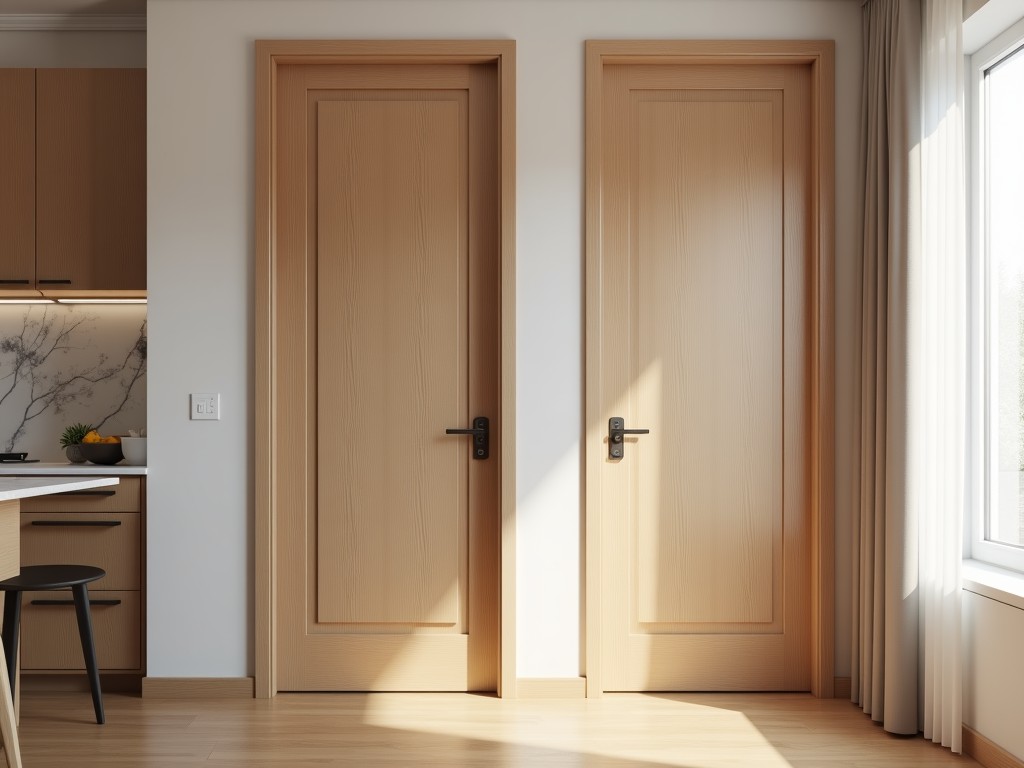
Wholesale Wooden Pocket Door
Pocket doors are sliding door assemblies designed to retract fully into a wall cavity, eliminating the swing clearance required by hinged doors. In commercial and institutional environments—such as
- Category:
- Interior Door
Wholesale Wooden Pocket Door Systems
Pocket doors are sliding door assemblies designed to retract fully into a wall cavity, eliminating the swing clearance required by hinged doors. In commercial and institutional environments—such as healthcare facilities, office partitions, and hospitality suites—this space-saving mechanism addresses spatial constraints while maintaining acoustic and fire-rated performance where specified. Wholesale supply of wooden pocket doors involves standardized hardware integration, precise jamb and track engineering, and material consistency across multiple units to support large-scale installations.
Core Components and Assembly Logic
A complete wooden pocket door system consists of four interdependent elements: the door slab, the overhead track and roller assembly, the vertical jambs with door guides, and the wall cavity frame (often supplied as a metal stud kit). The door slab, typically 1-3/8" to 1-3/4" thick hardwood or engineered wood, attaches to top-mounted rollers via a concealed connector plate. The track, usually extruded aluminum or steel, supports the door’s weight—commonly rated for 75 to 150 lbs per unit depending on roller bearing type and quantity. Floor guides, either bottom-mounted or wall-affixed, prevent lateral drift during operation without contacting the finished floor surface.
Wall cavity preparation is critical: the rough opening must exceed the door width by 2x the door thickness plus clearance for jambs and hardware, while the height accommodates the track and header. Steel stud framing, often 20-gauge, is reinforced with horizontal blocking at the header and sill to support track loads. Pre-assembled cavity kits reduce field labor by integrating studs, plates, and grommets for electrical conduit, though they require precise coordination with rough-in MEP layouts. Wholesale distributors typically supply slabs, hardware, and cavity frames as matched sets to ensure dimensional compatibility.
Material Selection for Door Slabs
Door slab material directly influences weight, stability, finish quality, and cost. Solid hardwoods like maple, oak, or walnut offer high density and machinability but are prone to movement with humidity changes unless properly acclimated and sealed. Engineered options—such as MDF with veneer faces or stave-core constructions—provide greater dimensional stability in fluctuating environments, making them suitable for healthcare or humid climates. Slab weight typically ranges from 2.5 to 4.5 lbs per square foot; a 3'0" x 6'8" door therefore imposes 50 to 90 lbs on the hardware, which must be verified against track and roller ratings.
Edge banding and lippings are essential for durability: PVC or wood veneer edges protect the slab core from impact and moisture ingress during repeated sliding. Finish systems—whether factory-applied UV-cured polyurethane or site-stained and sealed—must accommodate flexing at the roller connection point without cracking. Wholesale suppliers often offer pre-finished slabs in standard sheens (e.g., 30% or 60% gloss) to reduce field labor, though custom staining requires lead time and minimum order quantities due to batch mixing constraints.
Hardware Performance Specifications
Roller assemblies are the primary wear point in pocket door systems. Nylon-coated steel rollers on precision bearings offer quiet operation and corrosion resistance, suitable for interior applications. For heavier doors or high-cycle environments (e.g., hospital corridors), sealed ball-bearing rollers in stainless steel housings reduce friction and extend service life. Track deflection must remain under L/176 (where L is span) under full load to prevent binding; this is achieved through appropriate gauge selection and intermediate supports in openings over 4 feet wide.
Anti-jump blocks prevent the door from disengaging the track if swung upward accidentally, while soft-close dampers—hydraulic or pneumatic—mitigate impact at the end of travel, reducing noise and hardware wear. These are often optional in wholesale packages but recommended for automated or high-traffic settings. All hardware components should be sourced from a single supplier lot to ensure finish consistency and functional compatibility, particularly when integrating with access control or electromagnetic hold-open devices.
Dimensional Standards and Customization
Standard nominal widths for single pocket doors are 2'0", 2'4", 2'6", 2'8", and 3'0", with heights of 6'8" or 7'0" to match common door frames. Actual slab width is typically 1/2" less than the nominal size to allow for jamb clearance and hardware offset. For example, a 3'0" nominal door has a slab width of 35-1/2" and requires a rough opening of approximately 41-1/2" wide (accounting for two jambs and track clearance). Height adjustments are limited by the track length; non-standard heights require custom track fabrication and may affect roller load distribution.
Double (biparting) pocket doors, where two slabs meet in the center, require synchronized hardware and a center stop or astragal to cover the gap. These are common in conference rooms or therapy suites where wide, unobstructed access is needed periodically. Customization options include pre-mortising for locks or flush pulls, routing for wire chases (e.g., for access control or lighting), and non-standard thicknesses (up to 2-1/4") for fire-rated cores—though the latter necessitates reevaluating hardware ratings and cavity depth.
Quality Control and Consistency in Wholesale Supply
Wholesale procurement demands batch-to-batch uniformity in slab dimensions, moisture content (ideally 6-9% KD), and finish adhesion. Suppliers should provide mill test reports confirming compliance with AWI or AWS standards for flatness, twist, and cup—typically <0.005" per foot for premium grade. Hardware lots must be traceable, with roller bearing torque and track straightness verified via sample testing. Packaging for wholesale shipments includes edge protection, corner boards, and humidity-barrier wraps to prevent damage during transit and storage.
Upon receipt, installers should verify slab flatness across the width and length, check roller engagement with the track, and confirm that the door moves freely without binding or rubbing on jambs. Any deviation beyond 1/16" in alignment may indicate framing issues or hardware misinstallation. Wholesale suppliers often offer technical support for field adjustment procedures, including roller height tuning and guide clearance setting, to ensure long-term performance.
Applications in Commercial and Institutional Sectors
In healthcare environments, pocket doors reduce corridor congestion in patient rooms and treatment areas, allowing beds and equipment to pass through without requiring swing space. Acoustic-rated assemblies (STC 30-35) are achievable with solid-core slabs and perimeter seals, supporting privacy requirements in consultation rooms. The absence of a threshold facilitates wheelchair compliance under ADA when floor clearance is maintained.
Office fit-outs use pocket doors for flexible space division—enclosing private offices or focus rooms that can be opened to create collaborative zones. The clean retract profile maintains sightlines and light distribution when open. In hospitality, suites and bathrooms benefit from the space efficiency, particularly in urban hotels where every square foot is valued. Wholesale supply ensures consistency across dozens of identical units, simplifying maintenance and parts replacement.
Comparison: Pocket Doors vs. Hinged Doors in Commercial Use
| Aspect | Pocket Door | Hinged Door |
|---|---|---|
| Swing Clearance Required | None | Equal to door width (e.g., 36" for 3'0" door) |
| Wall Cavity Depth Needed | Min. 4-1/2" (for 1-3/4" door + hardware) | None |
| Typical Hardware Load Rating | 75–150 lbs per door | Hinge-dependent (typically 3 hinges @ 60–100 lbs each) |
| Installation Complexity | Moderate (framing integration) | Low (standard frame hanging) |
| Space Efficiency Rating | High (recovers floor area) | Low (requires clearance zone) |
| Acoustic Performance Potential | Good (with seals and solid core) | Good (standard sealing easier) |
Ordering and Lead Time Considerations
Wholesale orders typically require shop drawings showing slab dimensions, hardware locations, and cavity framing details for approval before production. Lead times vary: stocked hardwood slabs in standard sizes may ship in 2–3 weeks, while custom finishes, non-standard thicknesses, or fire-rated cores extend this to 6–8 weeks. Hardware kits (track, rollers, guides) are often available from stock for common sizes, but biparting systems or specialized dampers may require additional time.
Minimum order quantities apply for custom staining or veneer matching due to batch preparation. For large projects, suppliers may offer staggered delivery schedules aligned with construction phases to reduce on-site storage needs. Export shipments include ISPM-15 compliant packaging and corrosion inhibitors for hardware, with transit protection against moisture and impact. Buyers should request sample slabs and hardware kits for pre-installation testing, particularly when integrating with access control or automated systems.



