Slim Frame Sliding Glass Partition Door
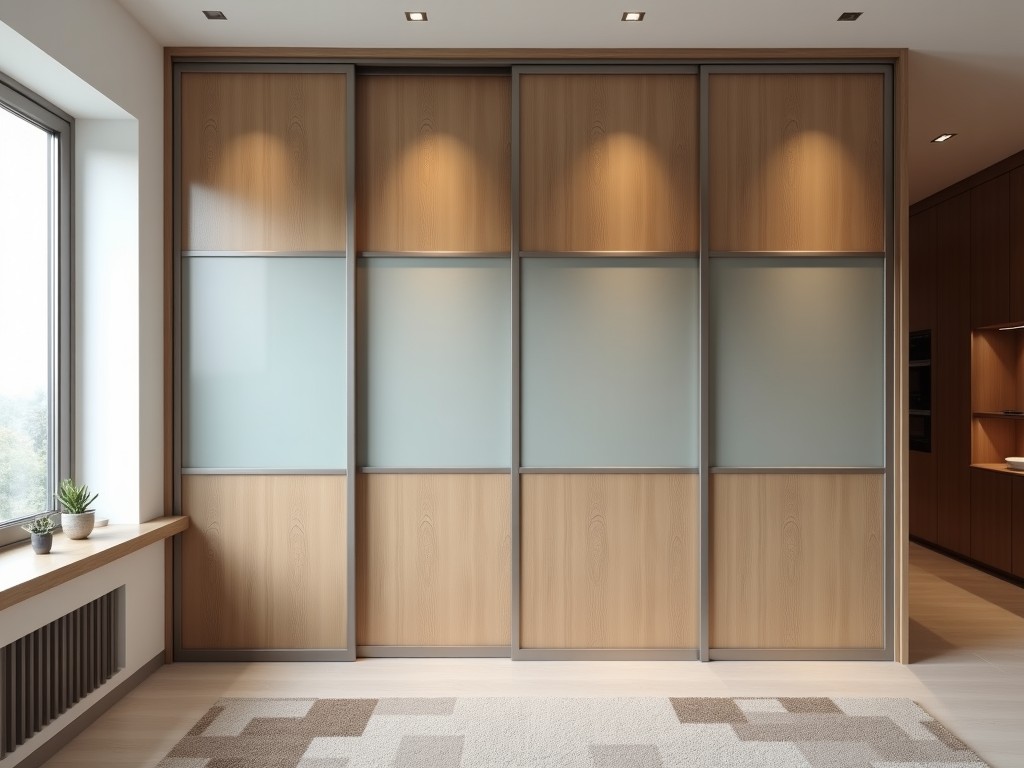
Slim Frame Sliding Glass Partition Door
Slim frame sliding glass partition doors are engineered for spatial division in industrial and commercial environments where minimal visual obstruction and smooth linear motion are required. The
- Category:
- Interior Door
Slim Frame Sliding Glass Partition Door
Slim frame sliding glass partition doors are engineered for spatial division in industrial and commercial environments where minimal visual obstruction and smooth linear motion are required. The system integrates narrow-profile aluminum or steel frames with tempered or laminated glass panels, enabling overhead or floor-guided sliding operation. This configuration supports frequent reconfiguration of workspaces while maintaining structural integrity and acoustic performance within defined limits.
Key Technical Characteristics
Frame depth typically ranges from 35 mm to 50 mm, reducing visual bulk without compromising load-bearing capacity. Glass thickness options include 8 mm, 10 mm, and 12 mm tempered glass, or 8.8 mm and 10.8 mm laminated glass for enhanced safety and sound attenuation. The sliding mechanism employs precision-engineered roller carriages with Delrin or nylon wheels running on stainless steel or anodized aluminum tracks, capable of supporting panel weights up to 120 kg per leaf. Horizontal and vertical alignment is maintained via adjustable guide systems, ensuring consistent operation over thousands of cycles.
Sealing is achieved through compressible EPDM or silicone gaskets located at frame-to-glass and frame-to-frame interfaces, providing draft resistance and limited acoustic damping (typically STC 28–32 depending on glazing and sealing quality). Threshold options include low-profile recessed designs (under 5 mm rise) for accessibility compliance or standard sills for improved weather resistance in semi-exposed applications. All metal components undergo surface treatment such as anodizing (AA15 micron) or powder coating (minimum 60 μm thickness) to resist corrosion in indoor industrial environments.
Material Options and Configuration Logic
Frame materials are selected based on environmental exposure, load requirements, and finish durability. Extruded aluminum alloys (6063-T5) offer high strength-to-weight ratio and excellent corrosion resistance, suitable for most indoor applications. Cold-rolled steel frames (SPCC) provide increased rigidity for wider spans or higher wind load scenarios, requiring protective coatings to prevent oxidation. Glass selection balances transparency, safety, and acoustic needs: tempered glass provides impact resistance and breaks into small granular pieces; laminated glass retains fragments upon breakage and improves sound transmission loss by 2–3 dB compared to monolithic tempered glass of equal thickness.
- Aluminum frame: 6063-T5 alloy, clear anodized or RAL powder coat
- Steel frame: SPCC, zinc-coated or powder coated
- Glass: 8/10/12 mm tempered; 8.8/10.8 mm laminated (PVB interlayer)
- Track: stainless steel 304 or anodized aluminum
- Rollers: Delrin wheels on stainless steel bearings, rated for 100,000 cycles
Typical Applications in Industrial and Commercial Settings
These partitions are commonly used in manufacturing facilities to create flexible clean zones, inspection areas, or temporary enclosures without sacrificing sightlines for supervision. In logistics and warehousing, they delineate sorting areas, packing stations, or visitor walkways while maintaining visibility for safety monitoring. Commercial environments such as showrooms, corporate lobbies, and modular office spaces benefit from the ability to reconfigure layouts quickly for events, team restructuring, or client presentations, all while preserving a minimalist aesthetic that does not interfere with interior design schemes.
The slim frame design minimizes visual clutter, allowing natural light to penetrate deeper into interior spaces, reducing reliance on artificial lighting. Unlike traditional swinging doors, sliding operation eliminates swing radius, enabling installation in tight corridors or adjacent to equipment where space is constrained. The system supports both single and multiple leaf configurations, including bypass and stacking arrangements, allowing adaptation to varying opening widths and traffic patterns.
Performance Considerations and Limitations
Acoustic performance is moderate; while laminated glass and effective sealing reduce sound transmission, these partitions are not designed for high-noise isolation applications. For environments requiring STC ratings above 35, alternative solutions such as stud walls with insulated glazing units or specialized acoustic sliding systems should be considered. Air infiltration is limited by gasket effectiveness but not equivalent to sealed exterior doors; therefore, these partitions are best suited for interior use where pressure differentials are minimal.
Load capacity depends on proper installation, including track alignment and structural support at ceiling or floor anchorage points. Uneven settling of building substrates can affect roller engagement over time, necessitating periodic adjustment. Glass deflection under its own weight must be evaluated for spans exceeding 1.2 m, particularly with thinner glazing; manufacturer-provided deflection charts should be consulted during design. Hardware components are subject to wear; scheduled inspection of rollers, tracks, and gaskets is recommended in high-cycle environments.
Customization and Project-Specific Adaptation
Customization extends beyond standard dimensions to include non-rectangular opening geometries, integrated access control hardware, and specialized glass treatments. Radius tracks enable curved sliding partitions for architectural features, while bi-parting or multi-leaf stacks accommodate wide openings in industrial halls. Glass can be supplied with low-iron content for improved clarity, fritted patterns for privacy, or switchable PDLC layers for on-demand opacity. Frame finishes can match corporate color schemes or integrate with adjacent wall systems through custom extrusion profiles.
Hardware options include soft-close dampers to reduce impact at end positions, locking mechanisms with cylinder or electronic access control, and floor guides designed to accommodate uneven surfaces. For cleanroom or hygienic environments, frames can be manufactured with radius corners and seamless welds to eliminate particle traps, paired with gaskets resistant to cleaning agents. All customizations are evaluated for structural compatibility, operational smoothness, and long-term maintainability before production.
Quality Control and Manufacturing Process
Manufacturing begins with precision cutting and machining of frame profiles to tolerances of ±0.2 mm for mating surfaces. Glass edges are polished and cleaned before lamination or tempering to ensure adhesion and strength. Frame assembly involves mechanical fastening or corner crimping, followed by gasket insertion and roller carriage installation. Each unit undergoes dry-cycle testing to verify smooth operation, alignment, and gap consistency across the full travel path.
Final inspection includes visual assessment of surface finish, glass integrity (using polarized light to detect tempering quality), and hardware function. Water and air leakage tests may be conducted upon request using standardized spray chambers or pressure differential equipment. Documentation provides material certificates, glass conformance to EN 12150 or ASTM C1048, and coating thickness measurements. Packaging uses corner protectors, edge foam, and stretch wrapping to prevent damage during transit, with units secured on pallets designed for forklift handling.
Typical Specification Table
| Parameter | Typical Value or Range | Notes |
|---|---|---|
| Frame Depth | 35–50 mm | Dependent on material and glass thickness |
| Glass Thickness | 8, 10, 12 mm tempered 8.8, 10.8 mm laminated |
Laminated improves safety and STC by 2–3 dB |
| Maximum Panel Weight | 120 kg per leaf | Limited by roller and track capacity |
| Track Material | Stainless steel 304 or anodized aluminum | Stainless preferred in humid or chemical environments |
| Acoustic Performance (STC) | 28–32 | Dependent on glazing and sealing quality |
| Surface Finish (Aluminum) | Clear anodized (AA15) or powder coat (60 μm min) | Custom RAL colors available |
| Cycle Life (Rollers) | >100,000 cycles | Based on Delrin wheels and stainless bearings |