Pocket Door For Bathroom Entry Factory
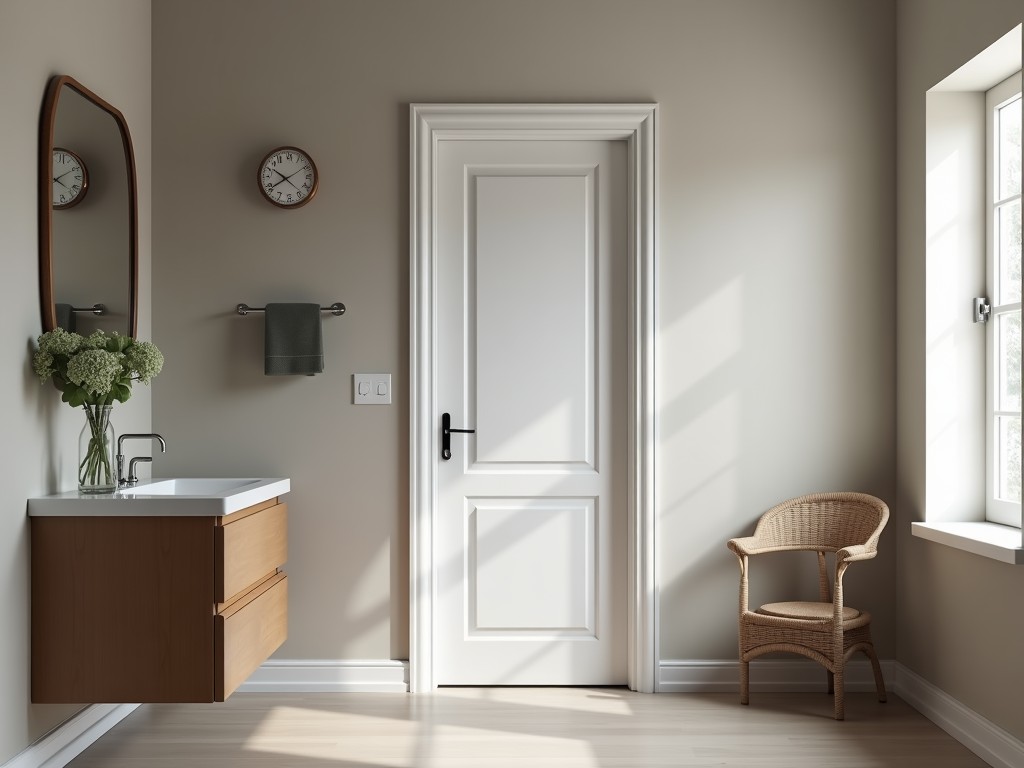
Pocket Door For Bathroom Entry Factory
Pocket door systems for bathroom entry are engineered to maximize usable space in confined sanitary environments by eliminating swing clearance requirements. These mechanisms allow the door leaf to
- Category:
- Interior Door
Pocket Door Systems for Bathroom Entry – Factory Solutions
Pocket door systems for bathroom entry are engineered to maximize usable space in confined sanitary environments by eliminating swing clearance requirements. These mechanisms allow the door leaf to retract fully into a cavity within the adjacent wall, providing unimpeded access while maintaining full privacy and acoustic separation when closed. Factory-produced units are designed for integration during new construction or major renovation, with precision tolerances to ensure smooth operation over decades of use in high-moisture environments.
Core Mechanical Design and Load Path
The structural integrity of a pocket door system depends on how vertical and lateral loads are transferred from the door leaf to the building framework. Factory systems typically employ a header-mounted steel track assembly that carries the full weight of the door through precision-engineered roller carriages. This track is anchored to structural studs or blocking, not merely to drywall, to prevent sagging under sustained load. The door leaf itself is reinforced with internal stiles or aluminum extrusions to resist warping, particularly important in bathroom environments where humidity fluctuations exceed 70% RH.
Lateral stability is maintained through floor guides and wall-mounted bumpers that prevent lateral drift during operation. Unlike surface-mounted sliding doors, pocket systems require the wall cavity to be framed to exact dimensions—typically matching the door leaf thickness plus clearance for rollers and finish materials. Factory units include detailed cavity preparation specifications to ensure the track remains level and plumb, which directly affects long-term operational smoothness and prevents binding caused by frame distortion.
Material Selection for Humid Environments
Bathroom environments demand materials resistant to corrosion, moisture absorption, and microbial growth. Factory pocket door systems for sanitary use commonly specify stainless steel (Grade 304 or 316) for all exposed hardware—track, rollers, brackets, and guides—due to its pitting resistance in chloride-rich atmospheres. Aluminum components, when used, are anodized to minimum 15µm thickness to withstand repeated cleaning cycles. Door leaf materials vary by application: solid core composite doors with PVC or FRP facings are standard for wet zones, while laminated glass or acrylic options are available for light-transmitting partitions where privacy is maintained via frosted or patterned finishes.
Sealing systems are critical for maintaining acoustic and moisture barriers. Factory units integrate compressible vinyl or silicone gaskets along the door edges and strike jamb, designed to maintain sealing force over 10,000+ cycles. These seals are selected based on compression set resistance (<5% after 24h at 70°C) and compatibility with common bathroom cleaners. Threshold designs avoid exposed crevices where water can accumulate, often employing low-profile, sloped profiles that direct moisture toward the drain without impeding wheelchair access per ADA or ISO 21542 guidelines.
Roller Carriage Performance and Lifecycle Expectations
The roller carriage is the wear-critical component in any sliding door system. Factory-engineered units for bathroom entry typically use dual-wheel nylon or polyurethane tires running on hardened steel or stainless steel tracks. Nylon offers quiet operation (<25 dB at 0.5 m/s) and self-lubricating properties, while polyurethane provides higher load capacity (up to 100 kg per carriage) and better resistance to edge loading. Carriage assemblies are sealed to prevent ingress of moisture and particulates, with lubrication points accessible only during factory service—eliminating the need for field maintenance in sealed environments.
Lifecycle testing follows ANSI/BHMA A156.14 or EN 1527 standards, with factory units commonly rated for 100,000 operational cycles without performance degradation. This equates to over 30 years of residential use or 10+ years in high-traffic institutional settings. Wear indicators are not typically included; instead, manufacturers specify replacement intervals based on accelerated testing data, ensuring that roller and track wear remain below 0.1mm over the rated lifespan—well within the threshold for noticeable friction increase or noise generation.
Factory Customization and Integration Logic
Pocket door systems are not off-the-shelf commodities; their success depends on precise integration with wall construction, door specifications, and hardware requirements. Factories offer customization along three primary axes: cavity dimensions (width, height, depth), track length and mounting configuration, and door leaf interface details. Cavity depth is standardized to accommodate common stud widths (e.g., 90mm for 2x4 framing with 12.5mm drywall each side), but can be extended for thicker walls or insulated partitions. Track length is cut to match the clear opening plus overtravel, typically adding 50–100mm beyond the door width to allow full retreat into the cavity.
Door leaf attachment methods vary by material and weight. For solid core composites, factories provide reinforced mounting plates or through-bolting kits that distribute load across the door’s internal structure. For glass leaves, point-fixings or top-hung brackets with shear-resistant adapters are used to prevent stress concentration. All customizations are supported by factory-generated shop drawings that show exact cutouts, blocking locations, and clearance requirements—reducing field errors and ensuring compatibility with electrical, plumbing, or HVAC rough-ins that may traverse the wall cavity.
Quality Control and Factory Testing Protocols
Industrial buyers require transparency in manufacturing consistency. Factory pocket door systems undergo multi-stage quality control: incoming hardware inspection (dimensional and material verification), sub-assembly tracking (roller pre-load, seal compression), and final system testing. Each unit is cycled through a minimum of 50 full open-close operations under load to verify smoothness, alignment, and seal engagement. Track straightness is verified using laser profilometry with tolerance of ±0.5mm over 2m length—critical to prevent cumulative binding.
Acoustic performance is tested per ASTM E90 or ISO 10140, with typical STC ratings ranging from 28 to 35 depending on door mass and seal effectiveness. Smoke leakage tests (per UL 1784) are conducted for units specified in healthcare or hospitality applications where compartmentalization is required for life safety. All test data is retained per project and available upon request—not as marketing claims, but as traceable engineering records supporting specification compliance.
Typical Configuration Table
| Parameter | Typical Value | Customizable? |
|---|---|---|
| Door Leaf Width | 600–900 mm | Yes, in 50 mm increments |
| Door Leaf Height | 1900–2200 mm | Yes, up to 2400 mm |
| Wall Cavity Depth | 100 mm (standard stud + 2x drywall) | Yes, up to 150 mm |
| Track Material | Stainless Steel 304 | 316 available for marine environments |
| Roller Type | Sealed dual-wheel nylon | Polyurethane or stainless steel options |
| Acoustic Rating (STC) | 30–32 (solid core) | Up to 35 with enhanced seals |
| Finish Options | Factory primed, PVC laminate, FRP, tempered glass | Custom finishes upon request |
Applications in Bathroom Entry Design
Pocket doors are particularly valuable in bathroom entries where space is at a premium and traffic flow must remain unimpeded. In residential renovations, converting a hinged door to a pocket system can recover up to 0.9 m² of usable floor area—critical in en-suites or powder rooms where every centimeter affects fixture placement and circulation. In healthcare settings, such as patient rooms or assisted living facilities, the absence of a swinging door reduces collision risks for individuals using mobility aids and allows staff to maneuver equipment without obstruction, directly supporting universal design principles.
Hospitality environments benefit from the acoustic separation provided by well-sealed pocket systems, ensuring guest privacy without sacrificing the open-plan aesthetic common in modern suites. Unlike curtains or folding panels, factory-engineered pocket doors maintain consistent performance over time, with no sagging, misalignment, or degradation of seal integrity—factors that compromise both privacy and noise control in high-turnover installations. The flush retractable design also eliminates cleaning obstacles, reducing maintenance labor in wet areas where hygiene protocols are stringent.
Industrial and laboratory facilities specify pocket doors for containment zones where rapid egress and minimal touch surfaces are required. The smooth, handle-activated operation (often with lever or push-plate hardware) reduces contact points compared to traditional knobs, supporting infection control protocols. When paired with automatic closing mechanisms or electromagnetic hold-opens, these systems can integrate with fire alarm or ventilation controls to ensure compartmentalization during emergencies—functions that rely on precise factory tolerances and reliable hardware performance over thousands of cycles.
Contact our engineering team to discuss your specific bathroom entry requirements, including cavity preparation details, load calculations, and material compatibility for your project environment.