Modern Wooden Bathroom Vanity Cabinet
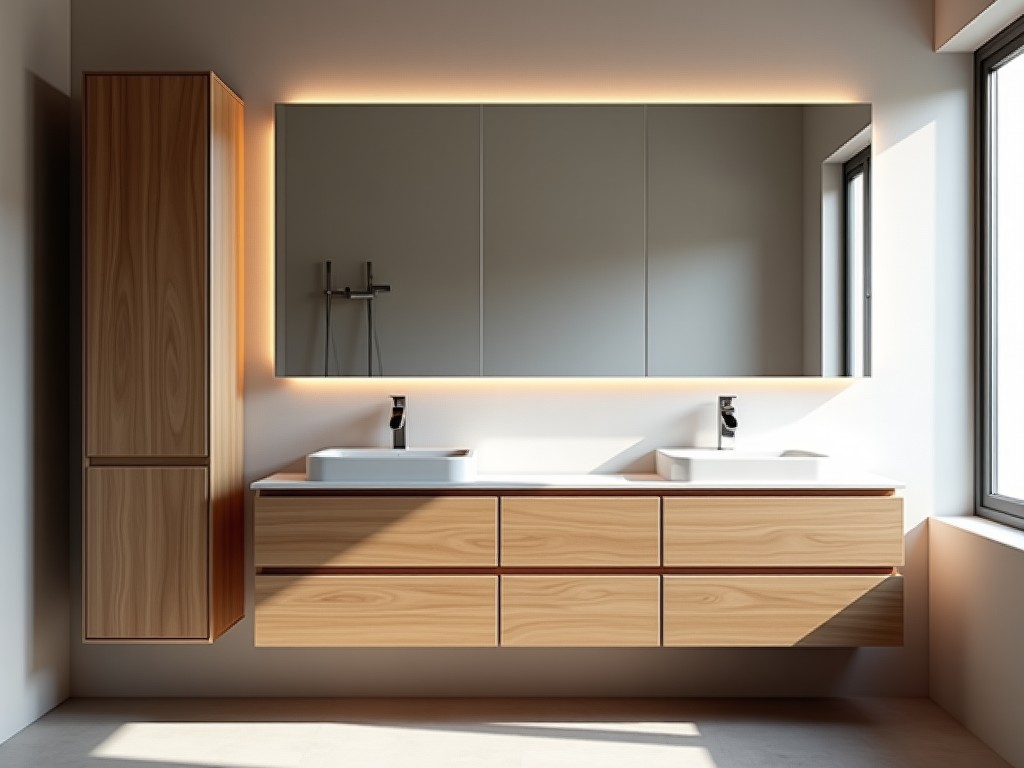
Modern Wooden Bathroom Vanity Cabinet
Selecting a bathroom vanity cabinet requires evaluating material stability, moisture resistance, and dimensional precision under fluctuating humidity conditions. This product page details the
- Category:
- Bathroom Cabinet
Modern Wooden Bathroom Vanity Cabinet
Selecting a bathroom vanity cabinet requires evaluating material stability, moisture resistance, and dimensional precision under fluctuating humidity conditions. This product page details the engineering considerations behind modern wooden vanity cabinets designed for commercial and high-end residential installations, focusing on construction methods, material behavior, and long-term performance in wet environments.
Core Construction and Material Selection
The cabinet carcass is constructed from 18mm thick, moisture-resistant medium-density fiberboard (MDF) with a Class E1 formaldehyde emission rating, bonded using melamine-urea-formaldehyde resin. Edge sealing employs 0.5mm PVC tape applied via hot-air extrusion to prevent water ingress at cut faces. Door and drawer fronts utilize 3-layer engineered wood: a poplar core with 0.6mm oak veneer on both faces, cross-banded to minimize warping. All joints are reinforced with dowels and PVAc adhesive, achieving shear strength exceeding 1.8 MPa in standard tests.
Hardware components are selected for corrosion resistance in humid environments. Drawer slides are full-extension, soft-close mechanisms rated for 30,000 cycles, constructed from cold-rolled steel with zinc-nickel plating (12μm thickness) and sealed with clear passivation. Hinges are concealed, 3-way adjustable, made from stainless steel grade 304 with nickel plating, tested to withstand 50,000 opening cycles without sagging or misalignment. All metal fasteners are passivated or coated to resist galvanic corrosion when in contact with wood preservatives.
Dimensional Stability and Moisture Management
Wood-based materials exhibit hygroscopic behavior, expanding or contracting with changes in relative humidity. To mitigate dimensional movement, the cabinet is designed with floating panels: the back panel is not glued but seated in a 3mm groove, allowing ±1.5mm expansion/contraction without stress buildup. Top and bottom panels are attached via figure-8 fasteners, permitting lateral movement while maintaining vertical alignment. Door and drawer gaps are set to 3mm initially, accommodating up to 2mm of seasonal swelling without binding.
Surface finishing uses a two-component polyurethane coating system: a primer layer (25μm dry film thickness) followed by a topcoat (50μm dry film thickness), providing a barrier against water vapor transmission (WVT < 5 g/m²/24h at 38°C and 90% RH). The coating is UV-stabilized to prevent yellowing under artificial lighting. Edge sealing continuity is verified via dye penetrant inspection, with no defects allowed at joints or corners. Final assembly includes a silicone bead (neutral-cure, mildew-resistant) applied between the cabinet top and countertop to prevent water migration into the carcass.
Configuration and Customization Options
Standard configurations are available in single-basin (600mm–900mm width) and double-basin (1200mm–1500mm width) layouts, with depths of 460mm or 500mm to accommodate varying plumbing rough-ins. Height options include 800mm (standard) and 860mm (ADA-compliant variant with knee clearance). Interior layouts feature adjustable shelving (25mm increments) and full-extension drawers with undermount slides. Plumbing cutouts are precut to standard sizes (100mm–150mm diameter for drains, 38mm for supply lines) but can be modified via CNC routing to match specific fixture layouts.
Veneer species options include white oak, walnut, and ash, each sourced from FSC-certified forests and quarter-sawn for grain stability. Stain colors are applied via water-based dyes to ensure even penetration, followed by the polyurethane topcoat. Hardware finishes are available in brushed nickel, matte black, or polished chrome, all meeting ASTM B117 salt spray resistance (minimum 200 hours). Custom dimensions, cutouts, and hardware placements are available upon receipt of approved shop drawings and fixture specifications.
Quality Control and Testing Protocols
Each unit undergoes a 7-point inspection before packaging: (1) dimensional verification (±1mm tolerance on width, height, depth), (2) squareness check (diagonal difference < 2mm), (3) surface finish adhesion (cross-hatch test, ISO 2409, Grade 1), (4) hardware function test (10 open/close cycles per door/drawer), (5) moisture meter reading (core moisture content 8%–12%), (6) edge seal integrity (visual and tactile inspection), (7) weight verification (to detect missing components). Units failing any criterion are segregated for rework or scrap.
Packaging includes corner protectors (expanded polystyrene, 50mm density), edge guards (corrugated polypropylene), and a double-wall cardboard box (275lb burst strength). Interior surfaces are shielded with LDPE film (50μm thickness) to prevent scratching during transit. Each package includes a QR code linking to the installation manual, material safety data sheet (MSDS), and warranty terms. Export shipments comply with ISPM 15 for wood packaging materials, with heat-treated pallets marked accordingly.
| Parameter | Typical Value | Test Method / Standard |
|---|---|---|
| Cabinet carcass thickness | 18mm | Caliper measurement |
| Door/drawer front thickness | 16mm (3-layer) | Caliper measurement |
| Surface coating thickness | 75μm (primer + topcoat) | DFT gauge (ISO 2808) |
| Hardware cycle life (slides) | 30,000 cycles | ANSI/BHMA A156.9 |
| Formaldehyde emission | Class E1 (<0.1 ppm) | EN 717-1 |
| Water vapor transmission (coating) | <5 g/m²/24h | ASTM E96 (Method B) |
Applications and Environmental Suitability
These vanity cabinets are specified in projects where long-term dimensional stability and resistance to cleaning agents are critical, such as hospitality suites, healthcare facilities, and high-traffic commercial restrooms. The sealed surface finish resists common disinfectants (quaternary ammonium, alcohol-based solutions) without degradation, making them suitable for environments requiring frequent sanitization. In residential applications, the construction accommodates seasonal humidity swings in climates with pronounced winter heating or summer cooling cycles, reducing the risk of joint cracking or door misalignment over time.
Distributors and OEM buyers benefit from the modular design, which allows for efficient flat-pack shipping and on-site assembly with minimal tools (cam locks, confirmation screws). The pre-drilled hole system for shelving and hardware reduces installation variability. For renovation projects, the availability of depth and height variants enables alignment with existing plumbing rough-ins without requiring costly rework. All materials are selected to meet indoor air quality standards, supporting LEED and WELL building certification goals where low-emitting materials are required.
Ordering and Technical Support
To initiate a quotation, provide the following: overall dimensions (width, depth, height), number of basins, preferred veneer species and finish, hardware finish, and any non-standard cutout locations (with fixture template or centerline measurements). Shop drawings should include wall stud locations and obstruction details. Lead time is typically 4–6 weeks from drawing approval, depending on material availability and order volume. Samples of veneer, hardware, and coating swatches are available upon request, shipped via courier with return labels for unused items.
Technical support includes assistance with plumbing coordination, ADA compliance verification, and packaging configuration for specific freight methods (LTL, FTL, container). For projects requiring BIM integration, Revit families are accessible via the manufacturer’s portal. Warranty covers material defects and finish adhesion for 5 years from date of installation, subject to proper maintenance and environmental conditions within specified limits (RH 30%–70%, temperature 10°C–30°C).



