Luxury Bathroom Vanity Set Design
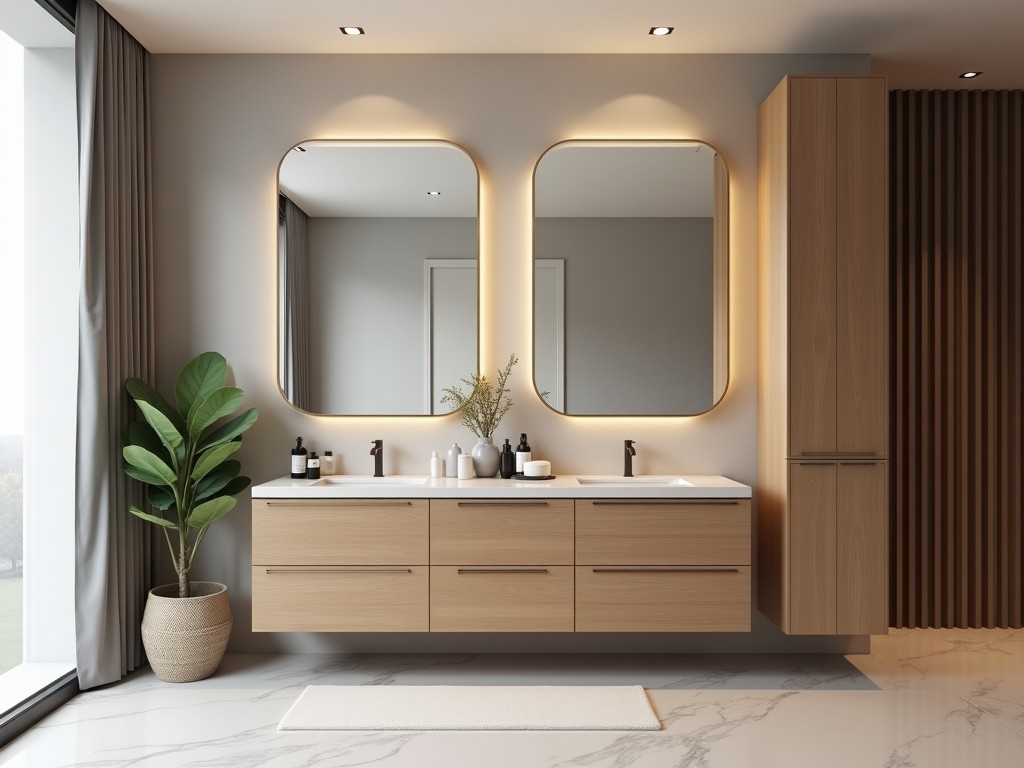
Luxury Bathroom Vanity Set Design
A luxury bathroom vanity set integrates countertop, basin, cabinetry, and hardware into a coordinated system designed for high-end residential and hospitality environments. These assemblies require
- Category:
- Bathroom Cabinet
Luxury Bathroom Vanity Set Design: Technical Specifications and Applications
A luxury bathroom vanity set integrates countertop, basin, cabinetry, and hardware into a coordinated system designed for high-end residential and hospitality environments. These assemblies require precise dimensional tolerances, material compatibility, and load-bearing specifications to ensure long-term performance under daily use conditions. Unlike standard vanities, luxury sets emphasize seamless joints, concealed fastening systems, and surface finishes resistant to moisture, staining, and thermal cycling.
Material selection directly impacts durability and maintenance requirements. Common substrates include marine-grade plywood with formaldehyde-free adhesives, solid hardwoods (such as white oak or walnut), and engineered stone composites for countertops. Basin materials range from vitreous china and fireclay to solid surface and tempered glass, each with distinct thermal expansion coefficients and chemical resistance properties. Hardware components—hinges, drawer slides, and faucet mounts—must meet ANSI/BHMA standards for cycle life and corrosion resistance in humid environments.
Dimensional accuracy is critical for installation and functionality. Standard vanity heights range from 800mm to 900mm, with depths between 460mm and 560mm to accommodate plumbing clearances. Countertop overhangs typically extend 25–40mm beyond cabinet edges to prevent water ingress. Double-basin configurations require minimum center-to-center spacing of 700mm to ensure user comfort and compliance with accessibility guidelines. All dimensions are subject to customization based on project-specific plumbing layouts and spatial constraints.
Material Properties and Performance Characteristics
Substrate stability determines long-term dimensional integrity. Marine-grade plywood with 5-ply construction and void-free core exhibits less than 0.2% linear expansion under 80% relative humidity conditions, outperforming particleboard alternatives which may exceed 0.8% under identical exposure. Solid hardwoods require kiln-drying to 6–8% moisture content and edge sealing to prevent end-grain absorption, which can cause localized swelling and joint failure over time.
Countertop materials must resist common bathroom chemicals including ethanol, hydrogen peroxide, and acidic cleaners (pH 3–5). Quartz composites typically show <0.5% weight loss after 24-hour immersion in these agents, while marble may exhibit 2–5% loss due to calcium carbonate dissolution. Solid surface materials offer repairability through sanding and polishing, whereas vitreous china relies on glaze integrity for stain resistance—micro-scratches can compromise this barrier over 5–7 years of use.
Hardware load ratings directly affect usability and safety. Soft-close drawer slides are rated for 30–40kg dynamic load with 50,000-cycle endurance, while European-style hinges support door weights up to 25kg with 100,000-cycle ratings. All exposed hardware undergoes salt spray testing (ASTM B117) for minimum 200 hours to verify corrosion resistance in coastal or high-humidity installations.
Design Integration and Customization Logic
Vanity sets are engineered as modular systems where cabinetry, countertop, and basin interfaces are defined by standardized tolerances. Cabinet face frames maintain 1.5mm reveal gaps to allow for thermal expansion without binding, while undermount basin installations require precise cutout tolerances of ±0.5mm to prevent stress concentration in brittle materials like porcelain. These specifications are communicated through CAD models with GD&T callouts to ensure manufacturer alignment.
Customization follows a hierarchical approach: primary dimensions (width, height, depth) are adjusted first to fit spatial constraints, followed by material selection based on environmental exposure and aesthetic requirements. Hardware choices are then matched to load expectations and usage frequency. Finish options—such as UV-cured polyurethanes, water-based lacquers, or natural oil treatments—are selected according to VOC compliance, scratch resistance (measured via ASTM D4060 Taber abrasion), and recoatability for future maintenance.
Lighting and power integration require early coordination. Recessed LED channels demand 12–15mm depth within the countertop or apron, with thermal management to prevent overheating. GFCI-protected outlets are positioned at least 150mm above countertop surface and 60mm from basin edges to meet NEC Article 406.8(B) requirements. These elements are incorporated during the design phase to avoid costly field modifications.
Typical Configuration Table
| Parameter | Typical Range | Notes |
|---|---|---|
| Overall Width | 600–1800 mm | Single to triple basin configurations |
| Overall Depth | 460–560 mm | Includes countertop overhang |
| Overall Height | 800–900 mm | Adaptable for vessel or undermount basins |
| Countertop Thickness | 12–30 mm | Dependent on material and edge profile |
| Basin Depth | 140–200 mm | Measured from countertop to basin bottom |
| Drawer Slide Load Rating | 30–40 kg | Dynamic load, 50k-cycle minimum |
Quality Control and Manufacturing Considerations
Incoming material inspection includes moisture content verification (pin meter, ±0.5% accuracy), flatness assessment (feeler gauge, 0.1mm resolution), and adhesion testing for laminated surfaces (cross-hatch test per ASTM D3359). Dimensional checks are performed at CNC cutting and assembly stages using coordinate measuring machines (CMM) with 0.01mm precision to validate critical interfaces such as basin cutouts and hardware mounting points.
Finish quality is evaluated under standardized lighting (D50, 500 lux) for color consistency (ΔE < 2.0) and surface defects. Edge sealing effectiveness is confirmed via dye penetration testing to detect micro-voids that could lead to moisture ingress. Final assembly undergoes functional testing: drawer and door alignment (gap uniformity <1.5mm), soft-close operation velocity (0.2–0.4 m/s), and leak simulation at plumbing connections using pressurized air (80 kPa) for 5 minutes.
Packaging for export incorporates corner protectors, edge guards, and moisture-barrier wrapping. Units are secured within double-wall corrugated cartons with internal bracing to prevent racking during transit. Shock indicators (50g threshold) and tilt monitors are included to detect mishandling. All packaging meets ISTA 3A standards for packaged-products weighing up to 65kg.
Applications in Commercial and Residential Sectors
In luxury residential projects, vanity sets are specified to match architectural detailing—such as shaker-style doors with exposed joinery or slab fronts with integrated finger pulls—ensuring continuity with millwork throughout the home. Master bathroom installations often feature double-basin configurations with extended countertops to provide ample toiletry storage, while powder rooms prioritize compact footprint and visual impact through material contrast (e.g., walnut cabinetry with white quartz countertop).
Hospitality applications emphasize durability and ease of maintenance. Hotels select solid surface or quartz countertops for seamless integration with undermount basins, eliminating grout lines that harbor bacteria. Wall-mounted vanities are common in guest rooms to facilitate floor cleaning, requiring reinforced mounting brackets rated for 150kg pull-out force. High-traffic areas like lobbies and spas use vandal-resistant hardware and impact-resistant edges (e.g., 3mm PVC or aluminum edgebands) to withstand frequent use.
Healthcare facilities demand additional considerations: non-porous surfaces, seamless transitions, and compliance with infection control guidelines. Vanity sets in patient rooms often feature slip-resistant flooring extensions and thermostatic mixing valves to prevent scalding. Material selections avoid organic substrates in favor of stainless steel frames with solid surface infills, ensuring resistance to chemical disinfectants and ease of decontamination.
For project-specific consultations, material selection guidance, or to request technical drawings and submittal packages, contact our engineering team.
Request Technical Specification Sheet


