China Wall Mounted Bathroom Vanity Cabinet
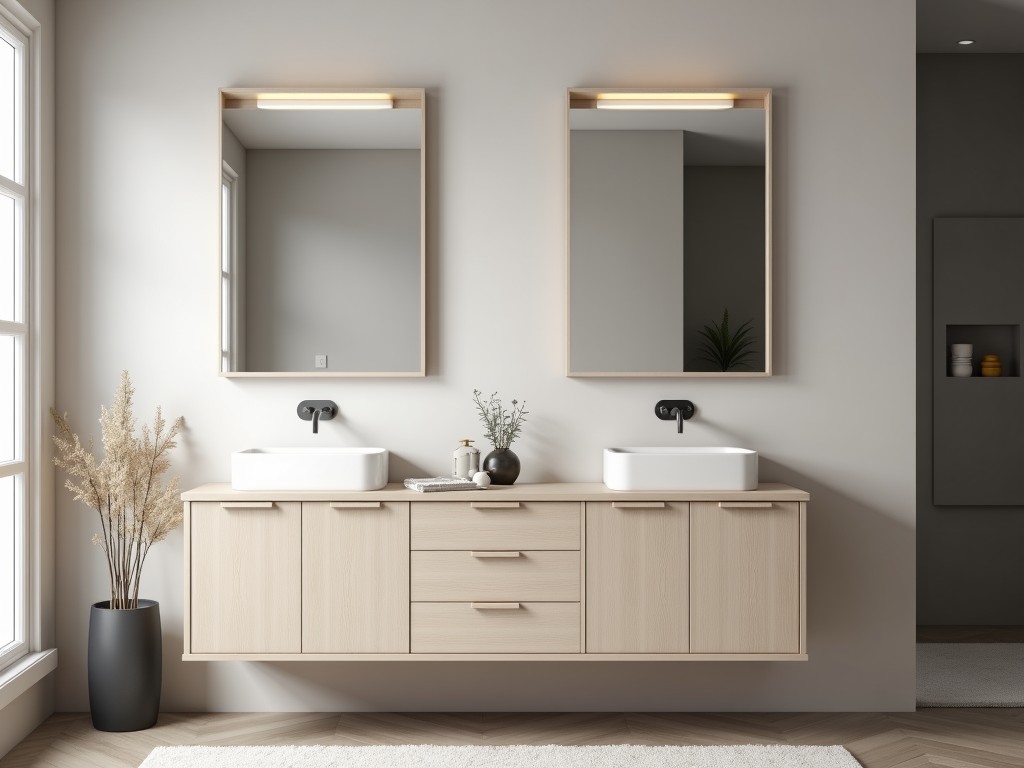
China Wall Mounted Bathroom Vanity Cabinet
Wall mounted bathroom vanity cabinets are engineered for durability in high-moisture environments, where resistance to water vapor, chemical exposure from cleaning agents, and long-term structural
- Category:
- Bathroom Cabinet
China Wall Mounted Bathroom Vanity Cabinet
Wall mounted bathroom vanity cabinets are engineered for durability in high-moisture environments, where resistance to water vapor, chemical exposure from cleaning agents, and long-term structural stability are critical. Unlike freestanding units, these cabinets transfer load directly to the wall substrate, requiring precise engineering of mounting hardware, back panel reinforcement, and weight distribution to prevent sagging or detachment over time. Industrial buyers prioritize measurable performance metrics such as load capacity per mounting point, humidity resistance ratings, and material compatibility with common bathroom substrates like concrete, gypsum board, or tile backer boards.
Material Selection and Environmental Resistance
The primary materials used in industrial-grade wall mounted vanities include marine-grade plywood with phenolic resin impregnation, high-density fiberboard (HDF) with melamine facing, or solid surface composites like acrylic-modified polyester. Marine plywood typically consists of 5-7 plies of hardwood veneer bonded with WBP (weather and boil proof) adhesive, achieving a swell rate of less than 5% after 24 hours of submersion per EN 317 standards. HDF cores are density-rated at 800-900 kg/m³ with a moisture content stabilized between 4-6% ex-factory, reducing the risk of expansion/contraction cycles in fluctuating humidity. Surface finishes undergo UV-cured coating or PVC lamination with edge sealing to prevent water ingress at joints, a critical failure point in humid environments.
Hardware components such as hinges, drawer slides, and mounting brackets are specified in stainless steel grades 304 or 316 for corrosion resistance, with salt spray test ratings exceeding 500 hours per ASTM B117. Soft-close mechanisms incorporate hydraulic dampers rated for 50,000 cycles, ensuring consistent performance over a 10-year lifecycle under daily use. Load testing is conducted per ANSI/BHMA A156.9 standards, where cabinets are subjected to 150% of rated dynamic load for 10,000 cycles to verify mounting integrity and joint fatigue resistance. These specifications are not marketing claims but baseline requirements for industrial procurement in commercial hospitality, healthcare, or high-end residential projects.
Structural Design and Load Distribution
Wall mounted vanities rely on a combination of French cleat systems, concealed steel brackets, or through-bolt anchoring to transfer cabinet load to the structural wall. A typical 600mm wide vanity with integrated sink and countertop exerts a static load of 80-120 kg, concentrated at the mounting points. Engineering calculations ensure that the shear force per anchor does not exceed 25% of the substrate’s pull-out capacity—critical when installing into gypsum board (typically 50-100 kg per anchor) versus concrete (200-400 kg per anchor). Back panels are often reinforced with 12mm plywood or steel stiffeners to prevent racking under lateral loads from door operation or accidental impact.
Countertop overhangs are limited to 25mm unsupported to prevent deflection, with thicker quartz or solid surface materials (20mm+) allowing up to 40mm overhang when supported by sub-frames. Sink cutouts are reinforced with internal baffles or additional framing to maintain torsional rigidity. Drainage slope is integrated into the countertop design at 1-2% grade toward the drain, preventing standing water that could degrade sealants or penetrate joints over time. These design parameters are derived from finite element analysis (FEA) simulations used in industrial product development to predict stress concentrations before physical prototyping.
Customization and Manufacturing Tolerances
Industrial buyers require precise dimensional control to accommodate site-specific plumbing rough-ins, electrical conduit placement, and ADA compliance standards. Standard wall mounted vanities are available in widths from 400mm to 1200mm in 100mm increments, with heights adjustable between 750mm and 900mm to suit varying user ergonomics or vessel sink configurations. Depth typically ranges from 450mm to 550mm, constrained by standard stud spacing in wall framing (406mm or 600mm oc) to allow for secure anchoring without interfering with insulation or vapor barriers.
Tolerances are held to ±1.5mm on critical dimensions such as sink cutout alignment, door reveal gaps, and mounting hole positions—achievable through CNC nesting and laser-guided drilling in automated production lines. Custom options include integrated LED lighting with IP65-rated drivers, touchless sensor faucets with hidden wiring chases, and antimicrobial surface treatments tested per ISO 22196. All customization requests require submission of plumbing rough-in drawings, wall substrate specifications, and load-bearing calculations to validate feasibility before tooling is initiated.
Quality Control and Testing Protocols
Quality assurance begins with incoming material inspection, where moisture content is verified via capacitance meters, and adhesive bond strength is tested per ASTM D905 on random samples. In-process checks include dimensional verification using coordinate measuring machines (CMM) on CNC-cut panels, hinge alignment within 0.5mm tolerance, and finish adhesion tested via cross-hatch per ASTM D3359. Final assembly undergoes 72-hour humidity cycling at 80% RH and 38°C to simulate accelerated aging, followed by functional testing of all moving parts and leak testing of sink-to-drain connections under 50 kPa water pressure.
Packaging for export includes corner protectors, edge foam, and 6mm corrugated cardboard with ISPM 15-compliant pallets. Units are boxed individually with internal bracing to prevent shifting during transit, and drop-tested from 760mm per ISTA 3A standards to ensure damage rates remain below 2%. Each shipment includes a material safety data sheet (MSDS) for finishes, a mounting hardware checklist with torque specifications (typically 8-12 Nm for M8 bolts), and an installation manual detailing substrate preparation, shimming procedures, and sealant recommendations for silicone or polyurethane-based compounds.
| Parameter | Typical Value | Test Standard |
|---|---|---|
| Moisture Swell (24h submersion) | <5% | EN 317 |
| Salt Spray Resistance (Hardware) | >500 hours | ASTM B117 |
| Dynamic Load Cycles | 10,000 @ 150% rated load | ANSI/BHMA A156.9 |
| Soft-Close Mechanism Life | 50,000 cycles | Manufacturer Cycle Test |
| Finish Adhesion (Cross-Hatch) | 4B or better | ASTM D3359 |
For projects requiring non-standard dimensions, integrated plumbing solutions, or compliance with specific regional regulations (e.g., CE marking for Europe, UL certification for North America), engineering support is available during the quotation phase. Buyers are advised to provide detailed wall cross-sections, load-bearing specifications, and plumbing fixture specifications to enable accurate structural validation. Lead times typically range from 4-6 weeks for standard configurations and 8-10 weeks for fully customized units, inclusive of prototype approval and pre-shipment inspection.
To initiate a technical inquiry or request a detailed quotation with material certifications, load test reports, and installation guidelines, please contact our engineering team. Provide your project’s dimensional constraints, substrate type, and intended use case to receive a tailored response addressing material compatibility, mounting requirements, and long-term maintenance considerations.
Request Technical Quotation


