China Solid Wood Bathroom Vanity Cabinet
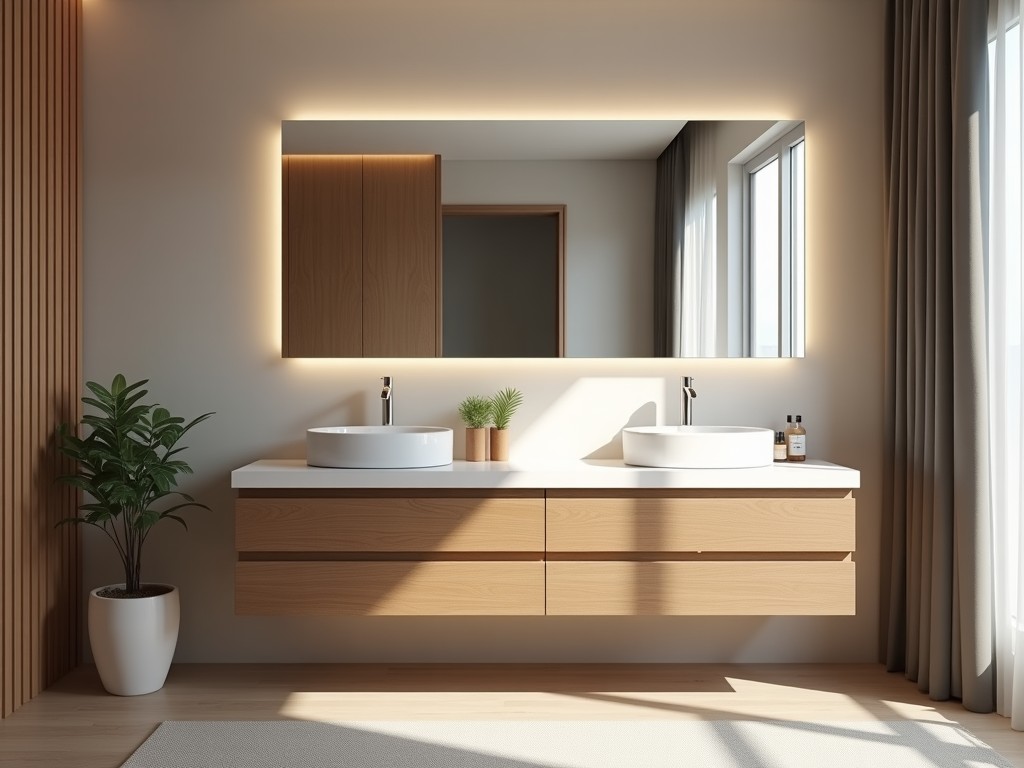
China Solid Wood Bathroom Vanity Cabinet
Solid wood bathroom vanity cabinets manufactured in China combine traditional joinery techniques with modern CNC precision to meet international dimensional tolerances and moisture resistance
- Category:
- Bathroom Cabinet
China Solid Wood Bathroom Vanity Cabinet
Solid wood bathroom vanity cabinets manufactured in China combine traditional joinery techniques with modern CNC precision to meet international dimensional tolerances and moisture resistance requirements. These units are engineered for commercial and residential wet environments where long-term dimensional stability and surface durability are critical procurement factors.
Material selection focuses on hardwood species with proven performance in high-humidity conditions, including rubberwood, oak, and maple, each processed through controlled drying cycles to achieve equilibrium moisture content below 12%. Surface finishing systems utilize multi-layer UV-cured polyurethanes or water-based lacquers tested for chemical resistance against common bathroom agents.
Structural design incorporates full-extension soft-close drawer systems, adjustable shelving, and integrated plumbing access panels configured to accommodate standard P-trap and supply line layouts. All units undergo factory assembly verification to ensure squareness within 2mm diagonal variance and drawer alignment tolerance of ±0.5mm.
Material Specifications and Performance Characteristics
Primary substrate materials are selected based on Janka hardness ratings, dimensional stability coefficients, and resistance to fungal growth in environments with relative humidity exceeding 70%. Rubberwood (Hevea brasiliensis) is commonly specified for its uniform grain structure and consistent machining response, achieving average shrinkage values of 0.25% radially and 0.45% tangentially after kiln drying to 8-10% MC.
Hard maple (Acer saccharum) and white oak (Quercus alba) offer higher density profiles (650-750 kg/m³) with improved impact resistance, suitable for high-traffic installations. All wood components undergo moisture content verification via pin-type meters before assembly, with batch tracking ensuring traceability to source lumber lots.
Surface protection systems are evaluated using ASTM D1308 for chemical spot resistance and ASTM D4060 for abrasion resistance. Topcoats typically achieve 200+ cycles Taber abrasion resistance (CS-17 wheel, 500g load) and demonstrate no blushing or delamination after 24-hour immersion in 5% ammonia solution or 10% vinegar solution.
Construction Methods and Joinery Integrity
Cabinet carcasses are constructed using mortise-and-tenon joints reinforced with PVAc adhesive compliant with EN 204 D3 classification for exterior-grade moisture resistance. Joint assembly undergoes 24-hour clamp pressure at 0.8 MPa to ensure full adhesive cure before machining of mating surfaces.
Drawer boxes utilize dovetail joints with 1:6 slope ratio, providing mechanical interlock that maintains integrity under repeated cyclic loading. Bottom panels are captured in grooves rather than nailed or stapled, allowing for seasonal expansion without joint stress. All interior surfaces receive sealed coating to prevent moisture wicking into end grain.
Frame styles include full-overlay, inset, and partial-overlay configurations, each requiring precise reveal calculations to maintain consistent door and drawer alignment across seasonal humidity fluctuations. Hinge systems are selected based on cycle life ratings exceeding 50,000 operations at 25kg load.
Dimensional Standards and Customization Parameters
Standard vanity depths range from 460mm to 560mm to accommodate varying bathroom layouts and plumbing rough-in heights. Width options follow 100mm increments from 600mm to 1800mm, with height adjustments available in 50mm intervals between 800mm and 900mm to align with countertop thicknesses and user ergonomics.
Customization capabilities include adjustable leg systems for floor clearance variation (50-150mm), removable access panels for serviceability, and integrated power module cutouts configured per NEC or IEC standards. Drawer interiors can be fitted with dividers, trays, or liners specified to material compatibility requirements.
Plumbing cutouts are precision-machined using CNC routers with ±0.3mm tolerance to ensure proper fixture alignment. Back panels incorporate ventilation channels to prevent moisture accumulation behind the unit, with airflow rates calculated based on cabinet volume and expected humidity differentials.
Quality Control and Factory Testing Protocols
Incoming lumber is inspected for moisture content, knot size, and grain orientation using calibrated meters and visual grading per NHLA standards. Each batch receives a unique identifier linking to drying kiln logs and supplier documentation.
Assembly verification includes squareness checks via diagonal measurement, drawer gap uniformity testing with feeler gauges, and door alignment verification using digital inclinometers. Function testing comprises 50-cycle open/close operations for doors and drawers under load, with torque measurements taken on hinges and slides.
Finish quality is assessed under 500 lux daylight simulation for color consistency, gloss uniformity (measured at 60°), and defect detection. Random samples undergo accelerated aging tests equivalent to 2 years of bathroom exposure using UV-A lamps and condensation chambers.
Packaging and Logistics Considerations for Export
Export packaging employs triple-wall corrugated cartons with internal bracing designed to withstand ISTA 3A vibration and shock profiles. Corner protectors are manufactured from recycled polyethylene foam with compressive strength exceeding 150 kPa to prevent impact damage during handling.
Interior separation uses die-cut cardboard inserts tailored to specific vanity models, preventing metal-to-wood contact and abrasion during transit. Moisture barrier bags with desiccant packs maintain internal relative humidity below 60% during ocean freight, critical for preventing wood movement in transit.
Palletization follows ISPM 15 standards with heat-treated hardwood pallets. Each unit receives a label containing SKU, dimensions, weight, material composition, and handling instructions in English and destination language. Flat-pack options are available for volume shipments, reducing container utilization by up to 40% compared to fully assembled units.
Typical Applications in Commercial and Residential Projects
In hospitality installations, these vanities are specified for guest room bathrooms where resistance to frequent cleaning agents and varying occupancy patterns is essential. The dimensional stability of properly dried hardwood minimizes callback risks associated with joint separation or drawer binding in high-turnover environments.
Healthcare facilities utilize these units in patient bathrooms where non-porous, cleanable surfaces and resistance to disinfectants are required. The absence of particleboard or MDF eliminates concerns about formaldehyde off-gassing in sensitive environments.
High-end residential projects specify solid wood vanities for material authenticity and repairability. Unlike laminated alternatives, surface damage can be addressed through spot sanding and refinishing without visible repair lines, supporting lifecycle cost arguments in luxury developments.
Comparison of Common Hardwood Options
| Property | Rubberwood | White Oak | Hard Maple |
|---|---|---|---|
| Density (kg/m³) | 600-650 | 700-750 | 650-700 |
| Janka Hardness (N) | 4,200 | 6,000 | 6,400 |
| Radial Shrinkage (%) | 0.20-0.30 | 0.15-0.25 | 0.18-0.28 |
| Tangential Shrinkage (%) | 0.35-0.50 | 0.25-0.35 | 0.30-0.40 |
| Typical MC Range (%) | 8-12 | 8-12 | 8-12 |
| Chemical Resistance (Spot Test) | Good | Very Good | Very Good |
*Values represent typical ranges; actual properties vary with growing conditions and drying protocols. Chemical resistance testing performed on finished surfaces with 24-hour exposure.
For technical inquiries, customization requests, or project-specific quotations, contact our engineering team to discuss material selection, dimensional tolerances, and finish systems applicable to your installation requirements.
Request Technical Specification Sheet


