China Mid Century Modern Bathroom Vanity Cabinet
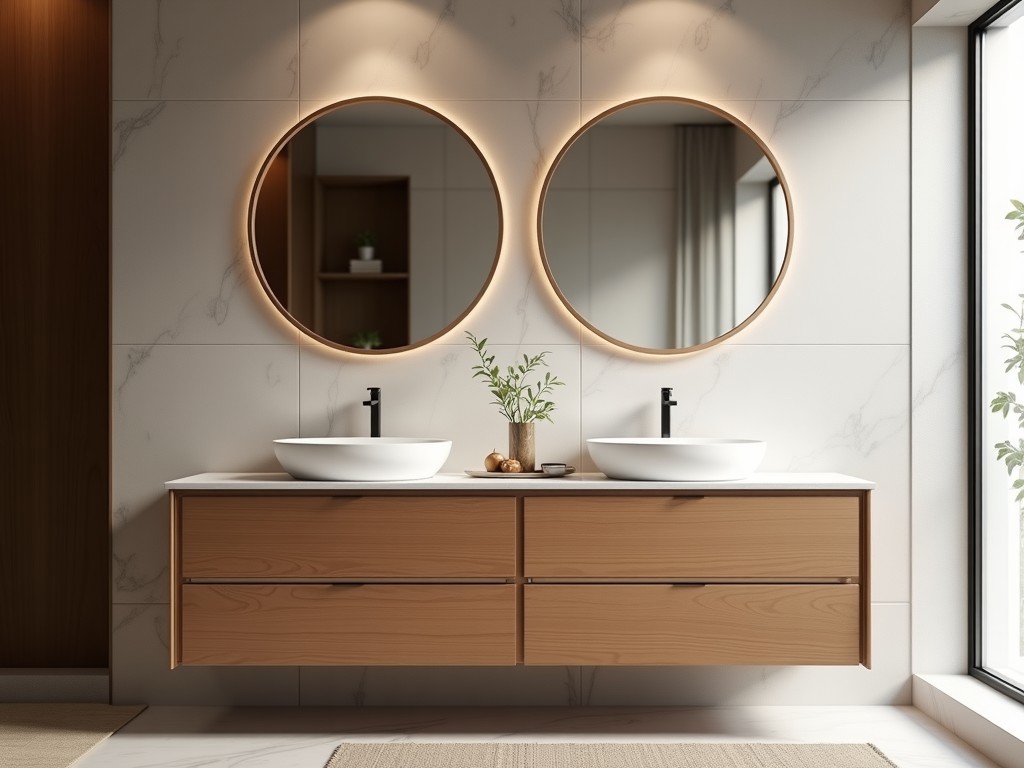
China Mid Century Modern Bathroom Vanity Cabinet
Industrial buyers selecting bathroom vanity cabinets for commercial or high-end residential projects require precise technical data to evaluate suitability, durability, and compliance with design
- Category:
- Bathroom Cabinet
China Mid-Century Modern Bathroom Vanity Cabinet
Industrial buyers selecting bathroom vanity cabinets for commercial or high-end residential projects require precise technical data to evaluate suitability, durability, and compliance with design intent. This document outlines the engineering characteristics, material specifications, dimensional standards, and manufacturing considerations for mid-century modern bathroom vanity cabinets produced in China, focusing on measurable attributes that influence long-term performance and installation success.
The mid-century modern aesthetic emphasizes clean lines, organic forms, minimal ornamentation, and a balance between natural materials and industrial precision. For vanity cabinets, this translates to specific dimensional tolerances, surface finish requirements, and hardware integration methods that must be controlled during manufacturing to maintain design integrity. Deviations beyond specified limits can compromise visual alignment, functional operation, or moisture resistance in wet environments.
Core Dimensional Standards and Tolerances
Standard vanity cabinet widths for single-sink applications range from 600mm to 900mm, while double-sink units typically span 1200mm to 1500mm. Height is consistently maintained at 800mm to 850mm from finished floor to countertop underside, accommodating standard vessel sink installations and ergonomic user access. Depth varies between 450mm and 550mm, with 500mm being the most common to balance storage capacity and clearance in confined bathrooms.
Manufacturing tolerances are critical for seamless countertop integration and door/drawer alignment. Width and height dimensions are held to ±1.5mm, depth to ±1.0mm, and diagonal squareness to ≤2.0mm deviation. These tolerances ensure that countertop overhangs remain uniform (±2mm) and that door gaps stay within 1.5–2.5mm for consistent reveal lines, a hallmark of the mid-century modern style.
Internal storage dimensions are designed around standard toiletries and towel rolls. Shelf spacing is adjustable in 25mm increments, with minimum clearance of 150mm for tall items. Drawer boxes are typically 120mm high for shallow units and 200mm for deep drawers, with front-to-back depth reduced by 20–25mm to accommodate drawer slide hardware without compromising usable space.
Material Composition and Surface Engineering
Cabinet carcasses are constructed from 18mm thick, E1-grade formaldehyde-compliant particleboard or MDF, selected for dimensional stability and screw-holding strength (≥180N lateral resistance per ISO 3269). Edge banding uses 0.5mm PVC or 1.0mm solid wood veneer, applied with hot-melt adhesive (EVA-based) achieving peel strength >1.5N/mm to resist delamination in humid conditions.
Exterior surfaces undergo multi-stage finishing to achieve the characteristic matte or low-sheen look of mid-century design. A UV-cured polyurethane topcoat (25–35μm dry film thickness) provides chemical resistance (tested per ISO 2812-1 for 10% ammonia, 5% vinegar, and 70% isopropyl alcohol) and abrasion resistance (≥300 cycles Taber CS-10, 500g load). Color stability is maintained with ΔE < 2.0 after 200 hours UV exposure (ISO 4892-2).
Hardware components are specified for load endurance and corrosion resistance. Soft-close drawer slides are rated for 30,000 cycles at 25kg dynamic load (ANSI/BHMA A156.9). Hinges use 304 stainless steel with nickel plating, achieving >500 hours salt spray resistance (ASTM B117). All exposed fasteners are countersunk and filled to maintain surface continuity.
Design Features Defining the Mid-Century Modern Aesthetic
The defining visual traits include tapered legs (typically 100–120mm high, angled at 5–10° from vertical), recessed panel doors with 3–5mm bead detailing, and integrated handles—either finger grooves routed 12–15mm deep into the door edge or minimalist metal pulls (≤25mm protrusion). These features eliminate visual clutter while emphasizing material texture and form.
Leg assemblies are mortised and glued into the carcass with 8mm diameter wooden dowels and PVA adhesive, providing shear strength >800Nm per leg. Optional metal brackets (zinc alloy, powder-coated) can be added for seismic zones, increasing lateral load capacity to 1.5kN without altering the external profile. Leg-to-floor clearance is maintained at 15–20mm to facilitate cleaning and prevent moisture wicking.
Countertop support is provided by a 15mm thick internal stretcher rail running the full width, bonded and screwed to the carcass. This prevents sagging under stone or quartz tops (up to 40kg/m² load) and maintains countertop levelness within ±0.5mm over 1200mm span. The design avoids visible support brackets, preserving the clean silhouette.
Manufacturing Process Controls
Panel cutting uses CNC routers with ±0.1mm positioning accuracy to ensure repeatable geometry. Edge banding is applied via automatic hot-air systems with temperature control (±5°C) and pressure rollers (0.3–0.5MPa) to prevent bubbles or lifting. Sanding proceeds through 80, 120, 180, and 240 grit stages to achieve Ra ≤ 1.6μm surface roughness before coating.
Coating application occurs in ISO Class 7 cleanrooms using HVLP spray guns at 60–80μm wet film thickness. UV curing uses 365nm LED arrays at 1.2–1.5J/cm² energy density, ensuring full polymerization without yellowing. Post-cure inspection includes gloss measurement (20° angle, target 15–25GU), adhesion testing (ISO 2409, Class 1), and hardness verification (pencil hardness ≥ 2H).
Assembly follows a sequenced protocol: carcass squaring verified before drawer/hardware installation, leg attachment after final sanding, and hardware torque controlled to 1.8±0.2Nm for cam locks and 0.8±0.1Nm for hinge screws. Each unit undergoes 24-hour climate conditioning (25°C/60% RH) prior to packaging to stabilize materials and prevent post-shipment warping.
Quality Inspection and Testing Protocol
Dimensional verification occurs at three stages: post-cutting, post-edge banding, and final assembly. A coordinate measuring machine (CMM) checks critical datums, while handheld calipers verify width/height/depth at 8 points per unit. Squareness is measured using a precision steel square and feeler gauges.
Surface quality is assessed under 500lux LED lighting (5000K) at 300mm distance. Defects such as orange peel, pinholes, or dust nibs are recorded if >0.5mm diameter or visible at 45° angle. Adhesion is tested via cross-hatch tape test (ISO 2409) on 5 locations per unit, with ≤5% coating removal accepted. Edge banding integrity is checked by flexing 10mm radius bends—no delamination permitted.
Functional testing includes 50 open/close cycles for doors and drawers, checking for binding, sag, or misalignment. Soft-close mechanisms are validated for damping speed (0.3–0.6s closing time) and full extension. Water resistance is tested by exposing edges and joints to 95% RH for 48 hours—no swelling >0.5mm or blistering allowed.
Customization Parameters and Project Adaptation
Dimensional adjustments are possible in 50mm increments for width and depth, and 25mm for height, within structural limits (max width 1800mm for single carcass, max height 900mm). Leg angle and height can be modified (±5° from standard, 80–150mm range) to accommodate uneven floors or specific design intent. Interior layout (shelf count, drawer configuration) is reconfigurable based on user storage needs.
Material substitutions include upgrading to FSC-certified plywood carcasses (12mm or 18mm), switching to water-based UV coatings (VOC < 50g/L), or selecting solid wood veneers (oak, walnut, teak) with open-pore finishes. Hardware can be specified with alternative finishes (brushed nickel, matte black, brass) or upgraded to soft-close with push-to-open mechanisms.
Export packaging uses 5mm triple-wall corrugated cartons with internal corner protectors (expanded polystyrene) and edge guards. Units are stacked horizontally with interleaving sheets (PE foam, 2mm thick) and secured with PET straps. Each carton includes humidity indicator cards (10–90% RH range) and shock sensors (50g threshold) to monitor transit conditions. Standard pack is 1 unit per carton; consolidation options available for LCL shipments.
| Parameter | Typical Value | Inspection Method |
|---|---|---|
| Width Tolerance | ±1.5mm | Caliper at 4 points |
| Height Tolerance | ±1.5mm | Caliper at 4 points |
| Depth Tolerance | ±1.0mm | Caliper at 4 points |
| Diagonal Squareness | ≤2.0mm | Steel square + feeler gauge |
| Door Gap Uniformity | 1.5–2.5mm | Feeler gauge at 3 points |
| Coating Adhesion | ISO 2409 Class 1 | Cross-hatch + tape test |
| Coating Hardness | ≥ 2H pencil | Pencil hardness test |
| Salt Spray Resistance (Hinges) | >500 hours | ASTM B117 |
| Drawer Slide Cycle Life | 30,000 cycles | ANSI/BHMA A156.9 |
| Leg Shear Strength | >800Nm per leg | Static load test |
Application Suitability in Commercial and Residential Projects
These vanity cabinets are specified in boutique hotels, high-end residential developments, and architectural renovation projects where design authenticity and long-term surface performance are critical. The mid-century modern language complements terrazzo flooring, teak accents, and recessed lighting schemes common in hospitality interiors. In residential settings, they appeal to clients seeking timeless design that avoids trend-driven obsolescence.
The engineered moisture resistance and dimensional stability make them suitable for master bathrooms and ensuite installations where temperature and humidity fluctuate. Unlike solid wood-only constructions, the engineered core minimizes seasonal movement, reducing the risk of joint failure or countertop cracking over 10+ year lifespans. The finish system resists common bathroom chemicals (toothpaste, soap residue, cleaning agents) without requiring frequent reapplication.
For project engineers, the standardized mounting options (wall-hung via French cleat or floor-standing with adjustable legs) simplify structural coordination. Wall-hung versions include a 18mm thick plywood backing plate with pre-drilled M8 mounting points at 150mm intervals, rated for 200kg static load when fixed to concrete or timber studs. Floor-standing units use leg levelers with 15mm vertical adjustment to compensate for uneven substrates.



